Here are a few tidbits:
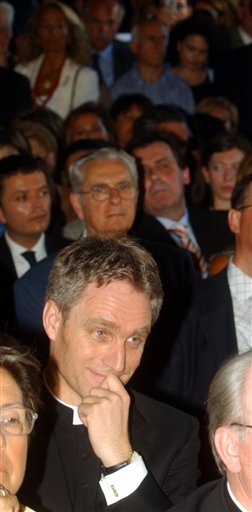
Peter Seewald (PS): Herr Praelat, how is the Pope ?
Msgr. Gaenswein (MG): He's well, feels very good, works a lot and is in "high gear".
PS: Does he use the exercise bike that his physician, Dr. Buzzonetti, told him to
MG: The bike is in our Appartamento Privato.
PS: What does that mean ?
MG: It's being a good bike, ready to be used.(...)
PS: Some criticize that he is in a kind of splendid isolation, a golden cage, that it's impossible to get near him.
MG: That's nonsense. Every morning there are private audiences, in the afternoon the work meetings with his closest aides - and that six days a week. In addition, there are many meetings within and without the walls of the Vatican. Golden cage? Hah! I guess it might be criticism of me, that I shield the Pope too much. Entirely exaggerated.
PS: He is basically a shy man. But at the same time he's always had something "inconvient" about him, a resistance against everything that's too common, against stupidity.
MG: That the Holy Father isn't an impetuous but a more reserved person is plain to see for everyone.
PS: The Pope writes all important texts himself, including the speech in Regensburg with the controversial quote from a historical book on a dispute with Muslims. Why did nobody edit the text?
MG: I find the Regensburg speech, as it was given, to be prophetic.
PS: Was the shock great when the angry attacks from the Islamic world became known ?
MG: We only heard of the crude reactions after we'd gotten back to Rome from Bavaria. It was a big surprise, to the Pope as well. The mighty trouble had started due to newspaper reports which had taken one quote out of context and presented it as the Pope's personal opinion.
(...)PS: Growing up, you were five children, the father a blacksmith, the mother a Hausfrau (housewife).
MG: My father ran a smithy in the seventh generation, later he haded a store for agricultural equipment, but it wasn't a whole lot of money. Until I was six, we also had a little farm going. Sometimes we had to make the money last. My father was also very active in local politics, in many clubs and associations. Because of that, he was rarely home at night. Our mother had to do all the more, bear the burden and duty of bringing up the children. Us five had a childhood without worries, but of course we also fought.
PS: Because everything didn't always go the way the firstborn wanted it?
MG: As the oldest, you're supposed to be the wisest and give in - but giving in isn't exactly my strength.
PS: Born to be wild - was that you ?
MG: At times maybe, between 15 and 18. I listened to Cat Stevens, Pink Floyd and some others, among them the Beatles. I had pretty long curly hair then, which my father didn't like, so there were fights at times about going to the barber. But that phase came to an end pretty unspectacularly.
(...)
MG: Inititally, I was, as the oldest, supposed to take over my father's agricultural appliances business but the happenings at the stock exchange interested me more. My idea was that there was a lot of money being made and that you had to be bright and fast. Later, a bit more mature, when I thought about it more intensively, I thought, ok if I can do all that and have money, what happens then ? Suddenly, existential questions took center stage. So I started to search and ended up, completely unplanned, coming across philosophy and theology.
PS: A long process.
MG: And a difficult one. At first, the world of theology drew me close very strongly, the priesthood was added as a second step. Of course celibacy was also a question. At some point I felt that I couldn't drive at half speed, either I'd do it completely or I'd quit. A little theology, that's not possible. So, step by step, I approached the priesthood.
PS: A quote from one of your homilies, on the occasion of some ordinations: "You are granted to know that you have a dignity that distinguishes you from all who aren't priests. You are allowed to have the consciousness that you are doing something great, that you are allowed to do something great." Pretty aloof.
MG: I'd say that again without ifs ands or buts.
PS: You take it seriously.
MG: Yes, I do.
PS: It also sounds a bit romantic.
MG: I don't think so. They are words that were made true by life, and life wasn't romantic. The sentences quoted by you may sound a bit ceremonious on paper but behind them there is a lot of personal experience and I did not want to keep it from the new priests that there is something grand ahead of him, that it costs something and that he has to be willing to pay that price.
PS: In 1984 you were ordained a priest, then you spent two years in the Black Forest. In 1993, you wrote your dissertation in Munich, about "Ecclesiology according to the Second Vatican Council." Did you have moments of great doubt ?
MG: After two years as Kaplan (assistant pastor), I was sent back to Munich for more studying - of something that's not really my preference - Canon Law. After half a year I was so fed up I said to myself, now I'm going to the archbishop and ask him to take me back into the diocese because I can't stand it anymore.
PS: That bad ?
MG: I'd always studied gladly and easily, but studying Canon Law I felt to be as dry as work in a quarry where there's no beer - you die of dryness. I was saved by my professor, Winfried Ayman who later made me his assistant. He helped me greatly to get out of this situation by showing me new perspectives. That helped me a lot and kept me from quitting. I am very grateful to him.
PS: Time and again these "verdicts" surface: dutiful, pious, conservative; a man of form and strictness.
MG: In the sense of "mild in form, strict in content" I can't let that stand. When I think something to be right, I stick to it. Admittedly, patience is not my strength. Sometimes I get pretty "in your face" (literally "I drive up pretty close"), which can irritate people.
PS: What abilities does the private secretary of the head of a Church with 1.1 billion members have to have ?
MG: In a way, he has to be a jack of all trades ("generalist"), but he also has to acknowledge that he can't do everything, and he shouldn't demand it from himself. He has to do what the Pope tells him to do, and that with all his force, heart and mind.
PS: Was there some kind of introductory training, like a school for Papal etiquette ?
MG: Not at all. The only thing there was was a private conversation with my predecessor, Monsignore Stanislaus Dziwisz, the current Cardinal-Archbishop of Krakow. That was about two weeks after the Conclave and the move into the Appartamento. He handed me an envelope containing some papers and a key for a safe. An ancient safe, German precision work. He only said, "You now have a very important, very beautiful but also a very, very difficult task. The only thing I can tell you is that the Pope must not be "suffocated" by nothing and no one. How to go about that, you have to find out for yourself." Period, the end. More he didn't say. That was the entire school for Papal etiquette.
PS: And what was in the envelope?
MG: That I won't tell you. They are things that are given from Papal Secretary to Papal Secretary.
PS: Your initial mistakes?
MG: I realized soon that the speed I demanded of myself was too high. To start in the pole position is one thing, to get through the laps and arrive at the finish line quite another. Starting at full speed, so to speak. So I had to find out the right speed. Another difficult point was the handling of the countless requests for private audiences and other encounters which were all tied to noble motivations. Requests without end - "just for a minute", "just once, as an exception", "the Pope has known me for a long time, he'd be very happy". Here, the right "filter system" was needed. I had to put in a stronger filter.
PS: What do you keep from the Pope?
MG: Nothing important. All important official letters and documents, everything coming from bishops and cardinals, from the world of politics and diplomacy, I present to the Holy Father in the daily briefing. Apart from that there is a huge pile of letters, pleas, requests, proposals that he doesn't get to see, because he simply doesn't have the time. There, the Pope has given me room for my own judgment.
PS: Do people try to instrumentalize you?
MG: It happens, but I know how to defend myself.
PS: Does one "take off" in your position at times ?
MG: The opposite is more the case, that you're being suffocated, pressed down. If there is a danger, it's isolation. At one point friends said that I wasn't around anymore and was withdrawing. That was an alarm signal, and I immediately tried to make free time to better take care of personal relationships and existing friendships. It's important for one's psychological health.
(...)PS: It's plain to see that so many priests of the new generation discover the spiritual, cultural and aesthetical treasures of the handed-down liturgy. With the new Motu proprio "Summorum Pontificum", an Apostolic letter of the Pope it has been stated that every priest may celebrate the Holy Mass also according to the earlier, Tridentine Rite. Will this bring new conflicts ?
MG: The opposite is the purpose and goal. Conflicts are supposed to be ended, existing fractions and schisms overcome. With the Motu proprio a spiritual home has been opened to a lot of the faithful. I am convinced that the letter of the Holy Father to the bishops which was released together with the Motu proprio and in which the Pope explains the goals and motivations of the document at length is the right key to its proper understanding.
PS: The French philosopher Rene Girard, member of the Academie francaise, is predicting a decisive Christian Renaissance. According to him, we are at the "eve of a revolution of our culture." This change is supposed to make the Renaissance of the 15th century pale by comparison.
MG: The religious element enjoys an attention it hasn't had in years. After a phase of indifferentism, people once more concern themselves with religion, questions of faith. I see that especially young people who have everything or could have everything, realize: One can do anything, one can even destroy the world - but one can't win the soul, when the essential is missing. The Catholic Church has treasures to offer that no one else can offer. Greater and more enduring than all politicial offers of "salvation." But, that doesn't happen automatically. Faith comes from being heard, as Saint Paul says, it has to be proclaimed.
If you want to know what the pope wears while watching tv, or how Msgr. Gaenswein feels about being a sex idol, you'll have to check out the full translation.