The First Things Blog has an amusing post about what happens when people from foreign countries rely entirely on translation software.
This post is about what happens when journalists rely on spell check or don't have a clue what they are writing about. According to a CBS article, Pope John Paul II beautified Mother Teresa in 2003. Hmm...facelift, tummy tuck? What do you mean it's supposed to say beatified?
I will give the author the benefit of the doubt because Microsoft Word automatically "corrects" words. I had a frustrating experience while writing my lastest philosophy paper. Apparently I "misspelled" many words that Word just had to correct without asking permission. When I reread the paper, it didn't make any sense. It was frustrating to have to go back and correct the corrections.
Now, I know the auto correct feature can be turned off, but I was at the computer lab at school and had forgotted that the feature even existed.
Showing posts with label Pope John Paul. Show all posts
Showing posts with label Pope John Paul. Show all posts
Sunday, July 20, 2008


Saturday, May 03, 2008
Agca to Become Polish Citizen?
Sometimes I come across a story that is confusing. Other times the story is just plain odd. This one is a bit of both.
From the AP via Yahoo:
From the AP via Yahoo:
The Turkish gunman who shot and wounded Pope John Paul II is applying for Polish citizenship because he wants to live in the country of the late pontiff, whom he called his "spiritual brother."
But the Polish Foreign Ministry said the chances of Mehmet Ali Agca getting citizenship are "minimal" since he hasn't provided any "good service" to John Paul's mostly Catholic homeland.
Agca also wants to be transferred to a prison in Poland to serve the remainder of his sentence on a different conviction, lawyer Haci Ali Ozhan told The Associated Press.
"He has chosen Poland because it is country of the pope," Ozhan said. "Because the pope forgave him and paid close attention to him, we believe that the application will be accepted."
Agca shot and seriously wounded John Paul at St. Peter's Square at the Vatican on May 13, 1981. Two years later the pope met with Agca in an Italian prison and forgave him for the shooting.
Agca served 19 years in an Italian prison for the attack. He currently is serving a prison term in Turkey for killing prominent journalist Abdi Ipekci in Turkey in 1979 and is due to be released in 2010.
What motivated his crimes remains a mystery, but he belonged to an extreme right-wing Turkish organization, the Grey Wolves, which was involved in political murders in the 1970s.
In a petition addressed to Poland's devout Roman Catholic president, Lech Kaczynski, Agca said: "I shall be proud of becoming a member of the noble Polish nation, if my request to be granted Polish citizenship is accepted."
The petition to the president, who has the power to bestow or revoke Polish citizenship, was made available to the AP.
"I am not a stranger to your country because the national hero of Poland, Pope Karol Wojtyla, is my spiritual brother," Agca said, referring to John Paul by his birth name.
Agca's lawyer said he submitted the application to the Polish Embassy in Ankara on Thursday. It wasn't immediately processed, however, due to some missing paperwork. Ozhan said he would return next week to complete the application.
In Warsaw, Poland, the Foreign Ministry spokesman, Piotr Paszkowski, said officials had known for some time of Agca's plan but that chances of him being accepted were slim.
"The condition for according Polish citizenship is residence in Poland for at least five years, prior to applying," Paszkowski said. "I think that at least from this formal point of view the chances for Ali Agca receiving Polish citizenship are minimal."
Paszkowski said the five-year rule "can be waived if the foreigner seeking Polish citizenship has special merits for the country, has done good service to Poland."
"Agca rather has not."
John Paul is revered as a national hero in Poland. After he was shot, priests throughout the country led prayers for him amid fears he would not survive.
John Paul II died April 2, 2005, after serving as pope for almost 27 years.
Sunday, April 27, 2008
The Last Secret
I am halfway through reading the Last Secret of Fatima and I hate to have to put it down. I suspect I will finish it today if nothing interrupts me.
It's an easy read and written in a very interesting style. The book is an conversation/interview between Dr. Giuseppe DeCaril and Tarcisio Cardinal Bertone, the Vatican Secretary of State.
I am not a great lover of apparitions, but since I am of Portuguese descent, Fatima gets a special acceptance. Still, I read the writings of most Fatimists with much suspicion. Not so with this book.
The book tells the story of the Revelation of the 3rd secret of Fatima and provides a great deal of credible evidence to the non-existence of a 4th secret. (That is if you aren't a conspiricist). If you are convinced that the Vatican is hiding a 4th secret or has released a falsified 3rd secret, this book will do little to change your mind.
The book contains fascinating anecdotes and personal insights about Sr. Lucia and her personality.
Towards the end of the book. Cardinal Bertone takes on such issues as Medjugorje and Pope Benedict's now infamous Regensburg address. Even personal issues, such as his transfer from the Archdiocese of Genoa to Rome are mentioned. In essence, there is something for everyone in this book.
I have already underlined and taken notes on many pages. So far, my favorite quote is from the Cardinal Albino Luciani's (the future Pope John Paul I) account of his meeting with Sister Lucia.
Perhaps my chosen quote is not the deepest or most Fatima based passage that I could have chosen, but see! There is something for everyone.
Place your order today. The book will be released on May 6th, just in time for the feast of Our Lady of Fatima.
Back to reading... check back tomorrow for more.
It's an easy read and written in a very interesting style. The book is an conversation/interview between Dr. Giuseppe DeCaril and Tarcisio Cardinal Bertone, the Vatican Secretary of State.
I am not a great lover of apparitions, but since I am of Portuguese descent, Fatima gets a special acceptance. Still, I read the writings of most Fatimists with much suspicion. Not so with this book.
The book tells the story of the Revelation of the 3rd secret of Fatima and provides a great deal of credible evidence to the non-existence of a 4th secret. (That is if you aren't a conspiricist). If you are convinced that the Vatican is hiding a 4th secret or has released a falsified 3rd secret, this book will do little to change your mind.
The book contains fascinating anecdotes and personal insights about Sr. Lucia and her personality.
Towards the end of the book. Cardinal Bertone takes on such issues as Medjugorje and Pope Benedict's now infamous Regensburg address. Even personal issues, such as his transfer from the Archdiocese of Genoa to Rome are mentioned. In essence, there is something for everyone in this book.
I have already underlined and taken notes on many pages. So far, my favorite quote is from the Cardinal Albino Luciani's (the future Pope John Paul I) account of his meeting with Sister Lucia.
We should pray the Holy Rosary. Naaman the great Syrian general, disdained the simple bath in the Jordan suggested to him by Elisha. Some people act like Naaman: "I am a great theologian, a mature Christian, who breathes the Bible with both lungs and sweats liturgy from every pore - and the tell me to pray the Rosary?" And yet the fifteen mysteries of the Rosary are biblical; the Pater, the Ave Maria, and the Gloria are Bible passages transformed into prayer, and they are good for the soul. Bible study solely for the sake of scholarship could puff up the soul and leave it in a state of sterile aridity. Bible scholars who have lost their faith are hardly a rare breed.
Perhaps my chosen quote is not the deepest or most Fatima based passage that I could have chosen, but see! There is something for everyone.
Place your order today. The book will be released on May 6th, just in time for the feast of Our Lady of Fatima.
Back to reading... check back tomorrow for more.
Saturday, March 01, 2008
A Local Miracle for JPII?
Wow! A local man may be the recipient of a miracle through the intercession of the Servant of God, Pope John Paul II.
From the Standard Times:
From the Standard Times:
With neck bent and gripping forearm crutches, Jose Amaral slowly climbed the stairs to the Bullard Street entrance of St. Anthony of Padua Church.If you are wondering, yes it is the Fr. Landry from EWTN and the Catholic Preaching site.
Once settled in the pew near the door, he stowed the crutches until it was time to receive Holy Communion. Then, with great devotion, he made the painful journey to the altar.
When Mr. Amaral was 19, he was diagnosed with spinal stenosis, which caused him great discomfort and pain.
"I also have had for years arthritis all over," he said.
In February 2003, Mr. Amaral's condition worsened. He collapsed at work and was diagnosed with cervical myelopathy, a stroke of the spine.
"The neurologist and neurosurgeon both said that there was considerable nerve damage. I've gotten progressively worse and had to have five surgeries."
On Jan. 26, Mr. Amaral was reading from a booklet of meditations on the Gospel when his eyes fell on the passages about Jesus curing the paralytic (Mark 2:1-12 and Luke 5:17-26).
"You remember the story," he said. "Jesus first healed the paralyzed man of his sins and then cured him of his physical paralysis."
Mr. Amaral said that he went to confession that afternoon so that Jesus could heal him of his sins.
"Something happened during that confession that I cannot explain," he said. "But I felt different."
Later that night, Mr. Amaral was thinking about the experience in the confessional, and his eyes lit upon a picture he had beside him of Pope John Paul II.
"Pope John Paul the Great, please help me," he prayed. "Help me to understand God's will."
Turning on the TV to EWTN, he watched the movie, "Witness to Hope," a biography of Karol Wojtyla, who became Pope John Paul II.
"That is when something came over me that is very difficult to explain," he said. "I just kept remembering the late pope's words, 'Be not afraid!'"
Over the next few days, Mr. Amaral said that he began to walk a little better with his forearm crutches.
"But I didn't say anything about it to anyone," he said. "I was very calm and peaceful."
On Jan. 30 at 3 p.m., Mr. Amaral prayed the Chaplet of Divine Mercy and looked over at Pope John Paul II's picture.
"I decided to get up and try to walk around without my crutches," he said. "I just walked back and forth, and I didn't stop — and I've never stopped since. My strength came all at once."
Mr. Amaral attended morning Mass on Feb. 2, and after the service, he approached the sacristy.
"I was taking off my vestments, and then all of a sudden I saw him," said the Rev. Roger Landry, pastor of St. Anthony's. "He was standing completely erect, and I had never seen him stand erect. I knew then as a person who had been trained as a scientist and worked at Mass. General for five years that the only way that happens is by direct intervention of the Lord."
The Rev. Landry said that his eyes welled up with tears and the men embraced and cried together.
"One of the most beautiful moments in my priestly life was when I saw him leaving the church, and this man whom I had never seen walk before, genuflected to Jesus in the Blessed Sacrament. I'll never forget that. Awesome."
Editor's note: The Rev. Landry has written a letter to the procurator at the Vatican relating Mr. Amaral's healing through the intercession of Pope John Paul II. A medically certifiable miracle is required for the late pontiff's canonization. Mr. Amaral visited his doctor last week and related that the physician had no scientific explanation for the healing. Last weekend, Mr. Amaral went shopping at the local Target for the first time and bought a pair of sneakers and a football.
Sunday, December 16, 2007
Extreme Makeover: Pope Edition
The quote recently appeared in the London Telegraph: "'Benedict still comes across as quite cold, which is a problem in his job.'" Who said it? None other than the film director Franco Zeffirelli of Jesus of Nazareth fame.
Several things are quite wrong with that quote.
Several things are quite wrong with that quote.
- No matter how you dress him up or try to change his image, those who hate Pope Benedict will continue to hate him because it isn't really an image problem. It's an obedience problem.
- Maybe part of the problem is the people who continue to call Pope Benedict XVI "Pope Ratzinger".
- Papal robes are too opulent and flashy? Which ones? He can't possibly mean the white simar and zuchetto. Oh! He means the chasubles? Well, they aren't really papal robes. The as the vestments of the Mass which are proper to any priest. As for opulent and flashy, I guess we should get rid of the gold chalices too and start using ceramic. Oh, I forget...been there and done that...it didn't work. I guess selling the Pieta will be next on Franco's list.
- No matter how Pope Benedict looks on TV and in pictures he is very warm in person. I am saying this as someone who has stood face to face with him. Cold is not only of the words I would use to describe him.
- Franco says that he "is in continual contact with his [Pope Benedict] inner circle". So am I. So what? Some may be impressed with that, I am not.
- The best line is at the end where he says that he "has directed holy ceremonies at the Vatican in the past". Hmmm, could that have been where the Liturgical ballerinas came from? Just asking.
Franco does have a point that Pope Benedict's personality doesn't always translate well onto film, but seriously so we want a Pope or a movie star. I think that after 26 years of the pontificate of Pope John Paul II, we have forgotten that there is more to the papacy than a friendly face and a well timed joke. Yes, we live in the age of the instant media, but I think people intelligent enough to realize that what a pope does and says is what is really important.
As for the image problem, Franco, check out the audience stats. Pope Benedict XVI's crowds are blowing Pope John Paul II's numbers out of the water. Benedict is getting so many people that they very often they have to be separated into two groups.
Friday, November 02, 2007
JPII on Priestly Vocation
You never know what jems you will find on YouTube. Listen to Pope John Paull II talk about his vocation to the priesthood.
Saturday, September 29, 2007
The Truth of Pope John Paul's Death
In an article published in MicroMega, an Italian periodical, Dr. Lina Pavanelli claims that Pope John Paul II and his doctors disregarded Church teaching by using a form of euthanasia to accelerate the pontiff’s death. This shocking claim reached the mainstream American media though an article in Time magazine, under the sensational title “Was John Paul II Euthanized?”. These articles are inaccurate because of Dr. Pavanelli’s, method of diagnosis, dismissal of the reported cause of death, misunderstanding of the teaching of the Catholic Church regarding life support, and intentions.
Dr. Pavanelli, a professor of intensive care medicine, claims that Pope John Paul II should have received a feeding tube weeks before his death. She has published this claim even though she never had access to either Pope John Paul II or his medical records. She openly admits that her claims are based on information she gained though media reports, watching the pope on television, and from a book written by the Pope’s doctor. Although doctors are not allowed to diagnose through these methods, Dr. Pavanelli not only makes a diagnosis, she accuses the pope of suicide. According to the article in Time, Dr. Pavanelli believes that the pope’s doctors recommended a feeding tube, but he refused the procedure, which she claims amounts to suicide in the opinion of the Church. On May 30, 2005, a Vatican press release stated that the pope had been given a feeding tube, but she claims that it was inserted too late. It has been argued that if Pope John Paul II intended suicide, a feeding tube would not have been inserted at any point. Furthermore, in a press conference given on September 26, 2007, the Vatican announced that the feeding tube had been inserted much earlier, but it was not reported to the media until later. In response, Dr. Pavanelli revised her accusations and now claims that the feeding tube provided was the wrong type. Because she was not present and does not have access to the pope’s medical records, these claims do not have any basis in fact.
Nonetheless, Dr. Pavanelli also claims that Pope John Paul “died for reasons that were clearly not mentioned. […] the incapacity to swallow.” All official reports state that Pope John Paul II died from septic shock and cardiovascular collapse. This was not the result of either starvation or dehydration. The incapacity to swallow and the difficulty breathing which he suffered are both symptoms of his advanced Parkinson’s disease. Difficulty breathing creates a greater risk of infection and physically weakens the patient. A tracheotomy was performed to help the pontiff breathe easier. If suicide had been his intention, he would have refused the tracheotomy.
The most disturbing aspect of the articles are the misrepresentations of the teaching of the Catholic Church. The article in Time claims that “Catholics are enjoined to pursue all means to prolong life.” This statement is false and does not appear in any document of the Catholic Church. On the contrary, article 2278 of The Catechism of the Catholic Church states:
Despite that, the dying can be allowed to suffer from starvation or dehydration. Just weeks before the publication of the MicroMega article, the Vatican released a document entitled Responses to Certain Questions of the United States Conference of Catholic Bishops Concerning Artificial Nutrition and Hydration. The document states:
While some may interpret that passage to mean that Catholics are obliged to provide feeding tubes at all costs, the Declaration on Euthanasia which was approved by Pope John Paul II in 1980 states:
The Catholic Church teaches that feeding tubes only need to be used when they are necessary and useful. In the case of a dying person, they are to be used to ensure the comfort of the patient. That seems to be exactly what the pope’s doctors did.
Despite appearances, the pope is not the real center of this controversy. He is simply the target which Dr. Pavanelli and MicroMega have chosen. This article is really about Piergiorgio Welby, an Italian man with muscular dystrophy who died after being taken off life support. Mr. Welby was not allowed to have a Catholic funeral because his death was seen by Church law as an act of suicide. The difference between Pope John Paul II and Piergiorgio Welby is that Pope John Paul II was actively dying. Earlier insertion of a feeding tube would not have prevented the pope’s death, but Mr. Welby could have lived for some time if his life support had not been removed. In that way, Mr. Welby’s death was directly caused by the removal of the life support system. Dr. Pavanelli and MicroMega have been vocal supporters of Mr. Welby’s decision. This is simply an attempt to promote their cause.
Through her unsubstantiated accusations and gross misinformation, Dr. Pavanelli has broken the physician’s credo of “First, do no harm”. She has harmed the integrity of the medical profession, the reputation of Pope John Paul II, and the knowledge of all those who do not have expertise in Catholic teaching on end of life issues. Her arguments are not cogent because they are not based on knowledge of the patient, they ignore many disclosed facts, and present an inaccurate view of Church teaching. Moreover, she does not openly disclose her true intentions. I am disappointed that Time has given Dr. Pavanelli a means to promote her message without questioning its factuality.
Read more on this topic here:
Fr. Jonathan Morris
LifeSite News
Dr. Pavanelli, a professor of intensive care medicine, claims that Pope John Paul II should have received a feeding tube weeks before his death. She has published this claim even though she never had access to either Pope John Paul II or his medical records. She openly admits that her claims are based on information she gained though media reports, watching the pope on television, and from a book written by the Pope’s doctor. Although doctors are not allowed to diagnose through these methods, Dr. Pavanelli not only makes a diagnosis, she accuses the pope of suicide. According to the article in Time, Dr. Pavanelli believes that the pope’s doctors recommended a feeding tube, but he refused the procedure, which she claims amounts to suicide in the opinion of the Church. On May 30, 2005, a Vatican press release stated that the pope had been given a feeding tube, but she claims that it was inserted too late. It has been argued that if Pope John Paul II intended suicide, a feeding tube would not have been inserted at any point. Furthermore, in a press conference given on September 26, 2007, the Vatican announced that the feeding tube had been inserted much earlier, but it was not reported to the media until later. In response, Dr. Pavanelli revised her accusations and now claims that the feeding tube provided was the wrong type. Because she was not present and does not have access to the pope’s medical records, these claims do not have any basis in fact.
Nonetheless, Dr. Pavanelli also claims that Pope John Paul “died for reasons that were clearly not mentioned. […] the incapacity to swallow.” All official reports state that Pope John Paul II died from septic shock and cardiovascular collapse. This was not the result of either starvation or dehydration. The incapacity to swallow and the difficulty breathing which he suffered are both symptoms of his advanced Parkinson’s disease. Difficulty breathing creates a greater risk of infection and physically weakens the patient. A tracheotomy was performed to help the pontiff breathe easier. If suicide had been his intention, he would have refused the tracheotomy.
The most disturbing aspect of the articles are the misrepresentations of the teaching of the Catholic Church. The article in Time claims that “Catholics are enjoined to pursue all means to prolong life.” This statement is false and does not appear in any document of the Catholic Church. On the contrary, article 2278 of The Catechism of the Catholic Church states:
“Discontinuing medical procedures that are burdensome, dangerous, extraordinary, or disproportionate to the expected outcome can be legitimate; it is the refusal of "over-zealous" treatment. Here one does not will to cause death; one's inability to impede it is merely accepted.”
Despite that, the dying can be allowed to suffer from starvation or dehydration. Just weeks before the publication of the MicroMega article, the Vatican released a document entitled Responses to Certain Questions of the United States Conference of Catholic Bishops Concerning Artificial Nutrition and Hydration. The document states:
"The administration of food and water even by artificial means is, in principle, an ordinary and proportionate means of preserving life. It is therefore obligatory to the extent to which, and for as long as, it is shown to accomplish its proper finality, which is the hydration and nourishment of the patient. In this way suffering and death by starvation and dehydration are prevented."
While some may interpret that passage to mean that Catholics are obliged to provide feeding tubes at all costs, the Declaration on Euthanasia which was approved by Pope John Paul II in 1980 states:
“When inevitable death is imminent in spite of the means used, it is permitted in conscience to take the decision to refuse forms of treatment that would only secure a precarious and burdensome prolongation of life, so long as the normal care due to the sick person in similar cases is not interrupted”
The Catholic Church teaches that feeding tubes only need to be used when they are necessary and useful. In the case of a dying person, they are to be used to ensure the comfort of the patient. That seems to be exactly what the pope’s doctors did.
Despite appearances, the pope is not the real center of this controversy. He is simply the target which Dr. Pavanelli and MicroMega have chosen. This article is really about Piergiorgio Welby, an Italian man with muscular dystrophy who died after being taken off life support. Mr. Welby was not allowed to have a Catholic funeral because his death was seen by Church law as an act of suicide. The difference between Pope John Paul II and Piergiorgio Welby is that Pope John Paul II was actively dying. Earlier insertion of a feeding tube would not have prevented the pope’s death, but Mr. Welby could have lived for some time if his life support had not been removed. In that way, Mr. Welby’s death was directly caused by the removal of the life support system. Dr. Pavanelli and MicroMega have been vocal supporters of Mr. Welby’s decision. This is simply an attempt to promote their cause.
Through her unsubstantiated accusations and gross misinformation, Dr. Pavanelli has broken the physician’s credo of “First, do no harm”. She has harmed the integrity of the medical profession, the reputation of Pope John Paul II, and the knowledge of all those who do not have expertise in Catholic teaching on end of life issues. Her arguments are not cogent because they are not based on knowledge of the patient, they ignore many disclosed facts, and present an inaccurate view of Church teaching. Moreover, she does not openly disclose her true intentions. I am disappointed that Time has given Dr. Pavanelli a means to promote her message without questioning its factuality.
Read more on this topic here:
Fr. Jonathan Morris
LifeSite News
Friday, June 29, 2007
Life With Karol
After a very long wait and a futile attempt on my part to learn Italian well enough to read the Italian version, I figured learning Polish would be impossible, I will finally be able to read Cardinal Dziwisz's book, Life With Karol, in English. Yay! Unfortunately, the book will not be released until March 11, 2008.
For those who are interested, the publisher will be Doubleday, the same company as Pope Benedict used for Jesus of Nazareth.
For those who are interested, the publisher will be Doubleday, the same company as Pope Benedict used for Jesus of Nazareth.
Monday, April 02, 2007
Tuesday, January 23, 2007
Life With Karol
Pope John Paul II's secretary, Stanislaw Cardinal Dziwisz, has written a book aptly titled "Life With Karol". While plans for this book's release in English have not been announced yet, it is being released this month in Italian and Polish.
Catholic News Service has posted several articles about the book.
Here are few quotes:
Catholic News Service has posted several articles about the book.
Here are few quotes:
In his last will and testament, made public after his death, Pope John Paul strongly hinted that he had considered resignation as he prepared to turn 80 in the year 2000.
Cardinal Dziwisz said the pope, in fact, decided at the time to consult on the question with his closest aides, including then-Cardinal Joseph Ratzinger.
The pope concluded that he would remain in office, saying that God had called him to the papacy and that "God will call me back, in the form that he wishes," Cardinal Dziwisz wrote.
"At the same time, John Paul II also established a specific procedure for giving his resignation, in case he would not have been able to carry out his ministry as pope to the very end," Cardinal Dziwisz said."So, as one can see, he considered this possibility," he said.
The book recounts other behind-the-scenes moments, according to excerpts provided by the Italian publisher, Rizzoli:
-- On Sept. 11, 2001, shortly after two planes crashed into the twin towers in New York, the phone rang in the pope's office in Castel Gandolfo outside Rome.
"On the other end of the line was the frightened voice of Cardinal (Angelo) Sodano, the secretary of state. We turned the television on, and the pope was able to see those dramatic images, the collapse of the towers with so many poor victims imprisoned inside.
"The pope passed the rest of the day going back and forth between the television and the chapel to pray, he said."
He was worried, strongly worried that it wouldn't end there, and that the attack could set off an endless spiral of violence," Cardinal Dziwisz wrote.
-- Toward the end of the book, Cardinal Dziwisz described the pope's final moments."It was 9:37 p.m. We had noticed that the Holy Father had stopped breathing. But only in that precise moment did we see on the monitor that his great heart, after continuing to beat for a few moments, had stopped." Someone, he said, blocked the hands of the clock to mark the hour of the pope's passing. Those around the pope's bed began singing a "Te Deum" of thanksgiving, not a requiem.
"We were crying. How could one not cry! They were tears of both sadness and joy. It was then that all the lights in the house were turned on. ... And then, I can't remember. It was as if it had suddenly become dark. It was dark above me, and it was dark inside of me," he said.
Read the complete article here.
And another:
In the winter of 1981, the pope, his secretary and two of his Polish aides decided to make a "getaway" to the mountains from the papal villa in Castel Gandolfo.
They packed into a car owned by one of the priests, in order not to raise suspicions, and when they passed the Swiss Guard post one prelate opened wide a newspaper to hide the pontiff in the back seat.
Then they drove to the central Italian ski town of Ovindoli without an escort, winding through mountain towns and carefully respecting the speed limits.
Once they arrived, they chose a deserted slope and the pope was able to ski all day long. On the way back, the pope smiled and said, "We did it!" It was the first of many such escapes, the papal secretary said.
In the beginning, no one -- including journalists and other Vatican officials -- knew about the mountain excursions.
And the odd thing was that, for a long time, no one recognized the pope, Cardinal Dziwisz said. He would dress as other skiers, with a ski jacket, beret and sunglasses, taking his place in line at the lifts with the rest.
One of the first people to recognize the pope was a young cross-country skier, a boy no more than 10 years old, who was lagging behind the rest of his family when he came upon the papal party. He asked them if they had seen his family go by, and one of the priests pointed to the trail.
At that moment, the pope arrived at the bottom of the slope.The boy looked astonished, pointed to the pontiff and began yelling, "The pope! The pope!"
One of the pope's aides intervened quickly: "What are you saying, silly! You'd better think instead about hurrying up, you're going to lose your group."
The boy skied away, and the pope and his friends quickly returned to their car and headed for Rome before the word got out.
Read the complete article here.
If the entire book is as good as these several stories, it should prove to be a vivid view into the life of our beloved departed Holy Father, John Paul the Great. I, as a proud member of the JPII generation, cannot wait for this book to be released in English.Thursday, November 09, 2006
Beware of False Relics
Ansa is reporting that there are false relics of Pope John Paul II being sold in shops near the Vatican.
Small pieces of cloth being sold near the Vatican as 'relics' of the ever popular John Paul II are bogus, Catholic Church authorities warned on Thursday .
Scraps of material which have allegedly been rubbed against the tomb of the late pontiff are being sold to tourists in at least one souvenir shop .
The scraps of material, encased in a round piece of transparent plastic, are available in three sizes and start at 3 euros each .
The same shop is also selling statuettes of the Polish pontiff on which he is described as Saint John Paul II, even though the process expected to lead to his canonisation is still long from over .
The shopkeeper was asked by a journalist on Thursday whether the articles had been approved for sale by the Vatican. He declined to answer .
Monsignor Slawomir Oder, the official in charge of John Paul's canonisation process, said that the cloth 'relics' now on sale had definitely not received a green light from either his office or the Rome diocese ."
They have no official recognition and anyway what's the point of rubbing cloth on his tomb when you can have a piece of one of his robes?" he said .Msgr Oder pointed out that pilgrims and devotees can obtain official John Paul relics free of charge through his office at the diocesan headquarters .
The authorised items comprise a small picture of the Polish pope together with a fragment cut out of one of the tunics he wore as pope .
Ever since John Paul died in April 2005, pilgrims have been coming to Rome to visit his tomb at St Peter's Basilica. Souvenir shops do a roaring trade in gadgets, calendars, posters showing the popular pontiff's face.
The widespread fascination with the charismatic figure has been fed by numerous TV dramas and films about his life. Meanwhile, procedures are under way to have the late pope declared a saint and there are frequent reports of alleged miracles attributed to him .
Saturday, November 04, 2006
A Miracle for John Paul II?
A young Italian man cured of lung cancer has attributed his recovery to the miraculous intervention of John Paul II in a case which could speed the late pope along the road to sainthood .
According to Neapolitan daily Il Mattino on Thursday, the man from Salerno south of Naples was taken into hospital last year where he was diagnosed with lung cancer. After his wife prayed to John Paul II, the dead pope reportedly appeared in a dream to her and reassured her that her husband would be alright .
A few days after the dream, doctors noticed a marked improvement in the man's condition. Within weeks, his cancer completely disappeared, doctors say .
Salerno Archbishop Gerardo Pierro told Il Mattino he was confident that a miracle had taken place .
"There is medical proof otherwise I wouldn't have dared bring up the case. The recovery has lasted - a year and a half later, the inexplicable remains confirmed," he said .
"This could mean that John Paul II will soon be beatified," the archbishop added .
The diocese of Salerno is now looking into the case .
Vatican officials are already working for the beatification of the Polish-born John Paul, who died in April 2005 at the age of 84 after a reign of 27 years .
Read the rest of the ANSA article here.
Saturday, March 04, 2006
Cardinal Dziwisz
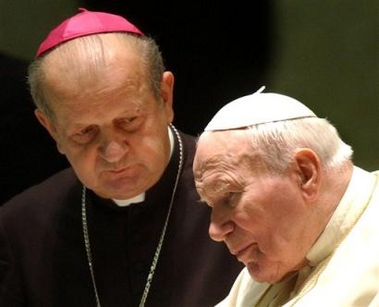
I was reading some old posts on Amy Welborn's blog and there were a few responses that bothered me. She had written about Archbishop Stanislaw Dziwisz being appointed to head the Archdiocese of Krakow. There were several vile replies to her post. It seems there are those who don't believe he has the experience or qualifications. I hope those sentiments are fading now that he is joining the College of Cardinals.
Cardinal-Designate Dziwisz has a wealth of knowledge gleaned from one of the best teachers possible, Pope John Paul II. I imagine that what he lacks in parish experience, he gained in worldwide pastoral experience. There have been few popes as pastoral as John Paul II. Being one of the only people with true 24 hour access to him and obviously serving as a trusted advisor and a true friend. I think Cardinal--Designate Dziwisz is well qualified to serve as Archbishop of Krakow and in the College of Cardinals.
Cardinal-Designate Dziwisz didn't plan on this path when he was ordained to the priesthood, but God and a bishop named Karol Wojtyla has other plans for him. He served Bishop Wojtyla during dangerous times in Poland and followed him faithfully when he was elected Pope. I am sure it was heartbreaking to leave his home and country.
He caught John Paul when he was shot and cradled him in his arms as the popemobile rushed to the waiting ambulance. He traveled around the world with him and was a listening ear to ideas and problems. He was a trusted advisor to John Paul. He administered the Sacrament of Anointing of the Sick and Viaticum during John Paul's last days and sat by his bedside, holding his hand as he died. The images of him sitting unwavering during John Paul's wake present us with the true closeness between them. He looked like a son. Exhausted by caring for someone so ill, happy to see him at rest and heartbroken at the loss of a dear friend. The image of his brushing away his tears is one that will remain with me always.
Cardinal-Designate Dziwisz is well qualified and deserves his red hat. Congratulations! Sto-lat!
Friday, September 23, 2005
The Last Days of Pope John Paul the Great
The Vatican is now reporting that the last words of Pope John Paul II (the great) were "Let me go to the house of the Father". What a beautiful final message. It is full of faith and trust in the Lord.
Pope John Paul lived a life of love, faith and suffering. He was a strong believer in the redemptive value of suffering. He is a shining example to the world that a person and be failing, suffering, and in the end unable to do much, but still have a trememdous impact on the world and those around him.
I am a grateful member of the JPII generation. His example has had a tremendous impact on my life and my ministry. For that, I will be forever grateful.
John Paul II, we love you.
Santo Subito!
Subscribe to:
Posts (Atom)