Showing posts with label Art. Show all posts

Saturday, July 28, 2007

More Foolishness

Thought DaVinci was old news. Think again. This gets more and more absurd.

From Reuters Via Yahoo News.
MILAN (Reuters) - A new theory that Leonardo's "Last Supper" might hide within it a depiction of Christ blessing the bread and wine has triggered so much interest that Web sites connected to the picture have crashed.

The famous fresco is already the focus of mythical speculation after author Dan Brown based his "The Da Vinci Code" book around the painting, arguing in the novel that Jesus married his follower, Mary Magdelene, and fathered a child.

Now Slavisa Pesci, an information technologist and amateur scholar, says superimposing the "Last Supper" with its mirror-image throws up another picture containing a figure who looks like a Templar knight and another holding a small baby.

"I came across it by accident, from some of the details you can infer that we are not talking about chance but about a precise calculation," Pesci told journalists when he unveiled the theory earlier this week.

Websites http://www.leonardodavinci.tv, http://www.codicedavinci.tv, http://www.cenacolo.biz, and http://www.leonardo2007.com had 15 million hits on Thursday morning alone, organizers said, adding they were trying to provide a more powerful server for the sites.

In the superimposed version, a figure on Christ's left appears to be cradling a baby in its arms, Pesci said, but he made no suggestion this could be Christ's child.

Judas, whose imminent betrayal of Christ is the force breaking the right-hand line of the original fresco, appears in an empty space on the left in the reverse image version.

And Pesci also suggests that the superimposed version shows a goblet before Christ and illustrates when Christ blessed bread and wine at a supper with his disciples for the first Eucharist.

The original Da Vinci depicts Christ when he predicts that one among them will betray him.


Yep, DaVinci must have known that computers were going to be invented and people would have the ability to superimpose the images and see this. I guess Leonardo DaVinci was just waiting for the invention of Photoshop. Yeah right!

Also, I find it interesting that no one has mentioned how the image of Christ become a vivid image of the Sacred Heart. That's because people see what they want.

Anyway, and most importantly, even if DaVinci intended for these "images" to be in his painting they would only represent his own personal opinions. They could represent whatever he wanted them to. Perhaps the woman with the baby was a reference to all being called to the altar and called to personal holiness. Maybe it was a reference to the sanctity of life. We don't know! We can only speculate. Plus, even if DaVinci believed that Mary Magdelene was Jesus' wife, that wouldn't give it any authority. Being a great artist does not give someone the credibility to be a historian or theologian. Just because someone or a group of people believe something doesn't make it true.

Monday, July 16, 2007

St. Dominic's Chapel

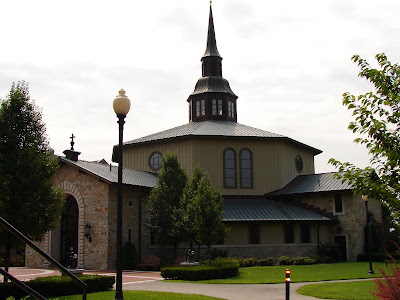
St. Dominic's Chapel is one of my favorite places on the Providence College campus. For modern construction, dedicated in 2001, it isn't a badly designed church.


The first time I saw the chapel I had my doubts about what the inside would look like, but I think it is pretty inside. If you are wondering, the stained glass windows feature Dominican saints. However, the sanctuary windows feature the four evangelists. Each of the 45 windows was created by Sylvia Nicolas.


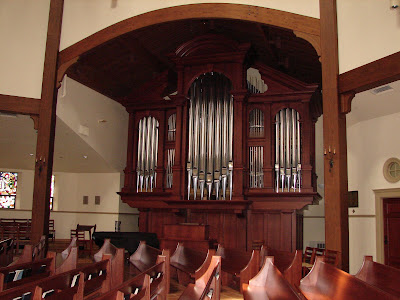
There is a real pipe organ. Ok, for the purists out there, it has electronic action, but it's still pipes. This organ was built by the Holtkalmp Organ Company from Cleveland, Ohio.


I have never seen a console where the keys are not black and white.


The sanctuary is very pretty. I could do without the bronze cross, but they aren't horrific. They were designed by Sylvia Nicolas, who also designed the windows, but they remind me of the work of a German woman. I can't remember what her name is, but I know that Cardinal Law had a great fondness for her work.


A close-up of the sanctuary.


The nave seats 600


When leaving the chapel from the main doors, you enter a large piazza. The building in the background was the location of the former Aquinas Chapel, now the Center for Catholic and Dominican Studies. The chapel occupied the first floor of the building. When the chapel was renovated, the stations of the cross and cruficix, as well as the main and side altars remained. I will add that the main altar is situated for Mass to be celebrated ad orientum.


Saturday, February 17, 2007

Michelangelo's Vatican Apartment

The Petrus Eni exhibit in Vatican City is continuing. While I have not visited it, people I know who have visited the exhibit tell me that it is awesome.

There are some items which are mentioned in the exhibit, but are not on display. One of these items is an account bookwhich containas an entry for a key which Michelangelo had made for a chest.

Here is are a few excerpts from the USA Today article:


Going through their archives for an exhibit on the 500th anniversary of the basilica, researchers from the Fabbrica di San Pietro, the office where all documents concerning the running of the basilica are kept, came across an entry for a key to a chest "in the room in St. Peter's where Master Michelangelo retires."

(...)

"We now know that Michelangelo definitely had a private space in the basilica," Maria Cristina Carlo-Stella, who runs the Fabbrica, said in an interview with The Associated Press this week. "The next step is to identify it."

The ink-scripted entry contained in a parchment-covered volume listing the expenditures of the Fabbrica for the years 1556-1558, refers to the payment of 10 scudos to the blacksmith who forged the key, but offers no details about the chest or the location of the room.

...

A frescoed room with a cozy fireplace, part of the area in the left wing of the basilica where the archives are housed, had traditionally been called "la stanza di Michelangelo," Michelangelo's room.

(...)

"The theory is very romantic and conspiratorial, but totally unfounded," said Federico Bellini, an art historian who works in the archive department, as he pointed to a 16th-century sketch on his computer showing the state of the left wing during Michelangelo's time at the Vatican — a pile of rubble intertwined with vegetation.

Originally the Fabbrica, whose documents date from as far back as 1506, was in the right wing of the basilica, already built at the time of Michelangelo. It was known that artisans had been allotted lodgings there, leading experts to direct their search for Michelangelo's studio to that area.


This gives me just one more reason to want to visit this exhibit. If only I was in Rome!

Thursday, January 11, 2007

Where is the Battle of Anghiari?

Permit me another art article. Since I just finished reading Irving Stone's "The Agony and The Estacy, this article is particularly interesting. I may just have to make a day trip to Florence on my next trip to Italy.

From ANSA:

The hunt for Leonardo da Vinci's greatest lost fresco is back on.

Italian Culture Minister Francesco Rutelli has greenlighted a dig behind a 'secret' wall in Palazzo Vecchio that may hide the fresco of the Battle of Anghiari.

The search will be led by art sleuth Maurizio Seracini, the one real-life character in Dan Brown's bestselling thriller The Da Vinci Code, and the man who uncovered the wall two years ago. "The city council finally gave its approval and we rubber stamped the excavation and analysis," the minister said.

A panel of art experts will assess any findings, under the supervision of Florence's famed heritage restoration body Opificio dell Pietre Dure.Seracini claims the wall could hide "significant" traces of the fresco.

The panel will examine new evidence as well as poring through past studies and Florentine archives.The discovery of the wall in summer 2005 raised new hopes of finding this Holy Grail of the art world.

But opinion was divided.

The world's top Leonardo scholar, Carlo Pedretti, was convinced the fresco could be hiding inside the palazzo's Salone dei Cincequento.

"I really believe it's behind that wall," said Pedretti, director of the Armand Hammer Center for Leonardo Studies at the University of California.

He said Renaissance accounts showed "the fresco can only be there".Pedretti rejected suggestions that a later artist, Giorgio Vasari, might have damaged the fresco when he was told to cover it.

Vasari was asked to paint over masterworks by Giotto and Masaccio in two other Florentine sites, but left the underlying works intact, Pedretti noted.

"If he didn't damage them, why should he have done so with the Leonardo?" This optimism contrasted with the views of Florence art chief Antonio Paolucci who said after the wall find was unveiled that "there's little or nothing behind that wall".

Paolucci, a former culture minister, may now have changed his mind - since he was one of the officials who decided to set up the international panel.

The Battle of Anghiari - described by sculptor Benvenuto Cellini as a ground-breaking masterpiece that any artist simply had to see and study - has long been known from sketches and copies.

But the original was thought lost for ever - a victim of Leonardo's typically unorthodox decision to jettison the traditional technique of applying paint to wet plaster.

Leonardo needed time for his painstaking approach and so used oils directly on the dry plaster in Palazzo Vecchio, the symbol of Florentine civic pride.

Like the Last Supper in Milan it soon began to crumble, helped on its way by a thunderstorm that hit the unfinished building.

Leonardo gave up and headed for Milan.

Though it has been wiped off the art map, the fresco's birth was well documented.Leonardo (1452-1519) started painting it on June 6, 1505, surrounded by an admiring throng.

Just Because I Think It's Interesting

This post has nothing to do with religion, but I think it is interesting and since it's about one of my favorite places on earth, Italy please give me the luxury of posting this.

It seems that many ancient works of art have gone missing in recent years. Well, a lot of them have been found.

From ANSA:

Italian police on Thursday recovered a haul of Etruscan and Roman tomb plunder as Italy continued to crack down on art theft.

Police raided a goldsmith's luxury villa belonging outside Arezzo, Tuscany and found what they called a "significant collection of ancient art, fit to grace a museum".

Among the artefacts recovered were several Roman statues including a particularly fine one of the Greek fertility and re-birth god Attis.

Other Roman items included stately Corinthian columns, ornate funerary urns and a striking marble sarcophagus dating from the First to Second centuries BC. Among the Etruscan artefacts were a dainty Seventh Century BC wine jug and a delightful Sixth Century BC tufa statuette of a cat. The plunder is believed to have come from tombs in southern Tuscany and northern Lazio.

Two Arezzo-based antiquities dealers have been implicated in the probe, which was initiated by chance after tax police spotted some outstanding examples of ancient art in the goldsmith's shop during a routine tax check. Investigations are continuing in a bid to find the wrecked tombs and the raiders who sold the artefacts, police said.

Italy is stepping up its efforts to combat tomb raiders and recover the loot they have traded. Last month art police unveiled their biggest recent coup, two magnificent Roman artefacts.

The Second Century AD works - a marble head of the sex-and-wine god Dionysus and a headless statue of a toga-garbed figure - were traced after decades of detective work.

The delicate little head of Dionysus was stolen from Rome's Villa Torlonia gallery in the 1980s and recently intercepted as it was about to go under the hammer at Christie's in New York.

The toga-clad figure, probably a Roman Senator, was tracked down in Barcelona after disappearing, again in the '80s, from a wall niche on Rome's Colle Oppio hill.Dionysus has just returned to the Villa Torlonia while the Senator has been put on show in the Capitoline museums, in the same room as the famed Marcus Aurelius equestrian statue.

Italy is tightening the screw on antiquities trafficking with a wave of raids that have reclaimed major tomb hauls.It has also signed landmark agreements with major American galleries to get looted works back, thus discouraging tomb raiders.

An accord with New York's Metropolitan Museum of Art in February dealt a major blow to art trafficking.Under the accord, Italy recovered a large collection of treasure in return for the promise of loans of equivalent value.

Italian Culture Minister Francesco Rutelli inked a carbon-copy accord with the Boston Museum of Fine Arts last month - while the minister is optimistic about reviving stalled talks aimed at securing a similar deal with the Los Angeles-based John Paul Getty Museum.

Italian authorities have prosecuted a former Getty Museum curator, Marion True, for allegedly receiving stolen artefacts.The Rome proceedings are the world's first such trial of a US art official.

Friday, December 01, 2006

Cardinalitial Art Exhibit

ROME (ANSA) - A new exhibit has opened in Rome charting the charismatic and powerful cardinals that have helped shape the history of the Catholic Church.

The event features over 70 portraits of the best-known princes of the church, spanning 500 years from the mid-16th century through to the 1990s.

"The show leads us through half a millennium of art, exploring the public and private affairs of many important figures who shaped the history of our city," said Rome Culture Councillor Gianni Borgna. "At the same time, it traces the development of art over the centuries, showing the evolution in tastes and styles.

"Popes are important but cardinals are more interesting from a history of art point of view, because they produce more lively portraits. There are more restrictions on paintings of popes," he explained.

The exhibit encompasses a variety of mediums, including paintings, sculptures and photographs.

One of the event's two curators, Maria Elisa Tittoni, explained that the exhibit sought to draw out the dual significance of portraiture.

"On the one hand, they are important with regards to the history of art and on the other, with regards to the history of the city," she said.

"There are basically three types of portrait, all of which are amply covered here: standing figures; sitting figures at a three-quarter angle and half figures".

The most significant portraits include a full-length painting of Cardinal Giovan Battista Montini (1897-1978) who would later become Pope Paul VI; a portrait of Alessandro Farnese (1468-1549), later Pope Paul III, attributed to Raphael; and a bronze sculpture entitled 'Cardinal Sitting' by one of Italy's best-known 20th-century sculptors, Giacomo Manzu.

There is also a selection from a series of photographs of the Roman Curia, taken by Marco Delogu between 1998 and 1999.He photographed 24 of the Vatican "government's" 27 members as part of the project, including the German cardinal Joseph Ratzinger, who was later elected Pope Benedict XVI.

"Ratzinger was the one who gave me most time, almost a whole hour, and he was the only one I was able to shoot in close-up," recalled the photographer.

One of the most striking elements of the exhibition is the array of tones and textures in the scarlet silk cassocks worn by the cardinals.

"Walking along the corridors of Palazzo Braschi, the predominant colour in the paintings is red," said Borgna. "However, as these are works from different eras, the approaches and techniques change, testifying the development in art itself".

Palazzo Braschi was deliberately chosen by the exhibit's curators owing to its history: now the Museum of Rome, it was built at the end of the 1700s by Pope Pius VI for his nephew Luigi Braschi Onesti.

'La Porpora Romana Rittrastica Cardinalizia dal Rinascimento al Novecento' runs until February 22.