Showing posts with label Providence. Show all posts

Thursday, May 01, 2008

A Few Good Schools

Every so often something happens which makes me very proud of my school. Today was one of those days. Fr. Shanley has done an excellent job since he became president three years ago. In addition to the current solid faculty, the theology department has attracted theologians such as David Bentley Hart. The college has also hosted theology conferences such as was held last year featuring Avery Cardinal Dulles.

From the Providence Journal:
Emphasis added

When Pope Benedict XVI asked to address Catholic educators during his recent visit to the United States, there was much speculation that he would scold Catholic college presidents for failing to remain true to the mission of their institutions. As all of America learned, however, the Holy Father is not a scold. He is a teacher of hope who believes that “the noble goals of scholarship and education, founded on the unity of truth and in service of the person and the community, become an especially powerful instrument of hope.” I returned from my encounter with him filled with hope for Providence College and convinced that it is realizing his vision — and the vision of our Dominican Friar founders — for Catholic education.

Many of the themes addressed by Pope Benedict in his remarks resonate deeply with the mission of Providence College and remind us of the unique place that a Catholic college or university occupies in higher education. For example, Pope Benedict considers one of the church’s roles in the world as a service (diakonia) of truth. In a time where there is widespread doubt about objective truth, a Catholic college such as Providence College (whose motto is veritas, or truth) is seen as countercultural, based on the optimistic proposition that the human mind has been created by God to know the ultimate truth. In opposition to the view that there are only perspective-based points of view, we believe that students can integrate what they learn into a unified view of the whole; we reject the popular assumption that all claims to knowledge are fragments that do not fit together.

Pope Benedict further articulated that knowledge of the truth leads to an appreciation of the good, and that true freedom is not the aimless pursuit of novelty or personal satisfaction, but choosing to embrace the truth about the dignity of the human person as made in the image and likeness of God. Catholic colleges do not focus on students’ intellect alone but equally on their moral character. We explicitly help our students to come to know the good and recognize the dignity of the human person through studies in ethics and moral philosophy and through participation in meaningful community service.

Pope Benedict introduced the intriguing idea of “intellectual charity” as a particularly urgent imperative in Catholic education. He noted the Catholic educator’s call to “recognize that the profound responsibility to lead the young to truth is nothing less than an act of love.” Once this passion for the fullness of unity and truth is awakened in students, the pope observed, “young people will surely relish the discovery that the question of what they can know opens up the vast adventure of what they ought to do.” As a teacher and administrator, I have watched this discovery of God’s providence unfold in countless students. We succeed not when students find employment for employment’s sake, but rather when they know the value of work within the context of a meaningful life that is focused on communion with God and service to others.

One of the most controversial issues on a Catholic college campus is the meaning of academic freedom. Pope Benedict thoughtfully described it as the “freedom to search for truth wherever careful analysis of evidence leads you,” and affirmed that the coherence and identity of a Catholic institution depends on all aspects of its life being consistent with the truth. Rooted in the harmony of faith and reason, a Catholic college is fundamentally optimistic that such a search for truth — undertaken in accord with scholarly canons of inquiry — will not lead to conclusions that contradict faith. So academic freedom cannot be invoked in order to justify positions that contradict the faith — because truth cannot contradict itself.

The remark in the pope’s address that elicited a spontaneous round of applause from all present was his exhortation that Catholic education must remain “accessible to people of all social and economic strata.” In describing the history of Catholic education in America, Pope Benedict notes that Catholic education has “helped generations of immigrants to rise from poverty and take their place in mainstream society.” This aptly describes the historic mission of Providence College. We remain committed to inviting and enrolling applicants from underrepresented populations, including economically disadvantaged students from urban schools and first-generation college students. In recent years, we have reinvigorated this mission by removing the barrier of standardized testing for applicants and by devoting greater resources to need-based scholarships.

Spring is decision time for college-bound students and their parents, who, the Holy Father noted, “recognize the need for excellence in the human formation of their children.” One marvelous feature of the American higher-educational landscape is its rich diversity. Students can choose from a wide array of institutional characteristics and values: public and private, religious and secular, urban and rural, large and small, and so many others. The best way for Catholic education to serve America is by providing a distinctive educational option for students and their parents. Pope Benedict has defined those distinctive features. It is my responsibility to see that Providence College continues to embody them.

The Rev. Brian J. Shanley is president of Providence College.

Tuesday, February 19, 2008

Diocese Interviews Liturgical Musicians

The Rhode Island Catholic interviewed a few liturgical musicians from around the diocese. There were a few interesting comments both good and bad.

The good:
It is important, Berbercik asserted, that choirs and cantors not try to steal the show. The music they perform is meant to be inviting, “we try not to turn that music into a performance, it’s a presentation or a participatory song,” she said. She is wary of any choir or cantor that is too invested in their individual performance. She compared liturgical music to the national anthem, which at many public events has become an opportunity for one singer to showcase, or showboat, their individual talents, rather than a communal experience for everyone to participate in. “We lose our love of the song because we detach from it,” she said, “we’re distracted by somebody going overboard.” (Unfortunately they failed to mention that first and foremost choirs and cantors should not try to steal the show because the music is worship, not a concert. God should be the focus of the Mass, not the muscians.)


The bad:
“I don’t go too contemporary because most of the parishioners like their old chestnuts,” said Stott. But, he added, it is important not to rule any music out, the selections “should be a mixed bag because that’s what the tradition of church music has become.” Others see putting an emphasis on contemporary music as a chance to bridge generations and reach out to younger audiences. “You want to keep people coming to church and I feel that if you want the young people you really have to do the contemporary music,” said LabrĂ©che. Berberick said that when choosing music at her parish she tries to “touch upon each generation” and “keep in mind other cultures.” (Sometimes music does need to be ruled out. As for contemporary music, all the guitar strumming that was done when I was a kid sure kept my generation at Mass. @@)


Finally, a comment I can agree with:

In the end, everyone agrees that music adds too much to the Mass to be ignored. “Music gets inside you in a different way that spoken word does,” said Rashed, “If you want the Liturgy to enter people’s hearts and minds, you better use some music.” (Yes! And it's all the more reason to be careful when selecting Liturgical music.)


Read the article here.

Thursday, January 31, 2008

Hartford and Providence Dioceses Shift the Date of St. Patrick's Day And the Annunciation for 2008

The Vatican decided that due to conflicts in the Catholic Church's liturgical calendar in 2008 that the dates of the feasts of St. Joseph and of the Annunciation of the Lord will be moved. In 2008, if the feast of St. Joseph were to be celebrated as usual on March 19, it would fall on the Wednesday of Holy Week and if the feast of the Annunciation of the Lord were to be celebrated March 25, it would fall on the Tuesday during the octave of Easter.

While the two feasts are among the 14 solemnities marked with special care in the Catholic Church, they do not take precedence over the commemoration of Christ's suffering, death and resurrection. Therefore in 2008 the feast of St. Joseph will be celebrated March 15, the day before Palm Sunday, and the feast of the Annunciation will be celebrated March 31, the Monday after the second Sunday of Easter, which also is Divine Mercy Sunday.

Regarding the feast of St. Patrick:
The Bishop has agreed to join the Bishop of the Hartford Province and assign the optional memorial of St. Patrick to Friday, March, 14.

Inquiries have been received concerning the optional memorial for St. Patrick (March 17), which falls on the Monday of Holy Week. As a result of the above mentioned change for the Solemnity of St. Joseph, a memorial for St. Patrick may be celebrated on Friday, March 14. The Bishop is prepared to issue a dispensation for those celebrating this optional memorial Friday, March 14, which is a Friday during the Lenten Season. Any social activities taking place around the feast of St. Patrick should be most sensitive to the solemn nature of Holy Week which observes the Passion, Death, and Resurrection of the Lord.

It is the first time in almost 100 years that the feast of St Patrick will not be celebrated March 17. In 1913, the same conflict occurred, and in that case the church marked the feast April 1.

According to historians, March 17 is the traditional date given for the death of St. Patrick, and his feast has been celebrated on this day since the seventh century.

The next time St. Patrick's Day will fall during Holy Week will be 2160

Tuesday, January 29, 2008

The TLM and the Human Desire for Mystery

Fr. David Lewis Stokes has done it again! This time the article is on the Extraordinary (Tridentine) Mass.

Excerpts from the Providence Journal:

In a New York Times story about the renewed interest in the Latin (or Tridentine) Mass (“Latin Mass Draws Interest After Easing of Restrictions,” Nov. 10), a professor at the Weston Jesuit School of Theology offered an intriguing caveat. Referring to the enthusiasts for the “old” mass, the Rev. John F. Baldovin commented, “A lot of them think this is the way to go, back to the future, because it is really going to revive Catholicism. You can produce a Tridentine mass, but can’t reproduce the world it came from.” Since this quotation concludes the article, many readers may imagine Father Baldovin’s words to be the final say.

In some ways he’s right.

[...]

But I wonder whether nostalgia is the only explanation for the fascination with the Latin Mass. I wonder whether this fascination might not be a part of a much larger cultural trend: our modern hunger for mystery. I mean by mystery our encounter with what is “other” — what Rudolph Otto called the mysterium tremendum, the numinous. That “other” which provokes in us both terror and fascination: the sense of the holy.

[...]

Unfortunately, the last few centuries in the West have not been fond of mystery, especially the century just ended. And in the 1960s two things in particular coincided to try to banish the numinous altogether... To be religious is another way to be a nice person...

Second, the reduction of religion to moralism found an unwitting ally in those committees that sought to “reform” religious worship — to simplify the language, to return to some imagined primitive idea of how-it-used-to-be, to stress the communal nature of church or synagogue. All good ideas, perhaps. But in our drive to make modern worship demotic, we forgot several things.

The human response to the numinous can never be the work of a committee. Poetry can never be pre-programmed. Like making love, rites and rituals demand time, attention and humility. Moreover, even if we could dismantle or alter a mystery, we risk sawing off the very limb on which we’re sitting...

[...]

And so we return to Fr. Bladovin’s caveat. True enough, restoration of the Latin Mass is not going to revitalize the Catholic Church in America.
But those who dismiss the renewed fascination with the Latin Mass simply as a matter of nostalgia or of curiosity would do well to consider. Whatever the motives of these seekers, their actions remind us that there just might be more things in heaven and earth than were ever dreamt of by a liturgical committee.


Read the complete article here.

Monday, November 19, 2007

Remembering Fr. Smith

Providence, RI -- Rev. Philip Alphonsus Smith, O.P., Providence College's 11th president, was remembered "as a child of God from the day he was baptized" during his Mass of Christian Burial on Friday, November 9, 2007 in St. Dominic Chapel on campus. Father Smith died unexpectedly at Rhode Island Hospital in Providence on Sunday, November 4. A current professor of philosophy at PC, he served as president from 1994-2005.

Approximately 650 members and friends of the College community, including 35 members of Father Smith's family as well as city and state government dignitaries, attended the Mass, overflowing into the lower level of the chapel.

The principal celebrant was the Very Rev. D. Dominic Izzo, O.P., prior provincial of the Dominican Province of St. Joseph and chair of the PC Corporation. The principal concelebrants were College President Rev. Brian J. Shanley, O.P.; Rev. Kenneth R. Sicard, O.P., College executive vice president and treasurer; Rev. Terence J. Keegan, O.P., professor of theology and College executive vice president and treasurer under Father Smith; and Rev. William P. Marquis, O.P., prior of St. Thomas Aquinas Priory and an assistant professor of economics and department chair.

Approximately 40 Friars from the Dominican Community at PC concelebrated the Mass from their pews.

Presiding were six bishops representing the Diocese of Providence: the Most Rev. Thomas J. Tobin, D.D., current ordinary bishop of Providence and a member of the Providence College Corporation and the Board of Trustees; the Most Rev. Robert E. Mulvee, D.D., bishop emeritus of Providence; the Most Rev. Louis E. Gelineau, D.D., bishop emeritus of Providence; the Most Rev. George H. Pearce, S.M., archbishop emeritus of Suva, Fiji; the Most Rev. Ernest B. Boland, O.P., D.D., bishop emeritus of Multan, Pakistan, and a resident of St. Thomas Aquinas Priory at PC, who ordained Father Smith in 1968; and the Most Rev. Francis X. Roque, D.D., retired auxiliary bishop of the Archdiocese for the Military Services/U.S.A.

In addition, four of Father Smith's seminary classmates--with whom he was ordained- -participated in the Mass: Father Keegan, who preached the homily, as well as Rev. Michael M. Burke, O.P., Rev. Bernard G. Dupont, O.P., and Rev. Donald P. Thibault, O.P., who traveled from New Orleans, La., Louisville, Ky., and Pleasantville, N.Y., respectively, to celebrate their Dominican brother's life.

Father Smith's niece, Jill Dunn '00, and his sister, Bertha Smith Dunn, proclaimed readings from the Book of Wisdom and the First Letter of John, respectively. The General Intersessions were proclaimed by two of Father Smith's nieces, Gwen Carragher Staub and Nora Smith Davis, while the offertory gifts were presented by two other nieces, Linda Mae Smith and Donna Smith Taucer.

At the start of his homily, Father Keegan addressed why a healthy and vibrant Father Smith was taken so suddenly.

"It's a simple answer and an answer I give to my ninety-seven-year-old mother when she asks me, 'Why am I still alive?'" said Father Keegan with a smile. "I tell her, 'Mother, you're still alive because God doesn't want you yet.' I firmly believe God wanted Father Philip Smith; it was his plan."

Father Keegan went on to laud Father Smith's tenure as College president. After saying that he joked with him about a College president "who went to hell and another who died and went to heaven," Father Keegan said there was no question where his friend of 46 years was.

"I don't know another person on Earth who had a greater love for Providence College than Father Philip Smith," he said. "There are so many reasons why we are here. He had a deep and meaningful influence on our lives….He was so many things to so many of us."

In referencing the earlier Gospel from St. John, Father Keegan added, "He was a rugged, strong, assertive person but inside he was a child of God. He was a child of God from the day he was baptized. He loved his priesthood, loved the Dominican Order, and loved to exercise his ministry."

On the day of the previous week when Father Smith was about to be driven to the hospital for surgery, Father Keegan recounted how Father Smith asked for his blessing and knelt before him.

"As I blessed him," Father Keegan said, "I prayed that the operation would be a success and that God would bring him safely home." He then added, "Be careful what you pray for because you might get it. The operation was a success and God did bring him home, not to his perishable, temporary home at Providence College but to his real, eternal home in heaven."

Referring to a passage in Mark's Gospel where Jesus knelt before John the Baptist and heard a voice from heaven, Father Keegan concluded, "Father Smith was indeed God's beloved son in whom God was well pleased."

After Communion, Father Smith's successor as president, Father Shanley, offered a reflection. He remembered Father Smith as a visionary whose goals for the College blossomed to magnificent fruition.

Father Shanley specifically noted the artificial-turf field, the Smith Center for the Arts and, most importantly, St. Dominic Chapel, as proof that Father Smith "was a builder" and "connected to the mission of Providence College."

"He left this place a much stronger institution than when he entered," Father Shanley said. "I know how tirelessly and passionately he worked."

He went on to say how impressed he was with Father Smith's drive to get back to teaching following his presidency. "After 11 years of not being in the classroom, having to face down eighteen- to twenty-one-year--olds is a daunting task, but he was up to it," he said.

However, despite his gifts as a teacher and his vision for the campus, Father Shanley said that Father Smith was first and foremost a priest who shined brightest in one-on-one situations. "I think that is when we saw Father Smith at his absolute best. He had a wonderful way of encountering a person in need and then presenting Christ to them," he said.

After the Mass, hundreds processed down the College's Grotto Lane to the Dominican Community Cemetery, where Father Marquis presided over the burial rite.


Video from the funeral Mass can be downloaded from the Providence College website.

Tuesday, November 06, 2007

PC and The Dominican House of Studies Mourns


I never had Fr. Smith as a professor, but I saw him around campus often. We chatted a few times, and I attended many Masses which he celebrated. He wasn't as strict as Fr. Shanley, the current president, but he made many positive changes at PC.
Here is his obituary:
Rev. Philip Alphonsus Smith, O.P. ’63, a priest, educator, and administrator who served as the 11th president of Providence College, died unexpectedly at Rhode Island Hospital in Providence on Sunday, November 4, surrounded by close friends, including members of the Dominican Community. He was 74 years old.

A current professor of philosophy at PC and a member of the Dominican Community of St. Thomas Aquinas Priory on campus, Father Smith served as president from 1994-2005, guiding an impressive, multifaceted transformation of the College.

Under Father Smith, the College achieved a reputation as a premier regional liberal arts institution, raising the academic standing of its undergraduates to its highest level ever. Providence College was consistently ranked #2 among colleges and universities in the North Region in U.S. News & World Report’s annual college guide, America's Best Colleges.

During his presidency, Father Smith also enhanced the quality and diversity of the faculty; directed a revision of the Mission Statement to emphasize the Catholic and Dominican traditions of PC; and oversaw $110 million in new construction and infrastructure improvements, including the construction of St. Dominic Chapel, a new performing arts center, and the campus’ first suites-style residential facility. He also oversaw the development of the College’s first Strategic Plan.

In recognition of his many achievements and commitment to the academic standing and mission of the College, Father Smith was awarded the Veritas Medal—the highest honor the College can bestow—during the College’s Eighty-Seventh Commencement Exercises in May 2005. The Board of Trustees also voted to name the new performing arts center on the East Campus in his honor, and the facility was dedicated as the Smith Center for the Arts on October 29, 2004.
“Father Smith ably led Providence College through eleven years of opportunity and growth,” said College President Rev. Brian J. Shanley, O.P. He continued, “Under his guidance, the academic profile of our student body dramatically improved and the campus landscape was transformed. I know that Father Smith was particularly gratified to oversee the building of St. Dominic Chapel, a dream that the College had long deferred. His legacy is one that we will always treasure and never forget.”

Father Smith served the Dominican Order as a priest for nearly 40 years. He entered the novitiate of the Dominican Order (Order of Preachers), Province of St. Joseph , at St. Joseph Priory in Somerset, Ohio, in 1961, and made his first religious profession there a year later. He was ordained a Roman Catholic priest on June 13, 1968, at St. Dominic Church in Washington, D.C., by the Most Rev. Ernest B. Boland, O.P., D. D. ’49, then-bishop of Multan, Pakistan, and currently a resident of St. Thomas Aquinas Priory at PC.

A native of Prince Edward Island, Canada, Father Smith joined the College faculty in 1981 as an assistant professor of philosophy. He was promoted to associate professor in 1984 and to professor in 1994. From 1982-1985, he also was the special assistant to then-College President the Very Rev. Thomas R. Peterson, O.P. ’51.

Before becoming president of PC, Father Smith served as president of the Pontifical Faculty of the College of the Immaculate Conception at the Dominican House of Studies in Washington, D.C., from 1990-1994.

After earning a bachelor of arts degree in philosophy from the College in 1963, Father Smith went on to attain his master’s degree in philosophy from St. Stephen’s College in Dover, Mass.; his bachelor of sacred theology (S.T.B.), licentiate of sacred theology (S.T.L.), and lectorate of sacred theology (S.T.Lr.) degrees from the College of the Immaculate Conception; and his Ph.D. in philosophy and religion from Drew University in Madison, N.J. He also received honorary degrees from Brown University and Caldwell College in Caldwell, N.J., in 2005.

Born on September 6, 1933, in Charlottetown, Prince Edward Island, Father Smith was a son of the late Philip and May (Byrne) Smith. He was raised on a 100-acre farm in Fort Augustus, east of Charlottetown, and attended the Webster Corner School, a one-room schoolhouse, from grades 1 through 10, before completing his high school education at St. Dunstan’s School in Charlottetown. He came to the United States in 1959.

His body will be received at the Chapel of Our Lady of the Rosary in St. Thomas Aquinas Priory on campus on Thursday, November 8, at 4:00 p.m. Calling hours will follow, concluding with the recitation of the Office of the Dead by the Dominican Community at 7:00 p.m.

A Mass of Christian Burial for Father Smith will be celebrated on Friday, November 9, at 10:00 a.m. in St. Dominic Chapel on campus. Burial will follow in the Dominican Community Cemetery on campus.

Donations may be made in his memory to the Rev. Philip A. Smith, O.P. Scholarship Fund in care of Providence College, Office of Institutional Advancement, 549 River Ave., Providence, R.I., 02918.

Friday, October 19, 2007

The Life of a Bishop

Bishop Thomas Tobin, from the Diocese of Providence, is featured in a four part series in the Providence Journal. Although Bishop Tobin is not my bishop, I attend school in his diocese, so I am happy to say his is almost my bishop.

The series includes information on episcopal regalia, such as the zuchetto and crozier.

Check it out here and remember to check back each Sunday for updates.

Sunday, October 14, 2007

On The Decline of the Funeral Homily

Followers of this blog will be aware of my fondness for a certain theology professor, Fr. David Lewis Stokes. Fr. Stokes recently wrote an article for the Providence Journal which has been picked up by newspapers across the country. The topic was how the decline of the funeral portrays our changing view of death.

Only Fr. Stokes could make the analogy that we view death as a cruise ship and heaven as "the predetermined destination of a cruise ship".

Of all the elephants galumphing around our culture’s living room, none is more significant than the change in our rhetoric of death. By this I mean the metaphors and similes by which we speak of the dead.

You have only to listen to a funeral homily, squirm through a eulogy, or read “verses” offered in memoriam to realize that there has occurred a seismic shift in our cultural imagination. Heaven now lies before us devoid of geography. Death has ceased to be a drama.

I’m not suggesting that our fascination about “spirits” and the “spirit-world” has diminished. Far from it. The trend of TV shows about angels, etc., reveals that this fascination with the “beyond” flourishes. Mary Roach’s Spook: Science Tackles the Afterlife remains a bestseller. You have only to drive through a suburban neighborhood to see how Americans have transformed even Halloween into a bizarre kind of dia de los muertos.

To name the specific elephant in question, let me be blunt: However fascinated most Americans are in the “afterlife,” the fact remains that those grand themes, once the raison d’etre of mainline churches and pulpits — that is, death, judgment, heaven and hell — have vanished from the very religious communities that first articulated them. They are just plain gone. Preachers and theologians, politicians and toastmasters may trot out the occasional words — but now for ornamentation, not out of any necessity.

To understand just how dramatic this shift in our rhetoric, consider three examples. When a dying John Donne crawled into his pulpit in 1631, he preached a sermon entitled “Death’s Duel.” What makes it one of the greatest sermons in the English language is its rhetorical force. It is an explosion of metaphors and images of incredible specificity. Donne rendered life as a perilous journey and death as our foe “even from the womb.” He left his congregation in no doubt that each individual’s appointment with death is the most serious engagement in life.

When John Bunyan’s stalwart Christian of The Pilgrim’s Progress (1678) finally reached sight of the Celestial City, he finds himself plunged neck-deep into a river of dread. “And . . . a great darkness and horror fell upon Christian, so that he could not see before him.” There was no immediate entrÉ into heavenly bliss. Heaven was a city to be won after arduous struggle, not the predetermined destination of a cruise ship.

As late as 1865 Cardinal Newman could publish The Dream of Gerontius, a dialogue between a dying man, angels and the demonic, which became something of a Victorian bestseller. Far from being a pious bit of Catholic triumphalism, he rendered death as no less than “this emptying out of each constituent / And natural force, by which I come to be.” The poem expresses a dread of death worthy of Dante or even Jean Paul Sartre.

Contrast these with the following contemporary tropes — gleanings typical of American pulpit: “Tom may be gone, but he will live on in our hearts.” “Aunt Bertha is in a better place.” “After years of hardship, Uncle Fred is finally home.” “We don’t know why Sally was taken from us so young, but someday we will.” Or, my own favorite, proclaimed over a woman who had made the lives of her children and grandchildren absolute hell, “For Edith the great symphony of life continues now among the stars.”

I have no doubt that many people have found comfort in such statements. The significant thing, though, is that compared with the specific rhetoric of a Donne, Bunyan or Newman, these tropes refer us ultimately to ... well, uh ... nothing.

They point to a landscape without topography or content. They imply that a human life is not so much a drama to be acted with the utmost ethical seriousness but a pleasant odor that will eventually dissipate. The only traditional image that seems to have hung on is that when we “pass” we enter into a bright white light. But within this light ... who can say? (Frankly, heaven for me has always been autumnal and filled with deep shade.)

But why should it matter? We forget. How a society renders death and the “beyond” says everything about how it renders life and the here-and-now. The ways in which we picture what happens to the dead determine the ways in which we picture our own lives — the ways in which we engage in ethical reflection.

A life pictured as a cruise that will encounter the occasional storm is very different from one whose destination is pictured as fraught with demands, uncertainties, and the abiding shadow of possible moral failure.

The reason that most mainline churches have ended up focused on politics or sexual expression or “an aesthetic experience,” is simple. Without a rhetoric of the “beyond,” what else is there to talk about?

And the reason that sustained ethical reflection is scarce among most theologians is obvious. Now that life’s drama has no final act of any depth, life itself cannot but be pictured as one discrete scene after another.

Sadly, our modern dilemma is that we cannot return to a lost rhetoric without making it artificial. Those well-meaning preachers and speakers who try to “follow an antique drum” have come to seem to me about as “genuine” as a costumed guide at some colonial theme park.

No doubt we may rediscover the rich and mysterious topography of the “beyond.” But if we do our rhetoric will be decidedly different.

Poets and novelists, painters and artists, as well as the itinerant mystic, are always stumbling into it. Just don’t look for it to come from the American pulpit.

Saturday, July 28, 2007

Dominican Sisters of St. Cecilia

Another plug for my favorite religious order. I know several of the sisters and I love seeing them in chapel and on campus.

Check out their vocation video.


and another video featuring some beautiful sacred polyphony.

Monday, July 16, 2007

St. Dominic's Chapel

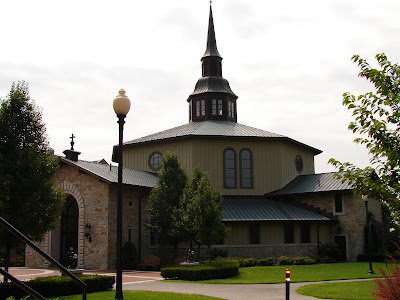
St. Dominic's Chapel is one of my favorite places on the Providence College campus. For modern construction, dedicated in 2001, it isn't a badly designed church.


The first time I saw the chapel I had my doubts about what the inside would look like, but I think it is pretty inside. If you are wondering, the stained glass windows feature Dominican saints. However, the sanctuary windows feature the four evangelists. Each of the 45 windows was created by Sylvia Nicolas.


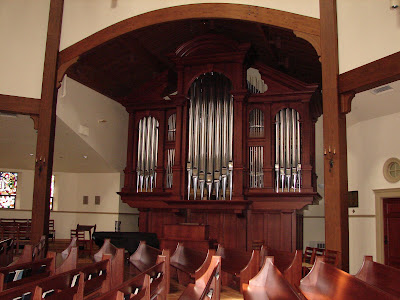
There is a real pipe organ. Ok, for the purists out there, it has electronic action, but it's still pipes. This organ was built by the Holtkalmp Organ Company from Cleveland, Ohio.


I have never seen a console where the keys are not black and white.


The sanctuary is very pretty. I could do without the bronze cross, but they aren't horrific. They were designed by Sylvia Nicolas, who also designed the windows, but they remind me of the work of a German woman. I can't remember what her name is, but I know that Cardinal Law had a great fondness for her work.


A close-up of the sanctuary.


The nave seats 600


When leaving the chapel from the main doors, you enter a large piazza. The building in the background was the location of the former Aquinas Chapel, now the Center for Catholic and Dominican Studies. The chapel occupied the first floor of the building. When the chapel was renovated, the stations of the cross and cruficix, as well as the main and side altars remained. I will add that the main altar is situated for Mass to be celebrated ad orientum.


Wednesday, June 06, 2007

Rudy! Listen up!

From LifeSite News:

In what is being perceived as an eerie instance of coincidence, a series of lightning hits caused audio disruption at the exact moments when pro-abortion presidential hopeful Rudy Giuliani attempted to defend his support for abortion despite his supposed Roman Catholic faith. The lightning storm occured during a New Hampshire debate.

The first bolt hit just as the former New York mayor took the mic to answer a question about the sharp criticism his position on abortion garnered him from Rhode Island Catholic Bishop Thomas J. Tobin, who publicly condemned Giuliani for his abortion stance earlier this week.

Bishop Tobin compared Giuliani's refusal to oppose abortion to Pontius Pilate's role in the crucifixion of Christ.

"I can just hear Pilate saying, 'You know, I'm personally opposed to crucifixion but I don't want to impose my belief on others," Bishop Tobin wrote in a column for the Providence Catholic news.

As Giuliani began to brush aside Bishops Tobin's view, a crack of lightning caused the sound system to give out and cut off his mic. Wolf Blitzer of CNN, who was moderating the debate, pointed out the electronic disturbance was caused by lightning.

The audience burst into laughter, evidently recognizing the possible interpretations of such the eerie event.

Giuliani said, laughing, as his debate opponents backed away from him in jest, "For someone who went to parochial schools all his life, this is a very frightening thing." However, a second bolt crashed moments later, just as Giuliani opened his mouth to answer the question again, cutting him off as he attempted to say he "respected" the views of Catholic and religious leaders.

He finally completed his answer audibly, despite two more lightning strikes, reiterating his position that while he believes abortion to be wrong, he does not believe it should be illegal. Giuliani's insistence of remaining on the fence over the issue was condemned by Bishop Tobin as "preposterous", saying he had "defected from the Catholic faith" on the issue.

"Rudy's preposterous position is compounded by the fact that he professes to be a Catholic," Bishop Tobin wrote. "As Catholics, we are called, indeed required to be pro-life, to cherish and protect human life as a precious gift of God from the moment of conception until the time of natural death. As a leader, as a public official, Rudy Giuliani has a special obligation in that regard."

Read Bishop Tobin's Column here.

Friday, June 01, 2007

New Funeral Policy in Providence

Brian has it:

Effective July 1, 2007, that will change. Per order Bishop Thomas J. Tobin, the new policy will be that the undertaker cuts one check to the parish for everything, including music, and the parish cuts the check for the musician.


I agree with Brian that the small inconvience of waiting until payday, is worth it for the benefits which will come from this.

Read the complete post and discover the benefits here.

Friday, May 04, 2007

Diversity to be Anything but Catholic

At my lovely institution of higher education, which just happens to be one of the few Catholic colleges in the U.S. which is Catholic in more than name only, a debate is brewing over "diversity". The diversity which some students desire would mean diluting or dissolving the Catholic identity of the school and changing it into a college "in the Catholic tradition" or worse, in the "Dominican tradition".

After arguing that Providence College should offer classes in other religion, Jackie Kramer, a writer for the college newspaper, The Cowl, wrote this in a recent article:


It is a big deal. Another girl in the class noted that she was not Catholic and she has had to drop two theology classes. She ascribes this to the fact that, because the core curriculum requires two theology classes, she had to take classes in Catholicism. She mentioned that she thought the professors gave the impression that the students should believe these teachings, otherwise they would go to hell. She withdrew from both classes and this action will stay on her transcript permanently.


Care to know my thoughts on this issue? Of course you do. If you didn't you wouldn't be reading this blog. If you don't want to learn about Catholicism, don't attend a Catholic school. I can't imagine attending a Protestant or Jewish college and complaining that Catholicism wasn't taught. Providence College doesn't hide the fact that it is a Catholic institution. The habited friars and sisters, the crucifixes in every classroom, the large chapel and several smaller chapels on campus, where the Eucharist is reserved, right down to meat not being served in the cafeteria during Lent, Providence College is a Catholic place.

Not all the theology classes at PC are based in Catholic theology. There is a class on World Religions, Basic Judaism, Hebrew Scripture, and Old Testament Prophets. Yes, there is a Catholic slant to most of these courses, but it's a Catholic school! There is supposed to be a Catholic slant.

This week another article appeared in the Cowl. This time a rebuttal from Andrew Sparks. Here is part of what he wrote:

One consideration that needs to be taken into account is the fact that both of those colleges [Boston College and Holy Cross] are Jesuit institutions; since the Jesuits are a primarily a teaching order, it seems appropriate that they should have wider spectrum of courses. Contrast this with our own beloved Dominicans, who are a preaching order, formed to fight heresy and spread the Catholic faith. Indeed we have dozens of Dominican friars on campus that daily devote themselves to living and preaching the Catholic faith, such a school attracts a certain kind of faculty and fosters a distinctly Catholic identity. In fact, this identity is apparent all across campus, as the main gate reads "Providence College" and "Dominican Fathers" quite clearly. Also, the campus tour, led by a Friar Club member, makes it a point to go past the newly renovated St Catherine of Siena building, housing the theology and philosophy departments; and even takes a detour inside of a practically brand new campus chapel, which is situated right across from the new center of Catholic and Dominican Studies. Buyer beware: This is a Catholic school.

Moreover, if the school was forced to cater to every single faith and denomination present on campus, we would be forced to stop serving alcohol at McPhail's, lest we offend the Muslims and fundamentalist Christians on campus. Also, going without meat on Fridays would pale in comparison if Raymond Cafeteria catered to the Muslim population by refusing to serve lunch every day during the month of Ramadan. We could go to the other extreme, however, and not offer any religiously based customs. This would mean removing the crucifixes from classroom walls (a spineless act performed at Boston College), providing condoms at the stores on campus, and prohibiting any in-class prayer often offered by our Dominican professors. If such an unfortunate series of events were to occur, the Catholic majority on campus would be denied their right to a Catholic education. Such measures have been carried out in other schools to avoid agitating sensibilities of students of other faiths. However, the religious minorities on campus expressed deep offense that those schools would presuppose their having any problems with a Catholic school's expression of its heritage.

Read both articles in their entirety here: Kramer and Sparks

I leave you with this warning, if you don't want Catholic theology, don't attend a Catholic school. However, if you want Catholic theology, be careful where you go. Not all colleges that claim to be Catholic really are.

Saturday, March 31, 2007

Cardinal Dulles at Providence College

A Jesuit, a Franciscan, and a Dominican walk into a auditorium...

No really. All joking aside, this evening Avery Cardinal Dulles presented the keynote address at the Divine Immpassability Conference which is being held, this weekend, at Providence College.

Following an introduction to the address by Fr. Brian Shanley, O.P., the president of Providence College, and an introduction by Dr. Gary Culpepper, the Director of the Graduate Studies Program at Providence College and a former student of Cardinal Dulles, Cardinal Dulles himself took the podium.

Avery Cardinal Dulles


At 88 years old, Cardinal Dulles delivered his keynote address entitled, Divine Providence and the Mystery of Human Suffering to a packed hall. It was literally standing room

The respondent to Cardinal Dulles' speech was Fr. Thomas Weinandy, OFM, Cap., the executive director of the Secretariat for Doctrine and Pastoral Practices of the United States Conference of Catholic Bishops.

Because of parish responsibilities I am unable to attend the other lectures. They all sound to be very interesting and I regret that I will be absent. Only a group of academics would schedule a major conference on the weekend of Palm Sunday.
While I enjoyed the lecture, I did not really learn anything new.

Cardinal Dulles then talked about how the view of suffering developed in Scripture. Particularly in the books of Habakkuk, Jeremiah and Job.
Habakkuk - Suffering is punishment for the sins of the nation.
Jeremiah - Suffering is only punishment for personal sin.
Job - Suffering is not necessarily the result of sin. (God permitted Job to suffer in order for Job to demonstrate his fidelity and grow in faith) When God permits adversity he does so for good reason, although we may not be aware of that reason.

Cardinal Dulles then talked about how the view of suffering in Scripture prepared people to recieve Christ.
Daniel - The young men who died in the fiery furnace were assured their suffering would result in their attaining eternal life. (The death of the righteous as a transition into heaven).
The Psalms - The Suffering Servant Psalms describe vicarious expiatory suffering. (Christ's suffering cleansed us from our sins and we can unite our own suffering to his). In the cross, Jesus takes on our infirmaties, diseases and sufferings and in a way becomes the new Job.

Cardinal Dulles explained that the suffering of Christ has four main results:
Jesus expiates the sins of the world
Jesus gives us an example of suffering
The Paschal Mystery shows that suffering in the world is nothing compared to the glory which we will attain in Heaven.
Christians can unite their personal suffering to Christ's for redemptive purposes.

One part of the lecture that I think surprised some people was when Cardinal Dulles spoke about Rabbi Kushner's popular book "Why do Bad Things Happen to Good People". Cardinal Dulles said that Rabbi Kushner wrote that God is not all powerful. He is a victim of evil and suffers because of it.

Cardinal Dulles asserted that that opinion "is not an option for Catholics". We must believe that God is all-powerful, all knowing, all good, all wise, and all perfect.

Speaking of natural evil, Cardinal Dulles said that particular evils are allowed because the order of the world is a greater good. God works according to the natural order. For example, "If death did not exist, the world would become overpopulated."

He described pain as being useful for making us avoid harmful things and to alert us to injury or illness. However, he said that pain is not always useful and for that reason the invention of painkillers can be viewed as a sign of God's providential care.

He said that the handicapped and those who suffer physical disabilities or pain provide an opportunity for compassion, care, and heroism.

He also said that while we believe that natural evil is a result of original sin, the suffering of Christ shows us that suffering is not necessarily related to sin and can lead us to heaven.

Cardinal Dulles said that Moral evil exists because God allows the human will to be free. "We can choose to serve God or not to serve God....Failure is not attributable to God, but to the creature alone." God could intervene, but ordinarily He does not. He allows the natural order to take it's course. If he always intervened to prevent good people from suffering, human responsibility would be decreased.

Cardinal Dulles ended his address with the reminder that all this is comforting to one who is not suffering, but that telling these things to one who is suffering will not necessarily comfort them. What will comfort them, he said, is our compassion, caring, and understanding.

Fr. Thomas Weinandy, OFM, Cap


Fr. Weinandy responded by aggreeing with and expanding on what Cardinal Dulles said.

He said that God must always be almighty because if we do not believe He is almighty, we cannot believe He is all good, all kind, all wise, and all just. Those attributes are dependent on Him being almighty.
"God exists in a different ontological order" he said. Unlike people, God never becomes more of what he is. "God is pure act in perfection".

Because God cannot reside in created order, "evil and suffering cannot wash back into God and cause him to suffer". However, God can act in time and history.

In Exodus, God frees the Israelites from slavery and as a result allows them to achieve a greater relationship with Him. This relationshipis different from His relationship with all other peoples and is possible because God acted in time.

The human acts of Jesus also bring about things that would not have been possible otherwise because He acts as the Son of God.

Fr. Weindandy said, "Because of Jesus Christ, we can relate to God in the fullness of His goodness. Because of our relationship with God, who is sinless and all powerful, we have hope that evil can be conquered. This hope will come to fulfillment when Jesus comes in glory".

It is the actions of the transcendent God that allows us to share eternal life.

The speeches were followed by a question and answer period.

Two of the most interesting questions were directed toward Cardinal Dulles.

One question was whether people would still die even if original sin did not exist?
Cardinal Dulles seemed to hesitate before answering, but he concluded that people would indeed die because of the problem of overpopulation, but that death would be completely painless and peaceful.

Another inevitable question was about the war in Iraq. Cardinal Dulles was asked, "What does the Lord want citizens to do if a nation is waging an unjust war"?
Cardinal Dulles, speaking like the son of a Secretary of State that he is, seemed to sense that this was an attempt to trap him. He said that there is a responsibility to not participate, but that is impossible because every action indirectly supports it. Therefore people have a responsibility to not participate directly. He also suggested that people not be forced to participate directly and that conciencious objector status be given. However, he added that people have a responsability to determin whether the war is really just or unjust and not simply go on a whim.

The questioner then challenged Cardinal Dulles saying, "More than 50% of the American public believes the war in Iraq is unjust".

Cardinal Dulles repeated that it is up to the individual to determine whether a war is just or unjust.

He was again challenged, "Ok, so what do those individuals to believe the war is unjust have to do".

Cardinal Dulles advised those who think the war is unjust to try to affect policy, participate in the election of candidates, write letters to newspapers, and even protest.

Friday, March 30, 2007

The Young Sisters


Yesterday, I was speaking with several of the Dominican Sisters of Saint Cecilia. The motherhouse of the congregation is located in Nashville, TN, but there are several sisters who work at St. Pius V school in Providence. Some of them are also students at Providence College. They are often seen on campus and at morning prayer and Mass.

Most of the sisters are young, and it is wonderful to see them. Their presence provides a wonderful witness for the students both at the parochial school and the college.
Please remember them in your prayers, and if possible, financially as well. They are currently in the process of renovating and expanding the motherhouse to repair damage and make room for more new sisters.
Photo from the website of the Dominicans of St. Cecilia.

Friday, January 12, 2007

Promoting the Priesthood Part 2

This ad is entitled Fulfillment.

Promoting the Priesthood

The Diocese of Providence has launched a media campaign to promote the priesthood.

I will be posting several of the ads.
This one is titled celibacy is the issue.


Learn more at www.catholicpriest.com

Saturday, December 09, 2006

Bishop Hendricken's Re-Entombment

From the Providence Journal:


Carried on the shoulders of six sturdy young men, the casketed body of Bishop Thomas F. Hendricken, first Roman Catholic bishop of Providence, was re-entombed yesterday in a place of honor in the cathedral that was his life’s work. Bishop Hendricken died 120 years ago, and his funeral, parts of which were reenacted yesterday, was the first Mass celebrated in the Cathedral of SS. Peter and Paul.

Led by the Most Rev. Thomas J. Tobin, the current bishop of Providence, four dozen priests and three retired bishops, all robed in white, presided over a song- and incense-filled ceremony the likes of which Rhode Island has never seen. Several hundred lay people attended yesterday’s service, which lasted an hour and a half and drew extensive media coverage.

“This observance has several purposes,” Bishop Tobin said at the end of the Mass.

“First, and most obviously, it is the re-entombment of Bishop Thomas Hendricken in a new and dignified place in this beautiful sanctuary that he envisioned and built.”
Bishop Hendricken, an Irish immigrant, spent more than a decade planning and raising money for the cathedral, which he imagined as a symbol of the Catholic Church’s growing importance in what was then a largely Protestant state. The building was nearly complete when he spoke his last words, “Thy will be done,” and died of complications of a cold and the severe asthma that had plagued him much of his life. He was 59. Until June, his body was entombed inside the cathedral’s neglected basement crypt


Read the rest of Providence Journal article here.
The Providence Journal has a slideshow of photos.

The Diocese of Providence has a video about Bishop Hendricken and the ceremonies and an article (PDF) by Bishop Tobin about him.

Wednesday, November 29, 2006

Bishop Hendricken to be Re-Entombed

The Diocese of Providence has announced that the body of Bishop Thomas Hendricken, the first bishop of Providence will be re-entombed in the Cathedral of Sts. Peter and Paul on December 8th. Music from Bishop Hendricken's funeral Mass will be performed.


The Roman Catholic Diocese of Providence today announced that Friday, December 8, 2006 at 12 Noon in the Cathedral SS. Peter and Paul, One Cathedral Square in Providence will mark the solemn return of the body of Bishop Thomas Hendricken, the first Bishop of Providence, to the Cathedral and his re-entombment to a new, dignified resting place. December 8 is also the Feast of the Immaculate Conception, a Holy Day of Obligation. Public and media are invited to attend the Mass.

“As the founding Bishop of Providence, Bishop Hendricken was a leader of historic proportions for the Catholic Church in New England,” said Bishop Thomas J. Tobin. “He made the establishment of our present Cathedral his personal and ardent goal – a goal that he would never live to see as the first Mass celebrated in the Cathedral was his funeral. The celebration of the return of Bishop Hendricken, which is significant in itself, is also an opportunity to recall the wonderful history of our Diocesan Church, and to remember with gratitude all those – bishops, priests, deacons, religious and laity – who have gone before us in faith.”

Bishop Hendricken was ordained the first Bishop of Providence in 1872 by Pope Pius IX. He was born in born in County Kilkenney, Ireland and emigrated to United States as a missionary. Bishop Hendricken served as shepherd for the Diocese of Providence until his death in 1886, with his Funeral Mass the first Mass said in the Cathedral of SS. Peter and Paul – the Cathedral he built, but never lived to see final completion.

Six bishops were buried separately in a tomb located in the lower area of the Cathedral. The remains of Bishop Tyler, the first bishop of Hartford, were returned to the Archdiocese of Hartford earlier this year. The remaining bishops were interred with fellow priests in the clergy section at St. Ann Cemetery in Cranston. The remains of Bishop Hendricken will be re-entombed in a sarcophagus located to the right of the altar along the interior wall of the Cathedral.

The sarcophagus is candeas green Brazilian granite and was obtained from Quality Granite in Pawtucket. Ten men carried the 2,100 pound sarcophagus into the Cathedral. The Bordeaux granite nameplate above the sarcophagus is also from Brazil. Louis Sciolto of Sciolto Memorials was the general contractor for the project. Fr. Anthony Verdelotti, director of Catholic Cemeteries, designed the sarcophagus.

“As we honor Bishop Hendricken, let us thank God for his faithful and devoted service that has resulted in so much good for the Church and community in Providence,” added Bishop Tobin. Catholic school students and representatives from each of the diocese’s 152 parishes are expected to attend this special Mass. Music from the original Funeral Mass will be performed by members of the Gregorian Concert Choir and Orchestra.

Tuesday, November 14, 2006

I Wouldn't Miss This For Anything

Avery Cardinal Dulles will give the keynote address at a symposium entitled Divine Impassibility and the Mystery of Human Suffering. The symposium will be from March 30-31st at my school...Providence College.

The Providence College website describes the event as follows:

The question of divine impassibility has resurfaced in theological literature in recent years, reigniting long-standing debate on classical metaphysics and Christian revelation.

Providence College is pleased to announce an upcoming theological conference which will highlight a particular issue: the relationship among divine impassibility, human suffering, and divine providence.

How does a doctrine of God's passibility or impassibility affect how we understand his governance of the world, particularly with regard to human suffering?

Theologians from a diversity of Christian confessional traditions will discuss these subjects, providing impetus for reflection from a variety of theoretical standpoints.


The other speakers are:

Paul L. Gavrilyuk, Ph.D.
Susan Ashbrook Harvey, Ph.D.
Bruce Lindley McCormack, Ph.D.
Peter Casarella, Ph.D.
Bruce D. Marshall, Ph.D.
Paul Gondreau, Ph.D.
Robert W. Jenson, Ph.D.
R. Trent Pomplun, Ph.D.
David Bentley Hart, Ph.D.
Rev. Brian J. Shanley, O.P., Ph.D.
Fr. Thomas G. Weinandy, OFM, Cap., Ph.D.


Needless to say, I will be there.

For more information, including registration information, visit the event website.