I know a good priest who is leaving his parish assignment because so many of his parishioners have failed to accept him. The people have no real grounds for not liking him so they complain about his personality, his liturgical style (Mass is longer now), they don't like his homilies (his homilies are actually very good), and they complain that his is not like the previous pastor. In many ways, they chose to make his life miserable and to think only about what they wanted while ignoring what their priest needed and was capable of. Now that they have driven him away, they are upset because they will no longer have a resident pastor. I am having a hard time feeling sorry for them, but I do feel sorry for the priest who will now be responsible for two parishes.
Over the last three weeks, I have spent a great deal of time reflecting on my 18 years in ministry. Some of these reflections and memories are posted here, some will be posted in the future, and others are simply treasured in my heart. Over and over again I have been reminded of the odd ideas that people have about what life is like in the parish office and rectory and what can be expected of the priest and parish staff. In many ways it often seems that people treat it as an alternate universe where the priest is some sort of humanoid robot creature and we, as parish staff, are among the chosen few who get taken up into the mothership each day.
Humanity
Sometimes I wonder if people think that when their priest was born the doctor said, "Congratulations, it's a priest!" He would have known, of course, by the white collar around the baby's neck. Let's enter reality! These men grew up in families. These families were not perfect and in many cases they were downright troubled. These men had their own experiences which shaped their personalities. Some were always good kids, but others had very dark and troubled lives. Some entered the seminary early while others entered after starting careers and entire lives. It is even becoming more common for widowers to enter the priesthood now. Of course people know these things, but it doesn't change what happens in parish life.
Holy Orders must be the source of this mystical vortex! Sometimes I wonder if people think that the indelible mark transforms the man into the humanoid. While it is true that ordination to the priesthood sets a man apart from the rest of the Christian faithful it does not change him into something other than human. It supplies him with the grace, if he accepts it, to fulfill his calling as a priest, but it does not make him perfect or change his personality, needs or nature.
Here are some of the strangest things I have experienced
At my home parish there was a woman who claimed that her mission in life was to turn priests into saints. She was a good woman who had a very loving and generous heart, but a very misguided mind. Every Sunday she would give Fr. C some booklet or paper about a saint who practiced one form of mortification or another. In one month she encouraged Father to sleep on a bed of nails, to fast on bread and water, and to sleep on the floor. Sleeping on the floor was her particular favorite and she would present information on in regularly. Father was becoming advanced in years and suffered from severe arthritis particularly in his back and knees, but she believed this suffering only made the penance more fruitful. Father would often respond by saying, "You like to have Mass, right? If I sleep on the floor I won't be able to get up to celebrate Mass." I was always responsible for helping Father up after the prostration that begins the Good Friday Liturgy and I knew the struggle he had to stand after just that short time. One Sunday, she rushed into the sacristy in a joyous mood, "Oh Father! I knew you were holy! You are going to be a great saint." Father was rather confused until the woman said, "You don't have to hide it. I saw the mattress and boxspring in the yard! I won't tell anyone that you are sleeping on the floor". With that she went to her pew. I turned to Father and said, "She has no idea that you bought a new mattress and boxspring?" She was clueless and was so happy that his was on the road to sanctity.
Parish supplies were also assumed to fall from the sky. One day I was stocking the sacristy cabinet with hosts and a parishioner came in and said, "Father has to buy those?" I was tempted to tell her that he only bought them once, blessed them and they kept on multiplying. It wasn't only hosts though! There were also strange ideas about clerical attire. One day I was opening a package from our local church supply store which contained several clerical shirts. A woman who was in the parish office saw the shirts and turned totally white! She gasped and said, "Those are priest shirts! You mean....well...I guess he....I never thought of it like that. He wears shirts!" I don't know what she thought he wore. I suppose it theoretically could have been possible for him to just have loosefitting black skin with buttons and a white collar if he was an alien from the planet Priestland.
The sad thing is that after years of this, it all gets rather frustrating. One day I was washing laundry because the housekeeper was sick. One of the parish groups was meeting in the conference room next to the laundry room and a few people said "hi" to me. Then one person noticed that I was washing clothes and said "You have to wash those?" At this point I was so tired and frustrated that I said, "Well, usually I put Father in the washer and then in the dryer. If it's a nice day I hang him out on the line, but he's been complaining that the spin cycle gives him a headache so I thought I would try just washing the clothes this time.
This semi-human status carried over into illness as well. Telling parishioners that Father wasn't available because of illness was unacceptable unless he was hospitalized. Once I had a woman come to the rectory who wanted to speak with the pastor, she refused to meet with the associate. I informed her that Father was unavailable because he was very ill with the flu and she said, "That's ok. I'm not afraid of catching it". I further explained that he had a high fever and needed to rest. She said, "It's ok, I don't mind". I wondered what her reaction would be if I, or maybe her boss, showed up at her door and demanded to see her when she was ill! While it is likely that Father would have left his bed to speak with her, since her need was important, given that she had refused the available priest, the rectory was a very busy place where at least 4-6 people an hour came by looking for one of the priests and had he come down to meet with her he would have never been able to get any rest, that was not a viable option.
More normal events
Those stories are just a few of the more amusing and memorable ones, but I have also seen priests berated by parishioners for sneezing during Mass, not being able to celebrate Mass standing or distribute Communion because of broken bones, accidentally misprouncing words, momentarily losing their place in the Missal, and speaking with an accent. Although we all want a priest who is a master at preaching, finances, business operations, administration, construction, building maintainence, counseling, theology, spirituality, liturgy, music, public relations, etc, the reality is that most priests are strong in some areas and weaker in others. I have worked with very holy priests who were strong in the pastoral areas of ministry, but were disasters in the temporal (financial and administrative) areas of ministry and the other way around as well.
So please, don't be surprised when the alter Christus at your parish turns out to be human after all. He is not ommiscient, he cannot bilocate, he cannot remember everything, he cannot make everyone happy all the time, he cannot change the rules to suit you, he has weaknesses and strengths, he makes mistakes, he has personal needs which must be fulfilled, he has emotions that can be deeply hurt, he has family and friends, he needs time off and time to relax. Have patience with him just as you want people to have patience with you. Remember, Jesus was human as well as divine. His humanity was not snuffed out or overwhelmed by his divinity. Jesus got tired, frustrated, sad and experienced the entirety of human life. His clothes even had to get washed.
Also remember, that your priest needs your support, your care and especially your prayers. Be grateful to have a priest. Don't be quick to judge him or to complain. Be gentle in giving advice or correction. Be forgiving. Send him a thank you note once in a while or just thank him after Mass some day. Be kind to him and speak well of him to others. Ask him how he is doing. Invite him to your home for a holiday particularly if he does not have family nearby. (I know many priests who spent Christmas by themselves because everyone assumed Father had plans) Pray for him every day (not for his transfer to another parish!) and pray that you will come to understand him better.
To read more on a similar topic: Read this post. The Dignity of the Priesthood
Showing posts with label Priesthood. Show all posts
Showing posts with label Priesthood. Show all posts
Sunday, June 26, 2011


Wednesday, June 15, 2011
The Dignity of the Priesthood

 One of the things which I always noticed about my dear spiritual Father were his hands. My first reaction, when I was very young, was fear. They were huge, far larger than the hands of a man of his stature are ordinarily, but I soon came to realize that they were gentle. As I got to know him better, I came to see that they were not a source of fear, but that they were a conduit a grace and peace as I watched those hands bring Christ to people and people to Christ. They were used for the extraordinary as well as the mundane. The hands which brought the Eucharist and anointed the sick also washed dishes and dug in the garden. As his body grew weak, those hands were used more and more to steady himself. The hands which had given me every Sacrament grew bruised from injury, illness, and medical procedures, but even in his last days he used them to bring Christ to others. Finally, I saw those consecrated hands for the last time as they lay still: holding the rosary which he had prayed so often.
 Today would have been my dear friend's 53rd anniversary of ordination to the priesthood. At his 50th anniversary the poem, "The Beautiful Hands of a Priest" was read and I would like to share it here.
The Beautiful Hands of a Priest
We need them in life's early morning,
we need them again at its close;
We feel their warm clasp of friendship,
we seek them when tasting life's woes.
At the altar each day we behold them,
At the altar each day we behold them,
and the hands of a king on his throne
Are not equal to them in their
greatness; their dignity stands all alone;
And when we are tempted and wander
to pathways of shame and sin,
It's the hand of a priest that will absolve
us----not once, but again and again;
And when we are taking life's partner,
other hands may prepare us a feast,
But the hand that will bless and unite
us is the beautiful hand of a priest.
God bless them and keep them all holy
For the Host which their fingers caress;
When can a poor sinner do better than
to ask Him to guide thee and bless?
When the hour of death comes upon us
may our courage and strength be increased.
By seeing raised over us in anointing the
beautiful hands of a priest!
Over the last week, I have come to realize that I love priests because I love Father, I love Father because I love Christ, and I love Christ because Father made him present to me.
It would seem impossible that anyone who claims to be a good Catholic could look at the funeral of a priest as an occasion to show disdain, but that is exactly what happened and it pained me greatly because of the disrespect it showed not only to this priest, but to all priests. The reason: Ordinary Form vs. Extraordinary Form. It was only one person, but it was a person who claims to love Christ and His Church, but who entered the Church during the wake clearly because he was forced to by his parents. See, he believes in the Extraordinary Form only. He looked at the body of the man, the whom he claims fed him politically correct fluff and was responsible for his poor catechesis as a child, and the priests in attendance with disgust - as though he thought himself superior to the clergy (who in his mind are clearly heterodox, if not heretics).
This man was young when Father left our parish, so it is likely that he never realized, or at least does not remember, the orthodoxy and fearlessness with which this priest preached the faith. He does not remember the fiddleback chasubles which, until I left my home parish, I thought were used at every church. He was unaware of the devotion with which which Father celebrated the Sacraments, his faithfulness and fidelity to his priestly commitment, his unwillingness to mess with the prayers of the Mass, and the self-empyting sacrifices he made for his parishioners, and his lifelong vocation which began when Father was a very young child. Instead, he only remembers the Charismatic Masses, the willingness to let his parochial vicars experiment with the "latest fads" which were sure to engage the young people (most of which would cause Father to roll his eyes as he declared them as insipid), and his deep desire to engage the laity in parish ministry and the life of the Church. I have heard many traditionally minded Catholics describe Father as being soft. "He should have been tougher", "he should have refused Sacraments to those he deemed unworthy", "he should have put his foot down unweildingly and made it clear that he didn't care what his parishioners thought" - "he should have made it clear that he was the boss."
There were times when he did all those things, but for the most part, he was a priest of gentleness and compassion. A good shepherd, who loathed needing to be harsh, and always sought to be the gentle, welcoming face of Christ. He always saw every person who came to the Church for assistance as a soul to be welcomed and loved and he truly believed that love and compassion would draw that person to Christ far better than a harsh rebuke - the rebukes were saved for other times.
Father was raised and ordained in what is now called the Extraordinary Form and celebrated the Sacraments for the first decade of his priesthood in that manner. He would often speak about both the beauty and the imperfections of the Traditional Latin Mass as well the excitement and confusion that surrounded Vatican II. He would never be called a traditionalist, but he was happy to see the Church returning to so much of what had fallen by the wayside after Vatican II. In his last years, we spoke often about his theological opinions and even after knowing him for so many years, I was often surprised by his traditional views which I did not know he held as well as the progressive views he held. Through these conversations, I came to see where a many of my own opinions came from and why people always fail when they try to fit me into their stereotypical theological box.
You don't have to agree with everything a priest does and says, and there are often plenty of times when criticism is warranted, but we must never lose sight of the innate dignity of the character of the priesthood which is present on the soul of every priest and always show honor to the priest. As St. John Chrystostom wrote "he who honors a priest, honors Christ, and he who insults a priest, insults Christ."
“What a priest unites in himself is what tears him apart. At every moment of his life he must answer two callings and entirely satisfy each of them without ever sacrificing either . . .. Transcendent yet incarnate; here is that same fundamental dualism which . . . constitutes the mystery of the Church and the paradox of Christian humanism.”
Cardinal Suhard
I have known faithful priests and unfaithful priests, orthodox priests and heterodox priests, priests who are liturgical masters and priests who are liturgical nightmares, but one thing always remains: they are deserving of respect because of their priesthood. We should pray for them all, offer support to the good and faithful, and offer direction to the troubled. We must be patient and forgiving of their failings, even when they anger us and never place ourselves in the position as the judge of their souls always remembering that they are consecrated to God and the Sacraments come to us through their hands. Although there are a few who are truly bad, the vast majority are good men who are doing the best they can with what they have to work with in their own human fraility.
I will leave you with this quote:
"You must never forget that priests are, and that they remain, men.
God does not perform a miracle to wrest them from the human state.
The priesthood does not of itself give a person the power to do everything or to excel in everything. It is important to remember this lest you fall into a very old error . . . that of dehumanizing the priesthood and consequently of setting the priest outside of ordinary life.
That does great harm for by thus isolating him, as unbelievers do, to the exclusive realm of ceremonies . . . he is deprived in good part of his reason for being. If men refuse to pass through him, he no longer can be, at least fully, their mediator."
Cardinal Suhard
Jesus, Savior of the world, sanctify Thy priests and sacred ministers.
Tuesday, June 14, 2011
Anticlerical clericalism?
A while ago I read an article that made this astounding claim "A form of 'pious' anticlericalism exists among the people who view the priest as a spiritual leader on the one hand and a man like every other man on the other".
It may be that I am blind to what is directly in front of my face, but I have encountered less anticlericalism, pious or otherwise, in the Portuguese community in which I was raised than in the non-Portuguese community I have encountered. I know that there are towns, particularly in mainland Portugal (Fatima comes to mind) where priests have been treated badly by the townspeople for many many years even to the point where they have had rocks thrown at them by children (and adults too) and at least during certain periods of recent history were afraid to wear clerical attire in public, but this is uncommon in most areas. So, yes, there are pockets of anticlericalism which reach back to the early and mid 1800's, but for the most part these attitudes are not any more prevalent than anywhere else in the world.
So, what support does the author use to explain the anticlericalism which she claims exists: she says that "the people who view the priest as a spiritual leader on the one hand and a man like every other man on the other". That is amazing and groundbreaking information! Of course he is viewed as a spiritual leader as well as man like any other. That IS what he IS! I imagine that if one is accustomed to the stereotype that Catholics see the priest as a perfect man who can do no wrong, then hearing Portuguese Catholics criticize their priests might be jarring, but the reality is that we know they aren't perfect and we don't have any problem letting them know that we know it. Some criticisms will be valid, while others will not be, but in the it leads to a healthy relationship between priest and parishioners. The priest is loved, but not put on a pedestal. He is respected, but seen as a sinner like everyone else. He is revered, but not idolized. At the same time, should he need anything from his people, whether personally or for the parish his parishioners will never fail to come to his aid. The priest also knows that he has a large number of people he can turn to for advice.
While I have seen this go overboard on occasion with parishioners who think they have a right to push the priest out of the way and do whatever they want (Don't we see that in plenty of American parishes), but I have never seen the lunacy in Portuguese parishes that I have seen in American parishes. What I have mostly encountered is a healthy balance between clericalism and anticlericalism which leads to a realistic view of the Church heirarchy.
It may be that I am blind to what is directly in front of my face, but I have encountered less anticlericalism, pious or otherwise, in the Portuguese community in which I was raised than in the non-Portuguese community I have encountered. I know that there are towns, particularly in mainland Portugal (Fatima comes to mind) where priests have been treated badly by the townspeople for many many years even to the point where they have had rocks thrown at them by children (and adults too) and at least during certain periods of recent history were afraid to wear clerical attire in public, but this is uncommon in most areas. So, yes, there are pockets of anticlericalism which reach back to the early and mid 1800's, but for the most part these attitudes are not any more prevalent than anywhere else in the world.
So, what support does the author use to explain the anticlericalism which she claims exists: she says that "the people who view the priest as a spiritual leader on the one hand and a man like every other man on the other". That is amazing and groundbreaking information! Of course he is viewed as a spiritual leader as well as man like any other. That IS what he IS! I imagine that if one is accustomed to the stereotype that Catholics see the priest as a perfect man who can do no wrong, then hearing Portuguese Catholics criticize their priests might be jarring, but the reality is that we know they aren't perfect and we don't have any problem letting them know that we know it. Some criticisms will be valid, while others will not be, but in the it leads to a healthy relationship between priest and parishioners. The priest is loved, but not put on a pedestal. He is respected, but seen as a sinner like everyone else. He is revered, but not idolized. At the same time, should he need anything from his people, whether personally or for the parish his parishioners will never fail to come to his aid. The priest also knows that he has a large number of people he can turn to for advice.
While I have seen this go overboard on occasion with parishioners who think they have a right to push the priest out of the way and do whatever they want (Don't we see that in plenty of American parishes), but I have never seen the lunacy in Portuguese parishes that I have seen in American parishes. What I have mostly encountered is a healthy balance between clericalism and anticlericalism which leads to a realistic view of the Church heirarchy.
Monday, June 13, 2011
Mourning With Abandon
One of the benefits of being Portuguese is the ability to grieve with abandon. It is commonly accepted and even expected. This grief does not cause shame on the mourner or an uncomfortable feeling in those nearby as they look for a quick exit. Rather, it draws the onlookers to compassion as they approach and offer comfort. It is reflected in the culture and particularly in the music.
Here is a translation of the lyrics to the fado song “Grito”(The Scream) which is posted above
Silence!
From the silence, I make a scream
All of my body hurts
Let me cry a little.
From shadow to shadow
There is a heaven…it’s so collected
From shadow to shadow
I have lost my direction
Oh sky!
Here I am without the light
Here I am wiithout a star
I cry more
When I try to follow it
And I,
whom the sun has forgotten
the one the world has lost
I only cry now
Because the dead no longer cry
Loneliness!
Even this is always with me
Always as my companion
A deep bitterness
Oh loneliness,
you, who were scorpion
Oh loneliness,
You have bitten the head.
Goodbye
I have already gone far beyond this life already
From what I had already set
I am sorrowful shadow
Leaning against a wall.
Goodbye
Life which is so hard.
Come death which takes so long
Oh, how I hurt
the loneliness is like insanity.
These sentiments are very different from what I have seen at so many "American" funerals where grief is expected to be neat, clean and moderate. You know, the "grieving without smearing my mascara" where people tell you to "be strong" when you are really dying inside. To me, that feels so unnatural and even unhealthy because it is a denial of the truth. It also isolated the mourner and prevents him from getting the support which is so deeply needed.
One of the things that was the most comforting to me was that I was able to give into my grief at my dear friend's recent funeral was that I did not have to put on the “happy or brave or whatever face”, but I could drown myself in the moment without distraction and grieve freely. I will admit to breaking down into a wet ragdoll at the wake service as the casket was closed and several times during the funeral Mass only to find other mourners whom I knew, but were not as close to my friend as I gathered around me and literally giving me their shoulders to cry on. They understood the intensity of our friendship and so also understood the intensity of my grief.
Even a week later, although the pain is decreasing, it is far from gone. Healing takes time and we cannot force it to happen before it’s time, but this grief does not mean that I do not have faith or that I am despairing – it simply means that someone whom I loved is now missing from my earthly life and that causes a pain which is far more than a metaphor. It is the real physical pain of grief. A broken heart is called that because it perfectly describes the physical sensation which accompanies a great loss. This must not be denied.
The song does a good job of describing the feelings of deep and early grief. Those feelings and thoughts which rush to us in the silence - to the point where we want to be alone and quiet even though the silence draws out the pain. We walk in darkness and even though we know that heaven is waiting to recieve our loved ones, we are lost in the darkness and cannot see our way. We know we are in darkness and we are searching for the light. It can feel as though the world has abandoned us and God has forgotten us because we cannot see beyond our own grief. The lonliness never goes away and even when we appear to be going about as usual, the pain and the anger remain. The poison flows through us like the bite of a scorpion and we can lose sight of hope. We long to be with our loved ones again and for the pain to cease and it can truly feel as though we are losing our minds.
However, as Catholics, the story does not end there. As the Scriptures tell us, “We do not want you to be unaware, brothers, about those who have fallen asleep, so that you may not grieve like the rest, who have no hope. For if we believe that Jesus died and rose, so too will God, through Jesus, bring with him those who have fallen asleep” (Thess 4:13-14). This hope allows for the time of grief described in the song to pass and for healing to begin. I know that I will see my friend again and we will always have a deep and abiding connection because I will pray for him always and I know that he will be watching out for me from Heaven just as he always did on earth. Even so, a piece of me will be missing until we are together with God.
Here is a translation of the lyrics to the fado song “Grito”(The Scream) which is posted above
Silence!
From the silence, I make a scream
All of my body hurts
Let me cry a little.
From shadow to shadow
There is a heaven…it’s so collected
From shadow to shadow
I have lost my direction
Oh sky!
Here I am without the light
Here I am wiithout a star
I cry more
When I try to follow it
And I,
whom the sun has forgotten
the one the world has lost
I only cry now
Because the dead no longer cry
Loneliness!
Even this is always with me
Always as my companion
A deep bitterness
Oh loneliness,
you, who were scorpion
Oh loneliness,
You have bitten the head.
Goodbye
I have already gone far beyond this life already
From what I had already set
I am sorrowful shadow
Leaning against a wall.
Goodbye
Life which is so hard.
Come death which takes so long
Oh, how I hurt
the loneliness is like insanity.
These sentiments are very different from what I have seen at so many "American" funerals where grief is expected to be neat, clean and moderate. You know, the "grieving without smearing my mascara" where people tell you to "be strong" when you are really dying inside. To me, that feels so unnatural and even unhealthy because it is a denial of the truth. It also isolated the mourner and prevents him from getting the support which is so deeply needed.
One of the things that was the most comforting to me was that I was able to give into my grief at my dear friend's recent funeral was that I did not have to put on the “happy or brave or whatever face”, but I could drown myself in the moment without distraction and grieve freely. I will admit to breaking down into a wet ragdoll at the wake service as the casket was closed and several times during the funeral Mass only to find other mourners whom I knew, but were not as close to my friend as I gathered around me and literally giving me their shoulders to cry on. They understood the intensity of our friendship and so also understood the intensity of my grief.
Even a week later, although the pain is decreasing, it is far from gone. Healing takes time and we cannot force it to happen before it’s time, but this grief does not mean that I do not have faith or that I am despairing – it simply means that someone whom I loved is now missing from my earthly life and that causes a pain which is far more than a metaphor. It is the real physical pain of grief. A broken heart is called that because it perfectly describes the physical sensation which accompanies a great loss. This must not be denied.
The song does a good job of describing the feelings of deep and early grief. Those feelings and thoughts which rush to us in the silence - to the point where we want to be alone and quiet even though the silence draws out the pain. We walk in darkness and even though we know that heaven is waiting to recieve our loved ones, we are lost in the darkness and cannot see our way. We know we are in darkness and we are searching for the light. It can feel as though the world has abandoned us and God has forgotten us because we cannot see beyond our own grief. The lonliness never goes away and even when we appear to be going about as usual, the pain and the anger remain. The poison flows through us like the bite of a scorpion and we can lose sight of hope. We long to be with our loved ones again and for the pain to cease and it can truly feel as though we are losing our minds.
However, as Catholics, the story does not end there. As the Scriptures tell us, “We do not want you to be unaware, brothers, about those who have fallen asleep, so that you may not grieve like the rest, who have no hope. For if we believe that Jesus died and rose, so too will God, through Jesus, bring with him those who have fallen asleep” (Thess 4:13-14). This hope allows for the time of grief described in the song to pass and for healing to begin. I know that I will see my friend again and we will always have a deep and abiding connection because I will pray for him always and I know that he will be watching out for me from Heaven just as he always did on earth. Even so, a piece of me will be missing until we are together with God.
Friday, June 10, 2011
Lord, Teach Me to Pray
We each have our own difficulties and struggles in our faith lives that we are usually loathe to share with others. This is doubly hard for people who work in parishes because we cannot burden those who come to us for help with our own struggles, but there are times when it is appropriate and helpful to share at least some of our own journey. Too often people look at us and think that we have it “all sewn up” and we have the ideal relationship with God. Well, let me tell you - Yeah right. I wish I had the perfect relationship with God, but I don’t.
My spiritual director hears all about my struggles and he gives me very good advice that I generally then struggle to follow. It helps, but I have found that there is more to it than good advice and a personal desire to overcome them.
For many years my struggle has been with prayer. Yes, I would talk with God randomly during the day and offer short aspirations, but I struggled to make consistent time to pray. When I did make the time, I struggled through prayer. I wanted to pray and I knew I should pray but I had little attraction to formal prayer outside of the Mass and sadly, often even during the Mass. This struggle is rooted in a far deeper problem with has long been overcome, thanks to the above mentioned amazing spiritual director who suggested the aspirations. I tried various forms of prayer and some worked better than others, but none really engaged me. Of all the types of prayer that I had previously loved, the rosary was the one that held the least attraction,
Through this, I have personally learned that the ability to pray is a gift. As someone who used to devote large portions of time to prayer, suddenly being unable to pray was a devastating blow, but it was also a necessary one. I knew the importance of prayer; I knew that we cannot get by with a superficial prayer life; I knew that I needed to make the time, but none of that helped.
As I wrote earlier this week, my priest mentor passed away one week ago today. He taught me the importance of prayer and he taught me how to pray. How to really pray: not just say the words, but how to put your heart into prayer and reach out to Jesus. As I was getting ready to go to his wake I felt a longing that I hadn’t felt in many, many years. I went to my desk drawer and pulled out my rosary.. I didn’t know why I was doing it, but I knew I couldn’t leave the house without it. When I worked with Fr. C, we used to pray the rosary together every day and I loved it. Oddly enough when I got to the church there was a priest leading the rosary. Of course, I joined in. The next morning I again took my rosary with me. I struggled to pray it before Mass only this time it wasn’t dryness that was keeping me from praying it was grief and tears. It took me an entire hour to pray five decades but I did it. Still, for the first time in years I was not forcing myself to pray.
Yesterday afternoon, I went to the church during Adoration of the Blessed Sacrament and I again prayed the rosary without any struggle and I prayed it again this morning. I plan to continue this every day and I hope it becomes a permanent part of my prayer life.
In Fr. C’s last weeks he, who always had an inspirational prayer life found himself unable to pray because of pain and illness and he fell back on short aspirations. “My Lord and my God” was the act of faith which he repeated over and over again in his last days and they were the words on his lips as he slipped away.
Looking at all this I have come to the conclusion that this experience was necessary. Fr. C. was able to fall back on those short aspirations because they had been a part of his life for so many years that they came naturally to him. He had taught many of them to me, but I never found much value in them until I found myself unable to pray. Now I see clearly how important they are. We will not always be able to pray as we may wish to for many reasons and when our bodies are breaking down and we are too weak, whether it be physically, spiritually, or mentally, if these short prayers are engrained in our minds they will get us through our darkest times.
I owe much gratitude to Fr. C and to God for this one last gift and lesson. I am sure that as time passes I will come to realize the value of so much more that he taught me and life puts it into a deeper context.
My spiritual director hears all about my struggles and he gives me very good advice that I generally then struggle to follow. It helps, but I have found that there is more to it than good advice and a personal desire to overcome them.
For many years my struggle has been with prayer. Yes, I would talk with God randomly during the day and offer short aspirations, but I struggled to make consistent time to pray. When I did make the time, I struggled through prayer. I wanted to pray and I knew I should pray but I had little attraction to formal prayer outside of the Mass and sadly, often even during the Mass. This struggle is rooted in a far deeper problem with has long been overcome, thanks to the above mentioned amazing spiritual director who suggested the aspirations. I tried various forms of prayer and some worked better than others, but none really engaged me. Of all the types of prayer that I had previously loved, the rosary was the one that held the least attraction,
Through this, I have personally learned that the ability to pray is a gift. As someone who used to devote large portions of time to prayer, suddenly being unable to pray was a devastating blow, but it was also a necessary one. I knew the importance of prayer; I knew that we cannot get by with a superficial prayer life; I knew that I needed to make the time, but none of that helped.
As I wrote earlier this week, my priest mentor passed away one week ago today. He taught me the importance of prayer and he taught me how to pray. How to really pray: not just say the words, but how to put your heart into prayer and reach out to Jesus. As I was getting ready to go to his wake I felt a longing that I hadn’t felt in many, many years. I went to my desk drawer and pulled out my rosary.. I didn’t know why I was doing it, but I knew I couldn’t leave the house without it. When I worked with Fr. C, we used to pray the rosary together every day and I loved it. Oddly enough when I got to the church there was a priest leading the rosary. Of course, I joined in. The next morning I again took my rosary with me. I struggled to pray it before Mass only this time it wasn’t dryness that was keeping me from praying it was grief and tears. It took me an entire hour to pray five decades but I did it. Still, for the first time in years I was not forcing myself to pray.
Yesterday afternoon, I went to the church during Adoration of the Blessed Sacrament and I again prayed the rosary without any struggle and I prayed it again this morning. I plan to continue this every day and I hope it becomes a permanent part of my prayer life.
In Fr. C’s last weeks he, who always had an inspirational prayer life found himself unable to pray because of pain and illness and he fell back on short aspirations. “My Lord and my God” was the act of faith which he repeated over and over again in his last days and they were the words on his lips as he slipped away.
Looking at all this I have come to the conclusion that this experience was necessary. Fr. C. was able to fall back on those short aspirations because they had been a part of his life for so many years that they came naturally to him. He had taught many of them to me, but I never found much value in them until I found myself unable to pray. Now I see clearly how important they are. We will not always be able to pray as we may wish to for many reasons and when our bodies are breaking down and we are too weak, whether it be physically, spiritually, or mentally, if these short prayers are engrained in our minds they will get us through our darkest times.
I owe much gratitude to Fr. C and to God for this one last gift and lesson. I am sure that as time passes I will come to realize the value of so much more that he taught me and life puts it into a deeper context.
Tuesday, June 07, 2011
A Successful Priest
At some point in the life of every Catholic they should have a priest who changes the course of their life for the better, even if only for a short time. I was blessed to be one of the lucky ones. For the last 32 years I have known a true and faithful priest. He loved the priesthood and showed me first hand what priest was. He was not only in persona Christi during the Sacraments, but throughout his entire life. I watched him empty himself for his flock nearly to the point of giving his own life. He answered the phone 24 hours a day and wouldn't hesitate to venture out at midnight in blizzards to anoint a dying person and stay for hours to comfort the family only to return to the church for 7 am Mass and a jampacked schedule for the day. That day, the short amount of down time he had was spent in the church at Eucharistic Adoration.
He wasn't afraid to preach about the immorality on television, to remind people about how to dress for Mass ("The Church is not a beach" will be engrained forever in my mind), he was constantly talking about the necessity of the Sacraments and the importance of the Mass, and the evils of abortion and cohabitation. These did not make him popular, but he didn't care.
He baptized me when I was 6 months old (He didn't want to because my parents weren't practicing Catholics, but his associate talked him into it), he also heard my first Confession, gave me my First Communion, was present at my Confirmation and at my wedding. I remember how he used to carry a pen in his shirt pocket and used to use it to tap me on the head when I was little. "Hey girl!" he would say. Years later it made me smile to see him tap my son on the head in the same way. I will admit that I was terrified of him as a young child (I think it was his enormous hands), but when I got to know him as a teenager I realized there was nothing to be scared of.
When I was 14 he was coerced (again by his associate) into letting me serve as a reader at Mass. This started me into a world I never thought would end with a career. I was always attracted to the Church. When I was 7 my friends started to attend CCD classes, but I had no idea what it was since we didn't go to church except for Easter and the Holy Ghost feast. I asked my parents to bring me and we went on a brief 6 month stint at the Episcopal Church. Even at 7 years old it wasn't enough for me. My grandmother had brought me to Mass every chance she got so I told my parents "I want to be Catholic". I ended up back at the church where I had been baptized with the priest who had baptized me and from the first day I was enthralled with the Mass. This attraction didn't die and I would go to daily Mass as often as I could with my grandmother.
The next year the associate was transferred at we had only one priest at the parish. He asked me to help him with many things and I would walk to the church every day after school to help him with whatever needed to be done. I washed dishes, answered phones, typed bulletins, trained altar servers, arranged flowers and more all under his supervision. In exchange for my work, he was the best mentor I could have ever wanted. We talked about so many things and there wasn't anything I wasn't comfortable talking with him about. His advice was always solid and he never once steered me wrong.
He was an extension of my own family. Our relationship was so much like father/daughter that when my now husband proposed, he asked Father for his blessing and permission. I knew I couldn't marry anyone he didn't approve of and I knew that if he was ok with it, I would be making the right choice. I'll never forget them going off into another room so Father could interrogate him on his commitment and understanding of marriage. They returned 30 minutes later and it was declared acceptable. As much as he loved seeing happy committed married couples, he loved promoting the priesthood even more. I loved to see him with my son. He loved to show him all the vestments and let him ring the carrilon. (I'm sure the neighbors loved that one) His last words to my son were "You would make a fine priest. Make sure you don't forget that".
He would often berate priests who worked "office hours" or were less than willing to give 100% of themselves. "The priesthood is not a job and the Church is not a business. Jesus gave it all and we are supposed to follow in his footsteps". Many times he would sacrifice himself to care for his people. One frigid rainy night he was very sick with the flu, when a house down the street from the church caught on fire. He didn't think twice to head out into the cold to pray with the families who had lost everything. The next day he was dreadfully ill, but continued on writing his homily for the upcoming weekend when he literally passed out at his desk. When he was rushed to the hospital we discovered that he was in heart failure and had double pneumonia. The nurse chastized him for not coming to the hospital and for standing out in the pouring rain, but all he said was "They lost everything, but they still had their faith. They needed a priest".
When he was transferred to another parish it was very heartbreaking for him, but once again I saw his dedication. In the midst of his grief when many people were telling him to say no to the bishop he said, "The bishop says he needs me there so I go. I promised obedience and it doesn't matter what I want".
One of the most extraordinary events was when a woman entered the church and asked for him. I brought her to him and she said that she was a parishioner at his brother's church (One of his older brothers was also a priest) and he visited her and anointed her when she was dying of cancer. She said that after the anointing her that her tumor shrank and she was cancer-free. She tried to give him credit for her healing saying that he has special powers, but all he said was "I didn't do anything. God makes miracles. Thank God, not me".
I saw scenarios like these occur again and again, but I'm not saying that he was perfect. He was human and had his faults and we had our arguments. I am also not saying that he never took time for himself. He loved to watch soccer and to plant flowers and vegetables in his little backyard garden and look after his two pet doves. He loved good food and would often try to get away with eating dessert for dinner. One of my fondest memories was seeing him fast asleep on the recliner after a long night out with the sick and dying.
Even after he retired he continued to help at several parishes. I also watched him bounce back from the brink of death so many times that he almost seemed immortal, but over the past two years it became obvious that the end was coming. His health was failing and he could no longer live on his own. He was in constant pain and had extreme difficulty walking. The last time I saw him was at the Chrism Mass. It is how I would like to remember him: at Mass renewing his commitment to God and His Church.
He suffered a devastating fall a few weeks later and after weeks of suffering, Jesus called him home last Friday. He was 80 years old and would have celebrated his 53 anniversary in almost two weeks. His death has made me think about all that he taught me and all the people he introduced me to. He made my interest in the Mass grow, he was my first liturgy teacher, he put me in touch with all the people who could help me to turn it into a full time ministry, and he gave me my first parish job. If it wasn't for him, I wouldn't be who I am today and I surely wouldn't be a theologian or a liturgist today. I don't even know if I would be Catholic. I am pretty sure that if it wasn't for him, I would have been swallowed up by the ugliness and immorality of the world. He showed me Christ in the Sacraments, Christ in the priest, and how to follow and love Christ.
A Ti Meu Deus
Translation by: Domini Sumus
To you, my God
I lift my heart
I lift my hands
My eyes, my voice
To you my God I want to offer you
My steps and my life
My paths, my suffering
(Chorus)
You embrace me in your kindness
And in your infinite goodness I find forgiveness
I will be your follower and give you my heart
I want to feel the warmth of your hands
To you, my God
Who are good and full of love
for the poor and the suffering
We serve you in expectant hope.
In You Lord
Humble will rejoice
Singing our song
Of hope and peace
He wasn't afraid to preach about the immorality on television, to remind people about how to dress for Mass ("The Church is not a beach" will be engrained forever in my mind), he was constantly talking about the necessity of the Sacraments and the importance of the Mass, and the evils of abortion and cohabitation. These did not make him popular, but he didn't care.
He baptized me when I was 6 months old (He didn't want to because my parents weren't practicing Catholics, but his associate talked him into it), he also heard my first Confession, gave me my First Communion, was present at my Confirmation and at my wedding. I remember how he used to carry a pen in his shirt pocket and used to use it to tap me on the head when I was little. "Hey girl!" he would say. Years later it made me smile to see him tap my son on the head in the same way. I will admit that I was terrified of him as a young child (I think it was his enormous hands), but when I got to know him as a teenager I realized there was nothing to be scared of.
When I was 14 he was coerced (again by his associate) into letting me serve as a reader at Mass. This started me into a world I never thought would end with a career. I was always attracted to the Church. When I was 7 my friends started to attend CCD classes, but I had no idea what it was since we didn't go to church except for Easter and the Holy Ghost feast. I asked my parents to bring me and we went on a brief 6 month stint at the Episcopal Church. Even at 7 years old it wasn't enough for me. My grandmother had brought me to Mass every chance she got so I told my parents "I want to be Catholic". I ended up back at the church where I had been baptized with the priest who had baptized me and from the first day I was enthralled with the Mass. This attraction didn't die and I would go to daily Mass as often as I could with my grandmother.
The next year the associate was transferred at we had only one priest at the parish. He asked me to help him with many things and I would walk to the church every day after school to help him with whatever needed to be done. I washed dishes, answered phones, typed bulletins, trained altar servers, arranged flowers and more all under his supervision. In exchange for my work, he was the best mentor I could have ever wanted. We talked about so many things and there wasn't anything I wasn't comfortable talking with him about. His advice was always solid and he never once steered me wrong.
He was an extension of my own family. Our relationship was so much like father/daughter that when my now husband proposed, he asked Father for his blessing and permission. I knew I couldn't marry anyone he didn't approve of and I knew that if he was ok with it, I would be making the right choice. I'll never forget them going off into another room so Father could interrogate him on his commitment and understanding of marriage. They returned 30 minutes later and it was declared acceptable. As much as he loved seeing happy committed married couples, he loved promoting the priesthood even more. I loved to see him with my son. He loved to show him all the vestments and let him ring the carrilon. (I'm sure the neighbors loved that one) His last words to my son were "You would make a fine priest. Make sure you don't forget that".
He would often berate priests who worked "office hours" or were less than willing to give 100% of themselves. "The priesthood is not a job and the Church is not a business. Jesus gave it all and we are supposed to follow in his footsteps". Many times he would sacrifice himself to care for his people. One frigid rainy night he was very sick with the flu, when a house down the street from the church caught on fire. He didn't think twice to head out into the cold to pray with the families who had lost everything. The next day he was dreadfully ill, but continued on writing his homily for the upcoming weekend when he literally passed out at his desk. When he was rushed to the hospital we discovered that he was in heart failure and had double pneumonia. The nurse chastized him for not coming to the hospital and for standing out in the pouring rain, but all he said was "They lost everything, but they still had their faith. They needed a priest".
When he was transferred to another parish it was very heartbreaking for him, but once again I saw his dedication. In the midst of his grief when many people were telling him to say no to the bishop he said, "The bishop says he needs me there so I go. I promised obedience and it doesn't matter what I want".
One of the most extraordinary events was when a woman entered the church and asked for him. I brought her to him and she said that she was a parishioner at his brother's church (One of his older brothers was also a priest) and he visited her and anointed her when she was dying of cancer. She said that after the anointing her that her tumor shrank and she was cancer-free. She tried to give him credit for her healing saying that he has special powers, but all he said was "I didn't do anything. God makes miracles. Thank God, not me".
I saw scenarios like these occur again and again, but I'm not saying that he was perfect. He was human and had his faults and we had our arguments. I am also not saying that he never took time for himself. He loved to watch soccer and to plant flowers and vegetables in his little backyard garden and look after his two pet doves. He loved good food and would often try to get away with eating dessert for dinner. One of my fondest memories was seeing him fast asleep on the recliner after a long night out with the sick and dying.
Even after he retired he continued to help at several parishes. I also watched him bounce back from the brink of death so many times that he almost seemed immortal, but over the past two years it became obvious that the end was coming. His health was failing and he could no longer live on his own. He was in constant pain and had extreme difficulty walking. The last time I saw him was at the Chrism Mass. It is how I would like to remember him: at Mass renewing his commitment to God and His Church.
He suffered a devastating fall a few weeks later and after weeks of suffering, Jesus called him home last Friday. He was 80 years old and would have celebrated his 53 anniversary in almost two weeks. His death has made me think about all that he taught me and all the people he introduced me to. He made my interest in the Mass grow, he was my first liturgy teacher, he put me in touch with all the people who could help me to turn it into a full time ministry, and he gave me my first parish job. If it wasn't for him, I wouldn't be who I am today and I surely wouldn't be a theologian or a liturgist today. I don't even know if I would be Catholic. I am pretty sure that if it wasn't for him, I would have been swallowed up by the ugliness and immorality of the world. He showed me Christ in the Sacraments, Christ in the priest, and how to follow and love Christ.
A Ti Meu Deus
Translation by: Domini Sumus
To you, my God
I lift my heart
I lift my hands
My eyes, my voice
To you my God I want to offer you
My steps and my life
My paths, my suffering
(Chorus)
You embrace me in your kindness
And in your infinite goodness I find forgiveness
I will be your follower and give you my heart
I want to feel the warmth of your hands
To you, my God
Who are good and full of love
for the poor and the suffering
We serve you in expectant hope.
In You Lord
Humble will rejoice
Singing our song
Of hope and peace
Monday, September 29, 2008
Fr. John C. Martins - R.I.P.
The Diocese of Fall River lost a good priest last week. Although he never served at a parish where I belonged or worked, Father Martins was very good friends with my childhood parish priest. Because of their friendship, he was one of the priests who had a great influence on my life.
I first met Fr. Martins when I was about 14 years old. At the time he was the most conservative priest knew. He would tell me long rants about the evils of the "modern" way of thinking and approaches to Catholicism. He was relentless in his attempt to impress upon his parishioners the importance of maintaining an active faith life and was never afraid to tell it to people like it is.
His influence caused me to question the squishy theology I was taught in CCD and gave me the courage to stand up to certain CCD teachers. I wish I could list all the ways he helped me, but this post would be unending.
I will miss this great priest, and dear friend who taught me to never be afraid to speak the truth.
Pe. Martins, levem-te os anjos ao paraíso; à tua chegada, recebam-te os mártires e introduzam-te na cidade santa de Jerusalém.
I first met Fr. Martins when I was about 14 years old. At the time he was the most conservative priest knew. He would tell me long rants about the evils of the "modern" way of thinking and approaches to Catholicism. He was relentless in his attempt to impress upon his parishioners the importance of maintaining an active faith life and was never afraid to tell it to people like it is.
His influence caused me to question the squishy theology I was taught in CCD and gave me the courage to stand up to certain CCD teachers. I wish I could list all the ways he helped me, but this post would be unending.
I will miss this great priest, and dear friend who taught me to never be afraid to speak the truth.
Pe. Martins, levem-te os anjos ao paraíso; à tua chegada, recebam-te os mártires e introduzam-te na cidade santa de Jerusalém.
Rev. John Cipriano Martins, retired pastor of St. Anthony of Padua Church in Fall River, passed away on Friday.
Born in Sao Sebastiao, Terceira, Azores, he was the son of the late Joao M. and Rita (Ferreira) Martins. After studying at Angra Seminary in Terceira, he was ordained on April 10, 1955 by the late Prelate Rt. Rev. Bishop Manuel A. Carvalho.
Later that year his first assignment in this country was as a Curate at St. Anthony of Padua Church where he remained until 1965. At the time, he was the youngest priest in the Fall River Diocese. Fr. Martins went on to serve as Curate at St. Anthony Parish, E. Falmouth; Curate at St. Elizabeth, Fall River; Assistant Pastor at St. Anthony Parish, Taunton; Administrator at St. Peter Parish, Provincetown; Administrator (for 12 years) at Our Lady of Health Parish, Fall River; Pastor at Santo Christo Parish and returning to St. Anthony of Padua as Pastor in 1994.
He was the brother of Miquelina Fagundes, Rita Coelho and the late Maria Jose Paiva and uncle of Lucia Drumonde, Maria Coelho, Jose M. Paiva, Teresina Dinis, John C. Paiva, Marilou Gouveia and Anne Gendreau.
His concelebrated Funeral Mass will be offered in St. Anthony of Padua Church, Bedford St. on Thursday at 11:00 AM followed by his committal service at Notre Dame Cemetery Mausoleum.
His body will lie in state at the church on Wednesday from 3:00 to 8:00 PM. Please omit flowers.
Donations may be made in his memory to Diabetes Assoc., PO Box 1525, Fall River 02722.
Saturday, March 01, 2008
Ordination

Do you recognize this seminarian?
No? I bet you know him.
The New Liturgical Movement Blog has a fascinating series of posts filled with pictures and newpaper articles from the 1951 priestly ordination of a certain well-known German prelate. Check it out. You won't be disappointed.
Monday, February 04, 2008
Adventure of the Priesthood
Yesterday afternoon, the Holy Father visited Rome's Major Pontifical Seminary for the occasion of the feast of its patroness, Our Lady of Trust. After presiding at Vespers, the Holy Father expressed his joy at having the opportunity, as Bishop of Rome, to visit "his seminary".
"Because the gift of being adoptive children of God has illuminated your lives", the Pope told the seminarians, "you have felt the desire to share this with others. That is why you are here, to develop your filial vocation and prepare yourselves for your future mission as apostles of Christ. ... Savouring the joy of life with God the Father means that you feel the ever more urgent need to become messengers of the Gospel of His Son, Jesus".
"All this cannot but induce great trust, because the gift received is amazing, it fills us with wonder and sates us with intimate joy. And thus you are able to understand the role Mary has in your lives. ... Just as 'the Son was born of woman', of Mary Mother of God, the fact that you are children of God means you have her as mother".
The Pope then addressed the parents of the future priests, saying "you are probably the most surprised of all about what has happened and is happening to your children. You had perhaps imagined for them a mission different from the one for which they are now preparing. ... Let us look to Mary. The Gospel helps us to understand that she too asked herself many question about her Son Jesus, and reflected on Him for a long time.
"It is inevitable that the vocation of children in some way also becomes the vocation of the parents", he added. "You have found yourselves participating in your sons' marvellous adventure. Indeed, although it may appear that a priest's life does not attract the interest of the majority of people, in reality it is the most interesting of adventures and the most necessary for the world: the adventure of demonstrating and realising the fullness of life to which everyone aspires. It is a very demanding adventure and could not be otherwise because a priest is called to imitate Jesus".
The Holy Father then went on to refer to two aspects that characterise the lives of seminarians. In the first place, that of listening to the voice of the Lord which, he said, "requires an atmosphere of silence. For this reason the seminary offers time and space to daily prayer; it pays great attention to liturgy, to meditation on the Word of God and to Eucharistic adoration. At the same time, it asks you to dedicate long hours to study: by praying and studying, you can create within yourselves the man of God that you must become and that people expect a priest to be".
The Pope went on: "There is also another aspect to your lives: ... the community aspect, which is of great importance. ... Your communion is not limited to the present but also concerns the future. The pastoral activity that awaits you must see you acting together united in a single body, an 'ordo' of priests who, with the bishop, watch over the Christian community".
"All this serves as a reminder that God calls you to be saints, and that sanctity is the secret of real success in your priestly ministry. From this moment on, sanctity must be the final goal of all your choices and decisions. Entrust this desire and this daily commitment to Mary, Mother of Trust".
"Follow your journey at the seminary with your hearts open to truth, to transparency, and to dialogue with those who guide you, and this will enable you to respond simply and humbly to the One Who calls you, freeing yourselves from the risk of pursuing a personal project of your own".
VIS
"Because the gift of being adoptive children of God has illuminated your lives", the Pope told the seminarians, "you have felt the desire to share this with others. That is why you are here, to develop your filial vocation and prepare yourselves for your future mission as apostles of Christ. ... Savouring the joy of life with God the Father means that you feel the ever more urgent need to become messengers of the Gospel of His Son, Jesus".
"All this cannot but induce great trust, because the gift received is amazing, it fills us with wonder and sates us with intimate joy. And thus you are able to understand the role Mary has in your lives. ... Just as 'the Son was born of woman', of Mary Mother of God, the fact that you are children of God means you have her as mother".
The Pope then addressed the parents of the future priests, saying "you are probably the most surprised of all about what has happened and is happening to your children. You had perhaps imagined for them a mission different from the one for which they are now preparing. ... Let us look to Mary. The Gospel helps us to understand that she too asked herself many question about her Son Jesus, and reflected on Him for a long time.
"It is inevitable that the vocation of children in some way also becomes the vocation of the parents", he added. "You have found yourselves participating in your sons' marvellous adventure. Indeed, although it may appear that a priest's life does not attract the interest of the majority of people, in reality it is the most interesting of adventures and the most necessary for the world: the adventure of demonstrating and realising the fullness of life to which everyone aspires. It is a very demanding adventure and could not be otherwise because a priest is called to imitate Jesus".
The Holy Father then went on to refer to two aspects that characterise the lives of seminarians. In the first place, that of listening to the voice of the Lord which, he said, "requires an atmosphere of silence. For this reason the seminary offers time and space to daily prayer; it pays great attention to liturgy, to meditation on the Word of God and to Eucharistic adoration. At the same time, it asks you to dedicate long hours to study: by praying and studying, you can create within yourselves the man of God that you must become and that people expect a priest to be".
The Pope went on: "There is also another aspect to your lives: ... the community aspect, which is of great importance. ... Your communion is not limited to the present but also concerns the future. The pastoral activity that awaits you must see you acting together united in a single body, an 'ordo' of priests who, with the bishop, watch over the Christian community".
"All this serves as a reminder that God calls you to be saints, and that sanctity is the secret of real success in your priestly ministry. From this moment on, sanctity must be the final goal of all your choices and decisions. Entrust this desire and this daily commitment to Mary, Mother of Trust".
"Follow your journey at the seminary with your hearts open to truth, to transparency, and to dialogue with those who guide you, and this will enable you to respond simply and humbly to the One Who calls you, freeing yourselves from the risk of pursuing a personal project of your own".
VIS
Wednesday, December 12, 2007
Website: Congregation for the Clergy
I have only looked at this briefly. Believe it or not, I am supposed to be writing three essays on the Summa Theologiae. Yeah, that's what I am doing.
Well, that was what I was doing until came across this new website for the Congregation of the Clergy. There are so many gems there that I really might need to turn off my internet access if I am going to get these written in time to turn in tomorrow.
Anyway, here is the link: Clerus.org
Well, that was what I was doing until came across this new website for the Congregation of the Clergy. There are so many gems there that I really might need to turn off my internet access if I am going to get these written in time to turn in tomorrow.
Anyway, here is the link: Clerus.org
Wednesday, November 28, 2007
Dominican Vocations
I saw this video a few weeks ago, but I didn't get a chance to watch it until today. It contains excerpts from "And the world looks at us", a 1964 Dominican Province of Saint Joseph vocation film written by Fr. Dominic Rover, O.P., and narrated by Dana Elcar. The original film was 28 min in length, but this is only nine minutes long. The scenes included here were filmed at St. Stephen Priory in Dover, MA, the Dominican House of Studies, Washington, D.C., and St. Dominic Church, Washington, D.C. From the archives of the Dominican Theological Library (www.dhs.edu) at the Dominican House of Studies, Washington, D.C.
Enjoy!
Friday, June 08, 2007
Remembering Fr. Ganni
Zenit has recieved and translated a beautiful letter from a friend of Fr. Ragheed Aziz Ganni which was written after his death. This friend is a professor at the Pontifical Gregorian University.
Here are a few excerpts:
Read the complete letter here.
Here are a few excerpts:
You were one of the first people I met when I arrived to Rome. We met in the halls of the Angelicum and we would drink our cappuccino in the university's cafeteria. You impressed me with your innocence, joy, your pure and tender smile that never left you.
I always picture you smiling, joyful and full of zest for life. Ragheed is to me innocence personified; a wise innocence that carries in its heart the sorrows of his unhappy people. I remember the time, in the university's dining room, when Iraq was under embargo and you told me that the price of a single cappuccino would have satisfied the needs of an Iraqi family for a whole day.
[...]
O God, we don't ask you for revenge or retaliation. We ask you for victory, a victory of justice over falsehood, life over death, innocence over treachery, blood over the sword. … Your blood will not have been shed in vain, dear Ragheed, because with it you have blessed the soil of your country. And from heaven, your tender smile will continue to light the darkness of our nights and announce to us a better tomorrow.
[...]
Brother, your blood hasn't been shed in vain, and your church's altar wasn't a masquerade. … You assumed your role with deep seriousness until the end, with a smile that would never be extinguished … ever.
Read the complete letter here.
It's That Season Again
Ordinations...Retirements...and Clergy Transfers. The season is upon us.
In my diocese, four retirements were announced last week. Six clergy transfers were officially announced today as well as the closing of two parishes and the creation of a new parish to replace the two that closed. There are no presbyteral ordinations but two seminarians are becoming transitional deacons tomorrow.
All of this requires a bit of change on the part of the clergy and the laity. One of the priests in my diocese, Fr. Tim Goldrick is blogging about the transition of moving from one parish to another. I think he captured it very well.
Unlike some dioceses, priests in my diocese do not serve terms. Although they can appeal the decision, they can be transferred at the will of the bishop. While this can cause some unhappy priests and parishioners, it allow the bishop to assign priests where they are most needed. I believe this allows the Church to be served best.
On a related note:
Shouts has posted an excellent vocations ad from the Diocese of St. Augustine.

The text at the bottom of the ad reads:
It takes a community to raise a priest; from families who talk about vocations, to parishioners who pray for and champion religious life, to priests themselves, who through their lives of compassion and sacrifice, reveal Christ's abundant love. If you know someone who would make a good priest, tell him. And ask him to call our Vocations Office. Your encouragement could make all the difference.
Wednesday, June 06, 2007
Dominican Ordination
Three Dominicans from the Dominican House of Studies were ordained by Archbishop Donald Weurl on May 18, 2007. Here is some video from the ordination.
Monday, June 04, 2007
Chaldean Priest and Three Deacons Killed in Mosul
From Asia News:
This morning Cardinal Bertone released the following statement on befalf of the Holy Father:
Asia News also published the following article in memory of Fr. Ragheed, who worked closely with the news agency while he was a student in Rome.
It is too easy to forget the plight of the Christians of Iraq. They are greatly oppressed by the muslim controlled government. I pray for all the Christians in Iraq: may God give them the strength they need to endure the horrors which surround them and may they find comfort in their faith.
An armed group gunned down and killed Fr Ragheed Ganni and three of his aides. The murder took place right after Sunday mass in front of the Church of the Holy Spirit in Mosul where Father Ragheed was parish priest. Sources told AsiaNews that hours later the bodies were still lying in the street because no one dared retrieve them. Given the situation tensions in the area remain high.
For some time since the fall of Saddam Hussein Christians have become victims of what amounts to an open campaign of persecution often denounced by Chaldean and Orthodox bishops.
Father Ragheed himself had been targeted several times in previous attacks. The Church of the Holy Spirit has also been repeatedly attacked and bombed in the last few years, the last time occurred but a few months ago.
This morning Cardinal Bertone released the following statement on befalf of the Holy Father:
THE MOST REVEREND PAUL FARAJ RAHHO
BISHOP OF MOSSUL OF THE CHALDEANS
THE HOLY FATHER WAS DEEPLY SADDENED TO LEARN OF THE SENSELESS KILLING OF FATHER RAGHEED AZIZ GANNI AND SUBDEACONS BASMAN YOUSEF DAOUD, GHASAN BIDAWID AND WADID HANNA, AND HE ASKS YOU KINDLY TO CONVEY TO THEIR FAMILIES HIS HEARTFELT CONDOLENCES. HE WILLINGLY JOINS THE CHRISTIAN COMMUNITY IN MOSSUL IN COMMENDING THEIR SOULS TO THE INFINITE MERCY OF GOD OUR LOVING FATHER AND IN GIVING THANKS FOR THEIR SELFLESS WITNESS TO THE GOSPEL. AT THE SAME TIME HE PRAYS THAT THEIR COSTLY SACRIFICE WILL INSPIRE IN THE HEARTS OF ALL MEN AND WOMEN OF GOOD WILL A RENEWED RESOLVE TO REJECT THE WAYS OF HATRED AND VIOLENCE, TO CONQUER EVIL WITH GOOD (ROM 12:21) AND TO COOPERATE IN HASTENING THE DAWN OF RECONCILIATION, JUSTICE AND PEACE IN IRAQ. TO THE FAMILIES AND TO ALL WHO MOURN THEIR DEAD IN FAITH AND IN THE HOPE WHICH DRAWS ITS CERTAINTY FROM THE RESURRECTION HIS HOLINESS CORDIALLY IMPARTS HIS APOSTOLIC BLESSING AS A PLEDGE OF CONSOLATION AND STRENGHT IN THE LORD.
CARDINAL TARCISIO BERTONE
SECRETARY OF STATE
Asia News also published the following article in memory of Fr. Ragheed, who worked closely with the news agency while he was a student in Rome.
Without Sunday, without the Eucharist the Christians in Iraq cannot survive”: that was how Fr Ragheed spoke of his community’s hope, a community that was used to facing death on a daily basis, that same death that yesterday afternoon faced him, on his way home from saying mass. After having fed his faithful with the Body and Blood of Christ, he gave his own blood, his own life for Iraq, for the future of his Church. This young priest had willingly, knowingly chosen to remain by the side of his parishioners from Holy Spirit parish in Mosul, judged the most dangerous, after Baghdad. His reasoning was simple: without him, without its pastor, his flock would have been lost. In the barbarity of suicide attacks and bombings, one thing at least was clear, and gave him the strength to resist: “Christ – Ragheed would say – challenger evil with his infinite love, he keeps us united and through the Eucharist he gifts us life, which the terrorists are trying to take away”.
He died yesterday, massacred by blind violence. Killed on his way home from Church, where his people, despite their decreasing numbers, bowed by fear and desperation, continued to come: “the young people – Ragheed told us just days ago – organized surveillance after the recent attacks against the parish, the kidnappings, the threats to religious; priests celebrate mass amidst the bombed out ruins; mothers worry as they see their children challenge danger to attend catechism with enthusiasm; the elderly come to entrust their fleeing families to God’s protection, they alone remain in their country where they have their roots and built their homes, refusing to flee. Exile for them is unimaginable”. Ragheed was one of them, a strong father figure who wanted to protect his children: “It is our duty not to give in to despair: God will listen to our prayers for peace in Iraq”:
In 2003 on finishing his studies in Rome, he decided to return to his country “that is where I belong, that is my place”. He also returned to help in the rebuilding of his nation, the rebuilding of a “free society”. He spoke of an Iraq full of hope with a captivating smile: “Saddam has fallen, we have elected a government, we have voted for a Constitution!” He organized theology courses for the lay faithful of Mosul; he worked with the young; he consoled disadvantaged families; this month he was in the grips of helping a small child with serious eye problems undergo surgery in Rome.
His testimony is of an enthusiastic faith. The target of a series of threats stretching back to 2004, he witnessed the pain of relatives and the loss of friends, and yet he carried on to the very end remembering that there was a sense to be found in that suffering, that carnage, that anarchy of violence: it was to be offered up. After an attack on his parish, on Palm Sunday last April 1st he said: “We empathise with Christ who entered Jerusalem in full knowledge that the consequence of His love for mankind was the cross. Thus while bullets smashed our Church windows, we offered up our sufferance as a sign of love for Christ”. “Each day we wait for the decisive attack – he said just weeks ago – but we will not stop celebrating mass; we will do it underground, where we are safer. I am encouraged in this decision by the strength of my parishioners. This is war, real war, but we hope to carry our cross to the very end with the help of Divine Grace”. And in the midst of the daily difficulties he himself marvelled at a growing awareness of “the great value of Sunday, the day we met the Risen Lord, the day of unity and of love between his community, of support and help”.
Then the bombings multiplied; the kidnappings of priests in Baghdad and Mosul became more frequent; Sunnis began to demand taxes from Christians to remain in their homes, or face their requisition by militants. Water and electricity grow scarce, telephones and communicating becomes difficult. Ragheed begins to grow tired, his enthusiasm weakens, to the point where in his last e-mail to AsiaNews, May 28 last, he admits: “We are on the verge of collapse”- And he tells of a bomb exploding in the Holy Spirit Church, on the feast of Pentecost May 27; of the “war” which broke out a week before, 7 car bombings, 10 explosions in swift succession, the three day curfew, “prisoners in our own home”, of not being able to celebrate the feast of the Ascension (May 20).
He pondered the path his country had taken: “In a sectarian and confessional Iraq, will there be any space for Christians? We have no support, no group who fights for our cause; we are abandoned in the midst of this disaster. Iraq has already been divided; it will never be the same. What is the future of our Church? Today it can barely be traced”.
But then the strength of his faith endures, a tired but solid faith: “I may be wrong, but I am certain about one thing, one single fact that is always true: that the Holy Spirit will enlighten people so that they may work for the good of humanity, in this world so full of evil”.
Dearest Ragheed, with a heart which cries in pain, you leave us your hope and your certainty. By taking you they aimed to wipe out the hope of Iraq’s Christians. Instead your martyrdom nourishes and gives new life to your community, to the Iraqi Church and the Church throughout the world. Thank you, grazie Ragheed.
It is too easy to forget the plight of the Christians of Iraq. They are greatly oppressed by the muslim controlled government. I pray for all the Christians in Iraq: may God give them the strength they need to endure the horrors which surround them and may they find comfort in their faith.
Thursday, April 05, 2007
The Chrism Mass
As I mentioned in my previous post, the Chrism Mass was celebrated in my diocese on Tuesday.
The Chrism Mass may only be celebrated by a bishop since while any priest can bless the Oil of the Sick and Oil of Catechumens, only a bishop can consecrate Sacred Chrism.
Nearly all the priests from the diocese and a large number of deacons attended the Mass. The cathedral was nearly filled to capacity.
Bishop Coleman's homily was based on Pope Benedict's comments that the Eucharist must always remain central in the lives of priests.
Following the homily, the priests renewed their priestly commitment:
This renewal of commitment is a beautiful ceremony which reminds us to the importance, and fragility of the priesthood. The priestly commitment is not a one time commitment, it must be renewed each day and in each moment. Likewise, we must commit to support our priests through prayer and temporal support.
The Oil of the Sick is blessed during the Eucharistic Prayer, just before the Doxology.
Then he says:
The Bishop breathes over the open vessel of Chrism.
He continues:
All concelebrants extend their right hands toward the chrism in silence until the end of the prayer.
The sanctuary of the cathedral
The Chrism Mass may only be celebrated by a bishop since while any priest can bless the Oil of the Sick and Oil of Catechumens, only a bishop can consecrate Sacred Chrism.
Nearly all the priests from the diocese and a large number of deacons attended the Mass. The cathedral was nearly filled to capacity.

Bishop Coleman delivers his homily
Bishop Coleman's homily was based on Pope Benedict's comments that the Eucharist must always remain central in the lives of priests.
Following the homily, the priests renewed their priestly commitment:
Bishop: My brothers, today we celebrate the memory of that first Eucharist at which our Lord Jesus Christ shared with His apostles and with us His call to the priestly service of His Church. Now, in the presence of your bishop and God's holy people, are you ready to renew your own dedication to Christ as priests of His new covenant?
Priests: I am.
Bishop: At your ordination you accepted the responsibilites of the priesthood out of love for the Lord Jesus and His Church. Are you resolved to unite yourselves more closely to Christ and try to become more like Him by joyfully sacrificing your own pleasure and ambition to being His peace and love to your brothers and sisters?
Priests: I am.
Bishop: Are you resolved to be faithful ministers of the mysteries of God, to celebrate the Eucharist and other liturgical services with sincere devotion? Are you resolved to imitate Jesus Christ, the head and shepherd of the Church, by teaching the Christian faith without thinking of your own profit, solely for the well-being of the people you were sent to serve.
Priests: I am.
The bishop now addresses the people:
Bishop: My brothers and sisters, pray for your priests. Ask the Lord to bless them with the fullness of His Love, to help them be faithful ministers of Christ, the high priest, so that they will be able to lead you to Him, the fountain of your salvation.
People: Lord, Jesus Christ, hear us and answer our prayer.
Bishop: Pray also for me, that despite my own unworthiness, I may faithfully fulfill the office of apostle which Jesus Christ has entrusted to me. Pray that I may become more like our High Priest and Good Shepherd. the Teacher and Servant of all, and so become a genuile sign of Christ's loving presence among you.
People: Lord, Jesus Christ, hear us and answer our prayer.
This renewal of commitment is a beautiful ceremony which reminds us to the importance, and fragility of the priesthood. The priestly commitment is not a one time commitment, it must be renewed each day and in each moment. Likewise, we must commit to support our priests through prayer and temporal support.

The three vessels of oil before being blessed.
Purple = Sick
White = Chrism
Green = Catechumens
The balsam is in the glass cruet on the right.
The Oil of the Sick is blessed during the Eucharistic Prayer, just before the Doxology.
The bishop says: God of all consolation, you chose and sent your Son to heal the world. Graciously listen to our prayer of faith: send the power of your Holy Spirit, the Consoler, into this precious oil, this soothing ointment, this rich gift, this fruit of the earth. Bless + this oil and sanctify it for our use. Make this oil a remedy for all who are anointed with it; heal them in body, in soul, and in spirit, and deliver them from every affliction. We ask this through Jesus Christ, you Son, who lives and reigns with you and the Holy Spirit, one God, forever and ever. Amen.After Communion, the bishop blesses the Oil of Catechumens saying:
Blessing the Oil of Catechumens

Then the olive oil which will become Chrism is uncovered. The Bishop pours balsam into the oil.Lord, protector of all who believe in you bless + this oil and give wisdom and strength to all who are anointed with it in preparation for their baptism. Bring them to a deeper understanding of the gospel, help them to accept the challenge of Christian living, and lead them to the joy of new birth in the family of your Church. We ask this through Christ, our Lord. Amen.

Adding balsam to the olive oil
Then he says:
Let us pray that God, our almighty Father, will bless this oil so that all who are anointed with it may be inwardly transformed and come to share in eternal salvation.
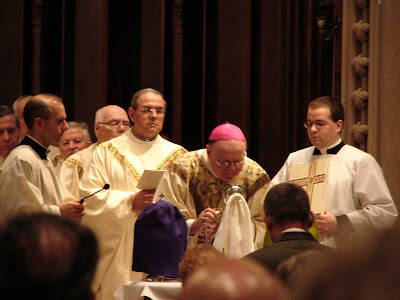
Bishop Coleman breathes into the vessel of Chrism
The Bishop breathes over the open vessel of Chrism.
He continues:
God, our maker, source of all growth in holiness accept the joyful thanks and praise we offer in the name of your Church. In the beginning, at your command, the earth produced fruit-bearing trees. From the fruit of the olive tree you have provided up with oil for holy chrism. The prophet David sang of the life and joy that the oil would bring us in the sacraments of your love. After the avenging flood, the dove, returning to Noah with an olive branch, announced your gift of peace. This was a sign of a greater giift to come. Now in the waters of baptism wash away the sins of men and by the anointing with oil make us radiant with your joy. At your command, Aaron was washed with water, and your servant Moses, his brother, anointed him priest. This, too, foreshadowed greater things to come. After your Son, Jesus Christ of Lord, asked John for baptism in the waters of Jordan, you sent the Spirit upon him in the form of a dove and by the witness of your own voice you declared him to be your only, well-beloved Son. In this you clearly fulfilled the prophecy of David, that Christ would be anointed with the oil of gladness beyond his fellow men.
All concelebrants extend their right hands toward the chrism in silence until the end of the prayer.
And so, Father, we ask you to bless + this oil you have created. Fill it with the power of your Holy Spirit through Christ your Son. It is from him that chrism takes its name and with chrism that you have anointed for yourself priests and kings, prophets and martyrs. Make this chrism a sign of life and salvation for those who are to be born again in the waters of baptism. Wash away the evil they have inherited from sinful Adam, and when they are anointed with this holy oil make them temples of your glory, radiant with the goodness of life that has its source in you. Through this sign of chrism grant them royal, priestly, and prophetic honor, and clothe them with incorruption. Let this be indeed the chrism of salvation for those who will be born again of water and the Holy Spirit. May they come to share eternal life in the glory of your kingdom. We ask this through Christ our Lord. Amen.
Monday, April 02, 2007
Have You Thanked A Priest Lately
On Holy Thursday we celebrate the institution of the Eucharist and also the institution of the priesthood. With that in mind, I would like to ask each of my readers to take some time out to thank their priests this week.
Priests are often taken for granted. They are often not given a second thought, until something happens and we call on them to celebrate the Sacrament of Anointing of the Sick or a Funeral Mass. Many priests give from themselves until they have nothing left to give, often to their own physical, spiritual, and psychological detriment.
In my years of ministry, both in parishes and in other means, I have worked with hundreds of priests. I have seen priests go without sleep for several days because they were at fire scenes comforting families who had lost their homes, and staying up all night with the dying. The next day, they had a full schedule of Masses, appointments, and other obligations to fulfill. All on no sleep.
These are things that parishioners are usually unaware of. Many priests also have obligations and duties outside of parish ministry. They may serve as directors of diocesan offices, or as pastor of more than one parish. In addition, to these responsibilities, they have familial obligations as well. Many priests have elderly parents who they are at least partially responsible for caring for. Parishioners are also usually unaware of these personal responsibilities. Priests are also responsible for their own personal health and well being. This requires time off for rest, exercise, spiritual care, and personal friendships. I have lost count of the number of times I have been out with a priest and heard people make rude comments to him such as, "Shouldn't you be praying for people, or something".
In my former job, we used to joke that we were the priests counseling service because so many priests would stop by just to sit and chat. They would laugh, joke, vent, and even cry with us. In that job, we were able to see the priest in a way that people often do not realize. We could see him as human.
This morning I was talking with some young people about the priesthood and one boy couldn't understand that priests had parents. I mean, he was completely confused by the idea. He seriously thought that priests we just placed on earth by God just as we see them. While I think all adults know that priests did not come about that way, it is often easy to forget that they are not a subspecies of human.
As Catholics, we expect the priest to minister to us. Take some time out this week, to minister to them. Do something nice for you priest. Remind him how much he is loved and appreciated.
Priests are often taken for granted. They are often not given a second thought, until something happens and we call on them to celebrate the Sacrament of Anointing of the Sick or a Funeral Mass. Many priests give from themselves until they have nothing left to give, often to their own physical, spiritual, and psychological detriment.
In my years of ministry, both in parishes and in other means, I have worked with hundreds of priests. I have seen priests go without sleep for several days because they were at fire scenes comforting families who had lost their homes, and staying up all night with the dying. The next day, they had a full schedule of Masses, appointments, and other obligations to fulfill. All on no sleep.
These are things that parishioners are usually unaware of. Many priests also have obligations and duties outside of parish ministry. They may serve as directors of diocesan offices, or as pastor of more than one parish. In addition, to these responsibilities, they have familial obligations as well. Many priests have elderly parents who they are at least partially responsible for caring for. Parishioners are also usually unaware of these personal responsibilities. Priests are also responsible for their own personal health and well being. This requires time off for rest, exercise, spiritual care, and personal friendships. I have lost count of the number of times I have been out with a priest and heard people make rude comments to him such as, "Shouldn't you be praying for people, or something".
In my former job, we used to joke that we were the priests counseling service because so many priests would stop by just to sit and chat. They would laugh, joke, vent, and even cry with us. In that job, we were able to see the priest in a way that people often do not realize. We could see him as human.
This morning I was talking with some young people about the priesthood and one boy couldn't understand that priests had parents. I mean, he was completely confused by the idea. He seriously thought that priests we just placed on earth by God just as we see them. While I think all adults know that priests did not come about that way, it is often easy to forget that they are not a subspecies of human.
As Catholics, we expect the priest to minister to us. Take some time out this week, to minister to them. Do something nice for you priest. Remind him how much he is loved and appreciated.
Tuesday, March 20, 2007
The Priest and the Actor
Everyone my age knows who Mark Walhberg is. We grew up listening to him sing in New Kids on the Block, and watched him drop from view, only to return as a model and finally as an actor. However, very few of us know that is was a priest who made the biggest difference in his life.
I have known Fr. Jim Flavin for many years, so I was one of the few who knew the story, but for the rest of you, here are some excerpts from a article in the Patriot-Ledger.
I have known Fr. Jim Flavin for many years, so I was one of the few who knew the story, but for the rest of you, here are some excerpts from a article in the Patriot-Ledger.
The Rev. Jim Flavin instantly recognized the voice on the phone. It was Mark Wahlberg, calling to ask the Brockton priest for guidance.
It was the night before the Oscars, and the tough-guy actor wanted help writing an acceptance speech in case he won the award for best supporting actor.
‘‘I told him to thank his family and God,’’ the Rev. Flavin said.
It was the same advice the priest gave Wahlberg 20 years ago when they first met.It was 2 a.m. in one of Boston’s toughest neighborhoods. Sheltered by darkness, youths were peddling drugs on a street corner. But that night they were being watched - not by undercover cops, but by a fearless young priest.
The gang was surprised when he marched up and demanded: ‘‘What the heck are you doing?’’
The Rev. Flavin, now pastor at St. Edith Stein Church in Brockton, remembers the moment well. It was his first encounter with Wahlberg, then 16.
That was 1987 in Dorchester - a far cry from the glamour of Hollywood, where Wahlberg was nominated last month for an Academy Award for his role in ‘‘The Departed.’’‘‘Father Flavin takes responsibility for saving my life,’’ Wahlberg said recently.
To Wahlberg, that’s no exaggeration. He was one of a group of hell-raising kids the priest dedicated himself to saving.
Wahlberg fought back tears as he described how the priest saved him from a life of crime.
‘‘It took me far too long to realize that the real heroes are there all the time. Where we grew up, we had a tendency to look for the wrong role models in the wrong places. But he helped us realize who the real heroes are. He is my hero, my mentor, my friend, my brother.‘‘He knows me better than anyone else. I can tell him anything. I can totally be myself. I also get to kick his ass at golf!’’
(...)
The actor is just one of countless youngsters whose lives have been turned around with help from the charismatic priest.
‘‘I used to go out when I was young, thinking I could change the world,’’ the Rev. Flavin said, remembering his days in Dorchester.
‘‘It was an area where the kids respected the priest. They all knew who the local priest was and were surprised to see me working at that time of night.’’
Before the Rev. Flavin’s intervention, Wahlberg’s rap sheet was long and getting longer.
‘‘I managed to get him off the streets and into the basketball team, which played in the Catholic church basketball league,’’ the Rev. Flavin recalled.
He remembers Wahlberg as a hothead who needed special attention.
‘‘Mark played basketball for us a lot. Every game a fight would break out and he was always at the center of it.
‘‘So I would hook him up with the coach that was from the inner city and who was brilliant at dealing with tough characters. It helped a lot.’’
(...)
Not all of his work has been blessed with success.
‘‘I have buried some of them because of drugs, and some are still in jail for murder,’’ he said.‘‘I just do my best and trust in God. My faith is at the center of it all. It shows me that everyone is redeemable and that everyone has value.’’
(...)
He (Fr. Flavin) also is one of two Brockton Police Department chaplains specializing in helping officers cope with tragedies they encounter on the job.
Police Chief William Conlon has known the Rev. Flavin for more than a decade and described him as ‘‘a great friend to everyone’’ at the station.
‘‘Father Jim reaches out to people,’’ Conlon said. ‘‘He doesn’t wait for you to come to him. If he thinks you need help, he is there offering it. He has been a great presence for our community.’’
Read the complete article here.
Friday, March 02, 2007
Look Out! The Meat Police are Coming for You
If you want a great laugh read Fr. Jay's post about joining the Meat Police.
Saturday, February 24, 2007
The Clericus Cup Begins Today
The first game, which will be held today, is between Pontifical International College Maria Mater Ecclesiae and Pontifical Gregorian University. Both seminaries are operated by religious orders. Mater Ecclesiae is operated by the Legionaries of Christ and the Gregorian is operated by the Society of Jesus (Jesuits).
The Pontifical North American College will not play until March 3rd when they face the Pontifical Urbanian University.
The tournament will end in June with the championship game.
Read the Catholic News report here.
and the Catholic World News report here.
The Pontifical North American College will not play until March 3rd when they face the Pontifical Urbanian University.
The tournament will end in June with the championship game.
Read the Catholic News report here.
and the Catholic World News report here.
Subscribe to:
Posts (Atom)