I have too much work to do right now to write my Spy Wednesday post, so it will remain trapped in my head.
I will let Clerical Whispers do the talking for me since his post is very similar to the one I intended to post.
Also, check out my post from last year which features Pope Benedict's thoughts on the Triduum.
Showing posts with label Lent. Show all posts
Showing posts with label Lent. Show all posts
Wednesday, March 19, 2008


Friday, February 08, 2008
Is Eating Meat on Friday a Mortal Sin?
One comment that I hear often during Lent is, "God won't send me to Hell because I ate meat."
The person who makes that statement is usually shocked when I respond by saying, "You know, I agree. You are right".
That usually gets their attention long enough, then catechesis begins.
First: God doesn't send anyone to Hell. We get their on our own.
Second: Eating meat on a Friday during Lent is not a sin, but the attitude of a Catholic who chooses to is.
Abstaining from meat is not a doctrine or a dogma of the Church. It is a practice much like priestly celibacy. The Church has chosen to enforce this practice because of the great benefit which it gives to individual Catholics and the Church as a whole. The Church has had 2,000 years to develop these practices. It doesn't create them on whims, serious thought and prayer goes into them.
So, where does sin come in? Simply put, the person sins by eating meat on a Friday during Lent because the individual presumes to know better than the Church. The Church has spent 2,000 years thinking about these topics. How much time have you spent? I thought so.
So, is it a mortal or a venial sin? Well, that depends on the attitude of the carnivore.
Basically what I want to say in this post is that it's not about meat at all. It's about denying ourselves, uniting with other Catholics in a common practice, and being obedient to Church law. There is so little that the Catholic Church requires of her members, not eating meat on 8 days isn't that much of a sacrifice. Just remember, you could be ordering a Ramadan meal or keeping Kosher all year long.
On a related note: Remember the Meat Police?
The person who makes that statement is usually shocked when I respond by saying, "You know, I agree. You are right".
That usually gets their attention long enough, then catechesis begins.
First: God doesn't send anyone to Hell. We get their on our own.
Second: Eating meat on a Friday during Lent is not a sin, but the attitude of a Catholic who chooses to is.
Abstaining from meat is not a doctrine or a dogma of the Church. It is a practice much like priestly celibacy. The Church has chosen to enforce this practice because of the great benefit which it gives to individual Catholics and the Church as a whole. The Church has had 2,000 years to develop these practices. It doesn't create them on whims, serious thought and prayer goes into them.
So, where does sin come in? Simply put, the person sins by eating meat on a Friday during Lent because the individual presumes to know better than the Church. The Church has spent 2,000 years thinking about these topics. How much time have you spent? I thought so.
So, is it a mortal or a venial sin? Well, that depends on the attitude of the carnivore.
Basically what I want to say in this post is that it's not about meat at all. It's about denying ourselves, uniting with other Catholics in a common practice, and being obedient to Church law. There is so little that the Catholic Church requires of her members, not eating meat on 8 days isn't that much of a sacrifice. Just remember, you could be ordering a Ramadan meal or keeping Kosher all year long.
On a related note: Remember the Meat Police?
Thursday, January 31, 2008
Hartford and Providence Dioceses Shift the Date of St. Patrick's Day And the Annunciation for 2008
The Vatican decided that due to conflicts in the Catholic Church's liturgical calendar in 2008 that the dates of the feasts of St. Joseph and of the Annunciation of the Lord will be moved. In 2008, if the feast of St. Joseph were to be celebrated as usual on March 19, it would fall on the Wednesday of Holy Week and if the feast of the Annunciation of the Lord were to be celebrated March 25, it would fall on the Tuesday during the octave of Easter.
While the two feasts are among the 14 solemnities marked with special care in the Catholic Church, they do not take precedence over the commemoration of Christ's suffering, death and resurrection. Therefore in 2008 the feast of St. Joseph will be celebrated March 15, the day before Palm Sunday, and the feast of the Annunciation will be celebrated March 31, the Monday after the second Sunday of Easter, which also is Divine Mercy Sunday.
Regarding the feast of St. Patrick:
The Bishop has agreed to join the Bishop of the Hartford Province and assign the optional memorial of St. Patrick to Friday, March, 14.
Inquiries have been received concerning the optional memorial for St. Patrick (March 17), which falls on the Monday of Holy Week. As a result of the above mentioned change for the Solemnity of St. Joseph, a memorial for St. Patrick may be celebrated on Friday, March 14. The Bishop is prepared to issue a dispensation for those celebrating this optional memorial Friday, March 14, which is a Friday during the Lenten Season. Any social activities taking place around the feast of St. Patrick should be most sensitive to the solemn nature of Holy Week which observes the Passion, Death, and Resurrection of the Lord.
It is the first time in almost 100 years that the feast of St Patrick will not be celebrated March 17. In 1913, the same conflict occurred, and in that case the church marked the feast April 1.
According to historians, March 17 is the traditional date given for the death of St. Patrick, and his feast has been celebrated on this day since the seventh century.
The next time St. Patrick's Day will fall during Holy Week will be 2160
While the two feasts are among the 14 solemnities marked with special care in the Catholic Church, they do not take precedence over the commemoration of Christ's suffering, death and resurrection. Therefore in 2008 the feast of St. Joseph will be celebrated March 15, the day before Palm Sunday, and the feast of the Annunciation will be celebrated March 31, the Monday after the second Sunday of Easter, which also is Divine Mercy Sunday.
Regarding the feast of St. Patrick:
The Bishop has agreed to join the Bishop of the Hartford Province and assign the optional memorial of St. Patrick to Friday, March, 14.
Inquiries have been received concerning the optional memorial for St. Patrick (March 17), which falls on the Monday of Holy Week. As a result of the above mentioned change for the Solemnity of St. Joseph, a memorial for St. Patrick may be celebrated on Friday, March 14. The Bishop is prepared to issue a dispensation for those celebrating this optional memorial Friday, March 14, which is a Friday during the Lenten Season. Any social activities taking place around the feast of St. Patrick should be most sensitive to the solemn nature of Holy Week which observes the Passion, Death, and Resurrection of the Lord.
It is the first time in almost 100 years that the feast of St Patrick will not be celebrated March 17. In 1913, the same conflict occurred, and in that case the church marked the feast April 1.
According to historians, March 17 is the traditional date given for the death of St. Patrick, and his feast has been celebrated on this day since the seventh century.
The next time St. Patrick's Day will fall during Holy Week will be 2160
Tuesday, January 29, 2008
Papal Lenten Message
Made public today was the 2008 Lenten Message of the Holy Father Benedict XVI. The text, dated 30 October 2007, has as its title a verse from St. Paul's Second Letter to the Corinthians: "Christ made Himself poor for you".
Extracts from the Message are given below:
"Each year, Lent offers us a providential opportunity to deepen the meaning and value of our Christian lives, and it stimulates us to rediscover the mercy of God so that we, in turn, become more merciful toward our brothers and sisters. In the Lenten period, the Church makes it her duty to propose some specific tasks that accompany the faithful concretely in this process of interior renewal: these are prayer, fasting and almsgiving. For this year's Lenten Message, I wish to spend some time reflecting on the practice of almsgiving, which represents a specific way to assist those in need and, at the same time, an exercise in self-denial to free us from attachment to worldly goods. The force of attraction to material riches and just how categorical our decision must be not to make of them an idol, Jesus confirms in a resolute way: 'You cannot serve God and mammon'.
"Almsgiving helps us to overcome this constant temptation, teaching us to respond to our neighbour's needs and to share with others whatever we possess through divine goodness. This is the aim of the special collections in favour of the poor, which are promoted during Lent in many parts of the world. In this way, inward cleansing is accompanied by a gesture of ecclesial communion, mirroring what already took place in the early Church.
"According to the teaching of the Gospel, we are not owners but rather administrators of the goods we possess: these, then, are not to be considered as our exclusive possession, but means through which the Lord calls each one of us to act as a steward of His providence for our neighbour".
"In the Gospel, Jesus explicitly admonishes the one who possesses and uses earthly riches only for self. ... In those countries whose population is majority Christian, the call to share is even more urgent, since their responsibility toward the many who suffer poverty and abandonment is even greater. To come to their aid is a duty of justice even prior to being an act of charity.
"The Gospel highlights a typical feature of Christian almsgiving: it must be hidden. ... This understanding, dear brothers and sisters, must accompany every gesture of help to our neighbour, avoiding that it becomes a means to make ourselves the centre of attention".
"In today's world of images, attentive vigilance is required, since this temptation is great. Almsgiving, according to the Gospel, is not mere philanthropy: rather it is a concrete expression of charity, a theological virtue that demands interior conversion to love of God and neighbour, in imitation of Jesus Christ".
"In inviting us to consider almsgiving with a more profound gaze that transcends the purely material dimension, Scripture teaches us that there is more joy in giving than in receiving. ... Every time when, for love of God, we share our goods with our neighbour in need, we discover that the fullness of life comes from love and all is returned to us as a blessing in the form of peace, inner satisfaction and joy".
"What is more: St. Peter includes among the spiritual fruits of almsgiving the forgiveness of sins. ... As the Lenten liturgy frequently repeats, God offers to us sinners the possibility of being forgiven. The fact of sharing what we possess with the poor disposes us to receive such a gift".
"Almsgiving teaches us the generosity of love. ... In this regard, all the more significant is the Gospel story of the widow who, out of poverty, cast into the Temple treasury 'all she had to live on'".
We find this moving passage inserted in the description of the days that immediately precede Jesus' passion and death, who, as St. Paul writes, made Himself poor to enrich us out of His poverty; He gave His entire Self for us. Lent, also through the practice of almsgiving, inspires us to follow His example. In His school, we can learn to make of our lives a total gift; imitating Him, we are able to make ourselves available, not so much in giving part of what we possess, but our very selves. Cannot the entire Gospel be summarised perhaps in the one commandment of love? The Lenten practice of almsgiving thus become a means to deepen our Christian vocation. In gratuitously offering himself, the Christian bears witness that it is love and not material richness that determines the laws of his existence, Love, then, gives almsgiving its true value; it inspires various forms of giving, according to the possibilities and conditions of each person".
VIS
Here is the complete message:
MESSAGE OF HIS HOLINESS
BENEDICT XVI
FOR LENT 2008
“Christ made Himself poor for you” (2 Cor 8,9)
Dear Brothers and Sisters!
1. Each year, Lent offers us a providential opportunity to deepen the meaning and value of our Christian lives, and it stimulates us to rediscover the mercy of God so that we, in turn, become more merciful toward our brothers and sisters. In the Lenten period, the Church makes it her duty to propose some specific tasks that accompany the faithful concretely in this process of interior renewal: these are prayer, fasting and almsgiving. For this year’s Lenten Message, I wish to spend some time reflecting on the practice of almsgiving, which represents a specific way to assist those in need and, at the same time, an exercise in self-denial to free us from attachment to worldly goods. The force of attraction to material riches and just how categorical our decision must be not to make of them an idol, Jesus confirms in a resolute way: “You cannot serve God and mammon” (Lk 16,13). Almsgiving helps us to overcome this constant temptation, teaching us to respond to our neighbor’s needs and to share with others whatever we possess through divine goodness. This is the aim of the special collections in favor of the poor, which are promoted during Lent in many parts of the world. In this way, inward cleansing is accompanied by a gesture of ecclesial communion, mirroring what already took place in the early Church. In his Letters, Saint Paul speaks of this in regard to the collection for the Jerusalem community (cf. 2 Cor 8-9; Rm 15, 25-27).
2. According to the teaching of the Gospel, we are not owners but rather administrators of the goods we possess: these, then, are not to be considered as our exclusive possession, but means through which the Lord calls each one of us to act as a steward of His providence for our neighbor. As the Catechism of the Catholic Church reminds us, material goods bear a social value, according to the principle of their universal destination (cf. n. 2404)
In the Gospel, Jesus explicitly admonishes the one who possesses and uses earthly riches only for self. In the face of the multitudes, who, lacking everything, suffer hunger, the words of Saint John acquire the tone of a ringing rebuke: “How does God’s love abide in anyone who has the world’s goods and sees a brother or sister in need and yet refuses to help?” (1 Jn 3,17). In those countries whose population is majority Christian, the call to share is even more urgent, since their responsibility toward the many who suffer poverty and abandonment is even greater. To come to their aid is a duty of justice even prior to being an act of charity.
3. The Gospel highlights a typical feature of Christian almsgiving: it must be hidden: “Do not let your left hand know what your right hand is doing,” Jesus asserts, “so that your alms may be done in secret” (Mt 6,3-4). Just a short while before, He said not to boast of one’s own good works so as not to risk being deprived of the heavenly reward (cf. Mt 6,1-2). The disciple is to be concerned with God’s greater glory. Jesus warns: “In this way, let your light shine before others, so that they may see your good works and give glory to your Father in heaven” (Mt 5,16). Everything, then, must be done for God’s glory and not our own. This understanding, dear brothers and sisters, must accompany every gesture of help to our neighbor, avoiding that it becomes a means to make ourselves the center of attention. If, in accomplishing a good deed, we do not have as our goal God’s glory and the real well being of our brothers and sisters, looking rather for a return of personal interest or simply of applause, we place ourselves outside of the Gospel vision. In today’s world of images, attentive vigilance is required, since this temptation is great. Almsgiving, according to the Gospel, is not mere philanthropy: rather it is a concrete expression of charity, a theological virtue that demands interior conversion to love of God and neighbor, in imitation of Jesus Christ, who, dying on the cross, gave His entire self for us. How could we not thank God for the many people who silently, far from the gaze of the media world, fulfill, with this spirit, generous actions in support of one’s neighbor in difficulty? There is little use in giving one’s personal goods to others if it leads to a heart puffed up in vainglory: for this reason, the one, who knows that God “sees in secret” and in secret will reward, does not seek human recognition for works of mercy.
4. In inviting us to consider almsgiving with a more profound gaze that transcends the purely material dimension, Scripture teaches us that there is more joy in giving than in receiving (cf. Acts 20,35). When we do things out of love, we express the truth of our being; indeed, we have been created not for ourselves but for God and our brothers and sisters (cf. 2 Cor 5,15). Every time when, for love of God, we share our goods with our neighbor in need, we discover that the fullness of life comes from love and all is returned to us as a blessing in the form of peace, inner satisfaction and joy. Our Father in heaven rewards our almsgiving with His joy. What is more: Saint Peter includes among the spiritual fruits of almsgiving the forgiveness of sins: “Charity,” he writes, “covers a multitude of sins” (1 Pt 4,8). As the Lenten liturgy frequently repeats, God offers to us sinners the possibility of being forgiven. The fact of sharing with the poor what we possess disposes us to receive such a gift. In this moment, my thought turns to those who realize the weight of the evil they have committed and, precisely for this reason, feel far from God, fearful and almost incapable of turning to Him. By drawing close to others through almsgiving, we draw close to God; it can become an instrument for authentic conversion and reconciliation with Him and our brothers.
5. Almsgiving teaches us the generosity of love. Saint Joseph Benedict Cottolengo forthrightly recommends: “Never keep an account of the coins you give, since this is what I always say: if, in giving alms, the left hand is not to know what the right hand is doing, then the right hand, too, should not know what it does itself” (Detti e pensieri, Edilibri, n. 201). In this regard, all the more significant is the Gospel story of the widow who, out of her poverty, cast into the Temple treasury “all she had to live on” (Mk 12,44). Her tiny and insignificant coin becomes an eloquent symbol: this widow gives to God not out of her abundance, not so much what she has, but what she is. Her entire self.
We find this moving passage inserted in the description of the days that immediately precede Jesus’ passion and death, who, as Saint Paul writes, made Himself poor to enrich us out of His poverty (cf. 2 Cor 8,9); He gave His entire self for us. Lent, also through the practice of almsgiving, inspires us to follow His example. In His school, we can learn to make of our lives a total gift; imitating Him, we are able to make ourselves available, not so much in giving a part of what we possess, but our very selves. Cannot the entire Gospel be summarized perhaps in the one commandment of love? The Lenten practice of almsgiving thus becomes a means to deepen our Christian vocation. In gratuitously offering himself, the Christian bears witness that it is love and not material richness that determines the laws of his existence. Love, then, gives almsgiving its value; it inspires various forms of giving, according to the possibilities and conditions of each person.
6. Dear brothers and sisters, Lent invites us to “train ourselves” spiritually, also through the practice of almsgiving, in order to grow in charity and recognize in the poor Christ Himself. In the Acts of the Apostles, we read that the Apostle Peter said to the cripple who was begging alms at the Temple gate: “I have no silver or gold, but what I have I give you; in the name of Jesus Christ the Nazarene, walk” (Acts 3,6). In giving alms, we offer something material, a sign of the greater gift that we can impart to others through the announcement and witness of Christ, in whose name is found true life. Let this time, then, be marked by a personal and community effort of attachment to Christ in order that we may be witnesses of His love. May Mary, Mother and faithful Servant of the Lord, help believers to enter the “spiritual battle” of Lent, armed with prayer, fasting and the practice of almsgiving, so as to arrive at the celebration of the Easter Feasts, renewed in spirit. With these wishes, I willingly impart to all my Apostolic Blessing.
From the Vatican, 30 October 2007
BENEDICTUS PP. XVI
Extracts from the Message are given below:
"Each year, Lent offers us a providential opportunity to deepen the meaning and value of our Christian lives, and it stimulates us to rediscover the mercy of God so that we, in turn, become more merciful toward our brothers and sisters. In the Lenten period, the Church makes it her duty to propose some specific tasks that accompany the faithful concretely in this process of interior renewal: these are prayer, fasting and almsgiving. For this year's Lenten Message, I wish to spend some time reflecting on the practice of almsgiving, which represents a specific way to assist those in need and, at the same time, an exercise in self-denial to free us from attachment to worldly goods. The force of attraction to material riches and just how categorical our decision must be not to make of them an idol, Jesus confirms in a resolute way: 'You cannot serve God and mammon'.
"Almsgiving helps us to overcome this constant temptation, teaching us to respond to our neighbour's needs and to share with others whatever we possess through divine goodness. This is the aim of the special collections in favour of the poor, which are promoted during Lent in many parts of the world. In this way, inward cleansing is accompanied by a gesture of ecclesial communion, mirroring what already took place in the early Church.
"According to the teaching of the Gospel, we are not owners but rather administrators of the goods we possess: these, then, are not to be considered as our exclusive possession, but means through which the Lord calls each one of us to act as a steward of His providence for our neighbour".
"In the Gospel, Jesus explicitly admonishes the one who possesses and uses earthly riches only for self. ... In those countries whose population is majority Christian, the call to share is even more urgent, since their responsibility toward the many who suffer poverty and abandonment is even greater. To come to their aid is a duty of justice even prior to being an act of charity.
"The Gospel highlights a typical feature of Christian almsgiving: it must be hidden. ... This understanding, dear brothers and sisters, must accompany every gesture of help to our neighbour, avoiding that it becomes a means to make ourselves the centre of attention".
"In today's world of images, attentive vigilance is required, since this temptation is great. Almsgiving, according to the Gospel, is not mere philanthropy: rather it is a concrete expression of charity, a theological virtue that demands interior conversion to love of God and neighbour, in imitation of Jesus Christ".
"In inviting us to consider almsgiving with a more profound gaze that transcends the purely material dimension, Scripture teaches us that there is more joy in giving than in receiving. ... Every time when, for love of God, we share our goods with our neighbour in need, we discover that the fullness of life comes from love and all is returned to us as a blessing in the form of peace, inner satisfaction and joy".
"What is more: St. Peter includes among the spiritual fruits of almsgiving the forgiveness of sins. ... As the Lenten liturgy frequently repeats, God offers to us sinners the possibility of being forgiven. The fact of sharing what we possess with the poor disposes us to receive such a gift".
"Almsgiving teaches us the generosity of love. ... In this regard, all the more significant is the Gospel story of the widow who, out of poverty, cast into the Temple treasury 'all she had to live on'".
We find this moving passage inserted in the description of the days that immediately precede Jesus' passion and death, who, as St. Paul writes, made Himself poor to enrich us out of His poverty; He gave His entire Self for us. Lent, also through the practice of almsgiving, inspires us to follow His example. In His school, we can learn to make of our lives a total gift; imitating Him, we are able to make ourselves available, not so much in giving part of what we possess, but our very selves. Cannot the entire Gospel be summarised perhaps in the one commandment of love? The Lenten practice of almsgiving thus become a means to deepen our Christian vocation. In gratuitously offering himself, the Christian bears witness that it is love and not material richness that determines the laws of his existence, Love, then, gives almsgiving its true value; it inspires various forms of giving, according to the possibilities and conditions of each person".
VIS
Here is the complete message:
BENEDICT XVI
FOR LENT 2008
“Christ made Himself poor for you” (2 Cor 8,9)
Dear Brothers and Sisters!
1. Each year, Lent offers us a providential opportunity to deepen the meaning and value of our Christian lives, and it stimulates us to rediscover the mercy of God so that we, in turn, become more merciful toward our brothers and sisters. In the Lenten period, the Church makes it her duty to propose some specific tasks that accompany the faithful concretely in this process of interior renewal: these are prayer, fasting and almsgiving. For this year’s Lenten Message, I wish to spend some time reflecting on the practice of almsgiving, which represents a specific way to assist those in need and, at the same time, an exercise in self-denial to free us from attachment to worldly goods. The force of attraction to material riches and just how categorical our decision must be not to make of them an idol, Jesus confirms in a resolute way: “You cannot serve God and mammon” (Lk 16,13). Almsgiving helps us to overcome this constant temptation, teaching us to respond to our neighbor’s needs and to share with others whatever we possess through divine goodness. This is the aim of the special collections in favor of the poor, which are promoted during Lent in many parts of the world. In this way, inward cleansing is accompanied by a gesture of ecclesial communion, mirroring what already took place in the early Church. In his Letters, Saint Paul speaks of this in regard to the collection for the Jerusalem community (cf. 2 Cor 8-9; Rm 15, 25-27).
2. According to the teaching of the Gospel, we are not owners but rather administrators of the goods we possess: these, then, are not to be considered as our exclusive possession, but means through which the Lord calls each one of us to act as a steward of His providence for our neighbor. As the Catechism of the Catholic Church reminds us, material goods bear a social value, according to the principle of their universal destination (cf. n. 2404)
In the Gospel, Jesus explicitly admonishes the one who possesses and uses earthly riches only for self. In the face of the multitudes, who, lacking everything, suffer hunger, the words of Saint John acquire the tone of a ringing rebuke: “How does God’s love abide in anyone who has the world’s goods and sees a brother or sister in need and yet refuses to help?” (1 Jn 3,17). In those countries whose population is majority Christian, the call to share is even more urgent, since their responsibility toward the many who suffer poverty and abandonment is even greater. To come to their aid is a duty of justice even prior to being an act of charity.
3. The Gospel highlights a typical feature of Christian almsgiving: it must be hidden: “Do not let your left hand know what your right hand is doing,” Jesus asserts, “so that your alms may be done in secret” (Mt 6,3-4). Just a short while before, He said not to boast of one’s own good works so as not to risk being deprived of the heavenly reward (cf. Mt 6,1-2). The disciple is to be concerned with God’s greater glory. Jesus warns: “In this way, let your light shine before others, so that they may see your good works and give glory to your Father in heaven” (Mt 5,16). Everything, then, must be done for God’s glory and not our own. This understanding, dear brothers and sisters, must accompany every gesture of help to our neighbor, avoiding that it becomes a means to make ourselves the center of attention. If, in accomplishing a good deed, we do not have as our goal God’s glory and the real well being of our brothers and sisters, looking rather for a return of personal interest or simply of applause, we place ourselves outside of the Gospel vision. In today’s world of images, attentive vigilance is required, since this temptation is great. Almsgiving, according to the Gospel, is not mere philanthropy: rather it is a concrete expression of charity, a theological virtue that demands interior conversion to love of God and neighbor, in imitation of Jesus Christ, who, dying on the cross, gave His entire self for us. How could we not thank God for the many people who silently, far from the gaze of the media world, fulfill, with this spirit, generous actions in support of one’s neighbor in difficulty? There is little use in giving one’s personal goods to others if it leads to a heart puffed up in vainglory: for this reason, the one, who knows that God “sees in secret” and in secret will reward, does not seek human recognition for works of mercy.
4. In inviting us to consider almsgiving with a more profound gaze that transcends the purely material dimension, Scripture teaches us that there is more joy in giving than in receiving (cf. Acts 20,35). When we do things out of love, we express the truth of our being; indeed, we have been created not for ourselves but for God and our brothers and sisters (cf. 2 Cor 5,15). Every time when, for love of God, we share our goods with our neighbor in need, we discover that the fullness of life comes from love and all is returned to us as a blessing in the form of peace, inner satisfaction and joy. Our Father in heaven rewards our almsgiving with His joy. What is more: Saint Peter includes among the spiritual fruits of almsgiving the forgiveness of sins: “Charity,” he writes, “covers a multitude of sins” (1 Pt 4,8). As the Lenten liturgy frequently repeats, God offers to us sinners the possibility of being forgiven. The fact of sharing with the poor what we possess disposes us to receive such a gift. In this moment, my thought turns to those who realize the weight of the evil they have committed and, precisely for this reason, feel far from God, fearful and almost incapable of turning to Him. By drawing close to others through almsgiving, we draw close to God; it can become an instrument for authentic conversion and reconciliation with Him and our brothers.
5. Almsgiving teaches us the generosity of love. Saint Joseph Benedict Cottolengo forthrightly recommends: “Never keep an account of the coins you give, since this is what I always say: if, in giving alms, the left hand is not to know what the right hand is doing, then the right hand, too, should not know what it does itself” (Detti e pensieri, Edilibri, n. 201). In this regard, all the more significant is the Gospel story of the widow who, out of her poverty, cast into the Temple treasury “all she had to live on” (Mk 12,44). Her tiny and insignificant coin becomes an eloquent symbol: this widow gives to God not out of her abundance, not so much what she has, but what she is. Her entire self.
We find this moving passage inserted in the description of the days that immediately precede Jesus’ passion and death, who, as Saint Paul writes, made Himself poor to enrich us out of His poverty (cf. 2 Cor 8,9); He gave His entire self for us. Lent, also through the practice of almsgiving, inspires us to follow His example. In His school, we can learn to make of our lives a total gift; imitating Him, we are able to make ourselves available, not so much in giving a part of what we possess, but our very selves. Cannot the entire Gospel be summarized perhaps in the one commandment of love? The Lenten practice of almsgiving thus becomes a means to deepen our Christian vocation. In gratuitously offering himself, the Christian bears witness that it is love and not material richness that determines the laws of his existence. Love, then, gives almsgiving its value; it inspires various forms of giving, according to the possibilities and conditions of each person.
6. Dear brothers and sisters, Lent invites us to “train ourselves” spiritually, also through the practice of almsgiving, in order to grow in charity and recognize in the poor Christ Himself. In the Acts of the Apostles, we read that the Apostle Peter said to the cripple who was begging alms at the Temple gate: “I have no silver or gold, but what I have I give you; in the name of Jesus Christ the Nazarene, walk” (Acts 3,6). In giving alms, we offer something material, a sign of the greater gift that we can impart to others through the announcement and witness of Christ, in whose name is found true life. Let this time, then, be marked by a personal and community effort of attachment to Christ in order that we may be witnesses of His love. May Mary, Mother and faithful Servant of the Lord, help believers to enter the “spiritual battle” of Lent, armed with prayer, fasting and the practice of almsgiving, so as to arrive at the celebration of the Easter Feasts, renewed in spirit. With these wishes, I willingly impart to all my Apostolic Blessing.
From the Vatican, 30 October 2007
Wednesday, June 06, 2007
Tenebrae
I have a large number of great videos to post so please bear with me. Here is an awesome video of Tenebrae at the Dominican House of Studies. It's only three minutes long. It isn't of the entire service, but fr those who have never attended Tenebrae, it will give an idea of what the service is like. If nothing else, it is worth watching simply for the Gregorian chant however, I am dissapointed that the strepitus was not included in the video.
Friday, April 06, 2007
A Pilgrimage of Faith
The Romeiros are one of the more unique Good Friday traditions here in Fall River. Romeiro is a Portugese word which means pilgrim. The tradition began in the Azores on the island of São Miguel. In 1522, Vila Franca do Campo, the capital at the time, was nearly destroyed by an earthquake and subsequent volcanic eruption. 4,000 of the town's 4,500 residents were killed. 40 years later, the volcano erupted again.
The earliest records of the Good Friday Romeiros date back to those events. The original romeiros were men who travel by foot around the island praying and visiting various churches. They prayed for an end to the disasters and for God to help them and their families deal with the great tragedies.
The tradition still exists as these men spend Holy Week on this pilgrimage. They are offered shelter and food in private homes and churches.
Here in the United States, the pilgrimage has been modified. Rather than lasting 8 days, the pilgrimage takes place early in the morning on Good Friday. Wearing the tratidional attire of blankets and colorful scarves, and carrying long metal tipped walking sticks, they walk through the city praying the rosary and visiting the many Catholic Churches in the city. The pilgrimage is also no long restricted to men. Many women and children take part now. While in the past the women had followed behind the men, women are now also joining the men.
The rosary and all the prayers are chanted with the mestre (leader) leading the litanies and prayers and the rest of the romeiros called irmãos (brothers) responding. Their chant is hauntingly beautiful and has changed little over the last hundred years.
In my city, the romeiros begin their procession at 7 a.m. They walk from church to church and stop at the Cathedral, where they are met by the bishop, around noon. The bishop gives a brief address and blessing to all the pilgrims.
They return to the church where they began their pilgrimage in time for the 7 p.m. Good Friday Liturgy. The Liturgy ends with the procession and burial of Christ. A statue of the dead Christ is placed in an crib-like "casket" and is carried through the streets with everyone from the church following. Two women from the parish are selected to portray the Virgin Mary and Mary Magdelene. Another woman portrays Veronica. At three points along the way, the clacker which was used at the consecration of the Mass on Holy Thursday is sounded. The procession stops as "Veronica" sings from the front porch of one of the homes. She raises the veil with the image of Jesus' face and sings, "Look! Look at the face of Jesus. Look, Look at what they have done to Him!..."
Many women and even men are brought to tears during this procession.
When the procession returns to the church, the statue of Christ is placed in the tomb.
These are the traditions which I was raised with. I was lucky enough to grow up at the parish which is homebase for the romeiros. I have walked with them on their amazing pilgrimage and I was shocked that it wasn't as grueling to complete as I expected. Of course, after it was over I was in pain. I hope these rich traditions are kept alive by the younger generations.
Here is a slideshow with some great pictures from today's pilgrimage.
The earliest records of the Good Friday Romeiros date back to those events. The original romeiros were men who travel by foot around the island praying and visiting various churches. They prayed for an end to the disasters and for God to help them and their families deal with the great tragedies.
The tradition still exists as these men spend Holy Week on this pilgrimage. They are offered shelter and food in private homes and churches.
Here in the United States, the pilgrimage has been modified. Rather than lasting 8 days, the pilgrimage takes place early in the morning on Good Friday. Wearing the tratidional attire of blankets and colorful scarves, and carrying long metal tipped walking sticks, they walk through the city praying the rosary and visiting the many Catholic Churches in the city. The pilgrimage is also no long restricted to men. Many women and children take part now. While in the past the women had followed behind the men, women are now also joining the men.
The rosary and all the prayers are chanted with the mestre (leader) leading the litanies and prayers and the rest of the romeiros called irmãos (brothers) responding. Their chant is hauntingly beautiful and has changed little over the last hundred years.
In my city, the romeiros begin their procession at 7 a.m. They walk from church to church and stop at the Cathedral, where they are met by the bishop, around noon. The bishop gives a brief address and blessing to all the pilgrims.
They return to the church where they began their pilgrimage in time for the 7 p.m. Good Friday Liturgy. The Liturgy ends with the procession and burial of Christ. A statue of the dead Christ is placed in an crib-like "casket" and is carried through the streets with everyone from the church following. Two women from the parish are selected to portray the Virgin Mary and Mary Magdelene. Another woman portrays Veronica. At three points along the way, the clacker which was used at the consecration of the Mass on Holy Thursday is sounded. The procession stops as "Veronica" sings from the front porch of one of the homes. She raises the veil with the image of Jesus' face and sings, "Look! Look at the face of Jesus. Look, Look at what they have done to Him!..."
Many women and even men are brought to tears during this procession.
When the procession returns to the church, the statue of Christ is placed in the tomb.
These are the traditions which I was raised with. I was lucky enough to grow up at the parish which is homebase for the romeiros. I have walked with them on their amazing pilgrimage and I was shocked that it wasn't as grueling to complete as I expected. Of course, after it was over I was in pain. I hope these rich traditions are kept alive by the younger generations.
Here is a slideshow with some great pictures from today's pilgrimage.
Why Good Friday
Today we celebrate Good Friday. One question which I am asked nearly every year at this time is, "Why is it 'Good' Friday?" The technical answer to that question is, "It isn't". I am sure right now you are saying, "what do you mean, I've been calling it Good Friday all these years. Of course it is Good Friday." Yes, we call it Good Friday, but a true translation of the Latin is Holy Friday. That is what people in countries such as Italy, Spain and Portugal call it.
Ok, I know that doesn't answer the question of why we call it Good Friday. Despite the poor translation, Good Friday is an appropriate title for today. Good Friday is a term which reminds us that the Christian view is different from that of the rest of the world. I am reminded of St. Paul words in 1 Cor. 1:18-25.
This day is known by several titles, Good Friday, Holy Friday, Mourning Friday in Germany, and Great Friday by the Orthodox and Eastern Rite Churches. Each of these titles focuses on a different part of the mystery.
Ok, I know that doesn't answer the question of why we call it Good Friday. Despite the poor translation, Good Friday is an appropriate title for today. Good Friday is a term which reminds us that the Christian view is different from that of the rest of the world. I am reminded of St. Paul words in 1 Cor. 1:18-25.
The message of the cross is foolishness to those who are perishing, but to us who are being saved it is the power of God. For it is written: "I will destroy the wisdom of the wise, and the learning of the learned I will set aside." Where is the wise one? Where is the scribe? Where is the debater of this age? Has not God made the wisdom of the world foolish? For since in the wisdom of God the world did not come to know God through wisdom, it was the will of God through the foolishness of the proclamation to save those who have faith. For Jews demand signs and Greeks look for wisdom, but we proclaim Christ crucified, a stumbling block to Jews and foolishness to Gentiles, but to those who are called, Jews and Greeks alike, Christ the power of God and the wisdom of God. For the foolishness of God is wiser than human wisdom, and the weakness of God is stronger than human strength.Those who cannot see what it good about Good Friday are missing the complete story. During the crucifixion, I am sure the apostles could not imagine that they day would be called Good Friday. I am sure they couldn't see anything good about it. They watched Our Lord suffer and die in such a horrific manner. But, just like today's Liturgy, the story didn't end on Good Friday. On Easter Sunday Jesus conquered death and rose from the grave. Unlike the apostles during the crucifixion, we know the rest of the story. Therefore, while we mourn because Jesus suffered to save us from our sins, we also rejoice as we look forward to Easter.
This day is known by several titles, Good Friday, Holy Friday, Mourning Friday in Germany, and Great Friday by the Orthodox and Eastern Rite Churches. Each of these titles focuses on a different part of the mystery.
Thursday, April 05, 2007
The Chrism Mass
As I mentioned in my previous post, the Chrism Mass was celebrated in my diocese on Tuesday.
The Chrism Mass may only be celebrated by a bishop since while any priest can bless the Oil of the Sick and Oil of Catechumens, only a bishop can consecrate Sacred Chrism.
Nearly all the priests from the diocese and a large number of deacons attended the Mass. The cathedral was nearly filled to capacity.
Bishop Coleman's homily was based on Pope Benedict's comments that the Eucharist must always remain central in the lives of priests.
Following the homily, the priests renewed their priestly commitment:
This renewal of commitment is a beautiful ceremony which reminds us to the importance, and fragility of the priesthood. The priestly commitment is not a one time commitment, it must be renewed each day and in each moment. Likewise, we must commit to support our priests through prayer and temporal support.
The Oil of the Sick is blessed during the Eucharistic Prayer, just before the Doxology.
Then he says:
The Bishop breathes over the open vessel of Chrism.
He continues:
All concelebrants extend their right hands toward the chrism in silence until the end of the prayer.
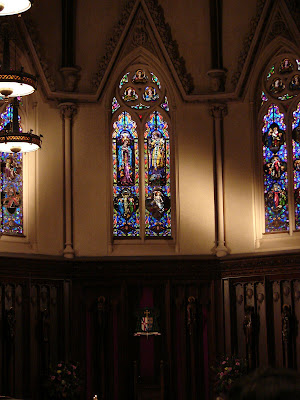
The sanctuary of the cathedral
The Chrism Mass may only be celebrated by a bishop since while any priest can bless the Oil of the Sick and Oil of Catechumens, only a bishop can consecrate Sacred Chrism.
Nearly all the priests from the diocese and a large number of deacons attended the Mass. The cathedral was nearly filled to capacity.

Bishop Coleman delivers his homily
Bishop Coleman's homily was based on Pope Benedict's comments that the Eucharist must always remain central in the lives of priests.
Following the homily, the priests renewed their priestly commitment:
Bishop: My brothers, today we celebrate the memory of that first Eucharist at which our Lord Jesus Christ shared with His apostles and with us His call to the priestly service of His Church. Now, in the presence of your bishop and God's holy people, are you ready to renew your own dedication to Christ as priests of His new covenant?
Priests: I am.
Bishop: At your ordination you accepted the responsibilites of the priesthood out of love for the Lord Jesus and His Church. Are you resolved to unite yourselves more closely to Christ and try to become more like Him by joyfully sacrificing your own pleasure and ambition to being His peace and love to your brothers and sisters?
Priests: I am.
Bishop: Are you resolved to be faithful ministers of the mysteries of God, to celebrate the Eucharist and other liturgical services with sincere devotion? Are you resolved to imitate Jesus Christ, the head and shepherd of the Church, by teaching the Christian faith without thinking of your own profit, solely for the well-being of the people you were sent to serve.
Priests: I am.
The bishop now addresses the people:
Bishop: My brothers and sisters, pray for your priests. Ask the Lord to bless them with the fullness of His Love, to help them be faithful ministers of Christ, the high priest, so that they will be able to lead you to Him, the fountain of your salvation.
People: Lord, Jesus Christ, hear us and answer our prayer.
Bishop: Pray also for me, that despite my own unworthiness, I may faithfully fulfill the office of apostle which Jesus Christ has entrusted to me. Pray that I may become more like our High Priest and Good Shepherd. the Teacher and Servant of all, and so become a genuile sign of Christ's loving presence among you.
People: Lord, Jesus Christ, hear us and answer our prayer.
This renewal of commitment is a beautiful ceremony which reminds us to the importance, and fragility of the priesthood. The priestly commitment is not a one time commitment, it must be renewed each day and in each moment. Likewise, we must commit to support our priests through prayer and temporal support.

The three vessels of oil before being blessed.
Purple = Sick
White = Chrism
Green = Catechumens
The balsam is in the glass cruet on the right.
The Oil of the Sick is blessed during the Eucharistic Prayer, just before the Doxology.
The bishop says: God of all consolation, you chose and sent your Son to heal the world. Graciously listen to our prayer of faith: send the power of your Holy Spirit, the Consoler, into this precious oil, this soothing ointment, this rich gift, this fruit of the earth. Bless + this oil and sanctify it for our use. Make this oil a remedy for all who are anointed with it; heal them in body, in soul, and in spirit, and deliver them from every affliction. We ask this through Jesus Christ, you Son, who lives and reigns with you and the Holy Spirit, one God, forever and ever. Amen.After Communion, the bishop blesses the Oil of Catechumens saying:
Blessing the Oil of Catechumens

Then the olive oil which will become Chrism is uncovered. The Bishop pours balsam into the oil.Lord, protector of all who believe in you bless + this oil and give wisdom and strength to all who are anointed with it in preparation for their baptism. Bring them to a deeper understanding of the gospel, help them to accept the challenge of Christian living, and lead them to the joy of new birth in the family of your Church. We ask this through Christ, our Lord. Amen.

Adding balsam to the olive oil
Then he says:
Let us pray that God, our almighty Father, will bless this oil so that all who are anointed with it may be inwardly transformed and come to share in eternal salvation.
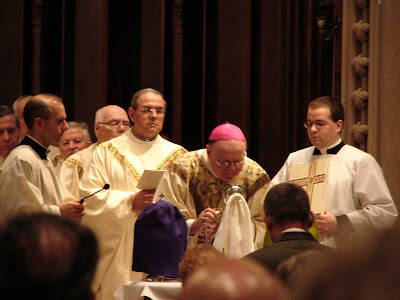
Bishop Coleman breathes into the vessel of Chrism
The Bishop breathes over the open vessel of Chrism.
He continues:
God, our maker, source of all growth in holiness accept the joyful thanks and praise we offer in the name of your Church. In the beginning, at your command, the earth produced fruit-bearing trees. From the fruit of the olive tree you have provided up with oil for holy chrism. The prophet David sang of the life and joy that the oil would bring us in the sacraments of your love. After the avenging flood, the dove, returning to Noah with an olive branch, announced your gift of peace. This was a sign of a greater giift to come. Now in the waters of baptism wash away the sins of men and by the anointing with oil make us radiant with your joy. At your command, Aaron was washed with water, and your servant Moses, his brother, anointed him priest. This, too, foreshadowed greater things to come. After your Son, Jesus Christ of Lord, asked John for baptism in the waters of Jordan, you sent the Spirit upon him in the form of a dove and by the witness of your own voice you declared him to be your only, well-beloved Son. In this you clearly fulfilled the prophecy of David, that Christ would be anointed with the oil of gladness beyond his fellow men.
All concelebrants extend their right hands toward the chrism in silence until the end of the prayer.
And so, Father, we ask you to bless + this oil you have created. Fill it with the power of your Holy Spirit through Christ your Son. It is from him that chrism takes its name and with chrism that you have anointed for yourself priests and kings, prophets and martyrs. Make this chrism a sign of life and salvation for those who are to be born again in the waters of baptism. Wash away the evil they have inherited from sinful Adam, and when they are anointed with this holy oil make them temples of your glory, radiant with the goodness of life that has its source in you. Through this sign of chrism grant them royal, priestly, and prophetic honor, and clothe them with incorruption. Let this be indeed the chrism of salvation for those who will be born again of water and the Holy Spirit. May they come to share eternal life in the glory of your kingdom. We ask this through Christ our Lord. Amen.
Holy Thursday
Today, we celebrate Holy Thursday. The Sacred Triduum begins at sundown with the celebration of the Mass of the Lord's Supper. It is the only Mass celebrated today, with the exception of the Chrism Mass.
In my diocese, as in many others, the Chrism Mass was celebrated earlier in the week, in order to make it more accessable for the clergy.
Today is the day we remember, in a special way, the events which took place at the Last Supper. We re-enact the washing of the feet, read the scriptures where Jesus instituted the Eucharist, and the clergy.
You will notice that today's Mass doesn't really end. The Eucharist is brought to the chapel of repose and the people just disperse. There is no recessional hymn or sign of the cross. Likewise, the Good Friday Liturgy begins and ends in silence and without the sign of the cross. In the same way, the Easter Vigil Mass also begins without a processional hymn and without the sign of the cross. However, it does end with the sign of the cross and a recessional hymn. If one pays attention to these details it becomes obvious that these three Liturgies are really one celebration which are spread out over three days.
In my diocese, as in many others, the Chrism Mass was celebrated earlier in the week, in order to make it more accessable for the clergy.
Today is the day we remember, in a special way, the events which took place at the Last Supper. We re-enact the washing of the feet, read the scriptures where Jesus instituted the Eucharist, and the clergy.
You will notice that today's Mass doesn't really end. The Eucharist is brought to the chapel of repose and the people just disperse. There is no recessional hymn or sign of the cross. Likewise, the Good Friday Liturgy begins and ends in silence and without the sign of the cross. In the same way, the Easter Vigil Mass also begins without a processional hymn and without the sign of the cross. However, it does end with the sign of the cross and a recessional hymn. If one pays attention to these details it becomes obvious that these three Liturgies are really one celebration which are spread out over three days.
Wednesday, April 04, 2007
Happy Spy Wednesday
Today is the Wednesday of Holy Week, also known as "Spy Wednesday" because today is the day Judas would have conspired to have Jesus arrested. Tenebrae is traditionally celebrated today.
In today's general audience, held in St. Peter's Square, the Pope spoke on the Easter Triduum which begins tomorrow.
"What we are celebrating over the coming days," he said, "is the supreme confrontation between Light and Darkness, between Life and Death. We too must place ourselves in this context - aware of our own night, our own sins, our own responsibilities - if we wish to gain spiritual benefit from reliving the Paschal Mystery, which is the heart of our faith."
The Holy Father recalled how on Holy Thursday, during the Chrism Mass, diocesan bishops and priests "renew the promises they made on the day of their priestly ordination," and "the oils used for catechumens, to anoint the sick and for confirmation" are blessed. During Mass "in Cena Domini" the Christian community relives "the events of the Last Supper. In the Cencacle, the Redeemer wished, in the Sacrament of the bread and wine transformed into His Body and Blood, to anticipate the sacrifice of His life, His definitive gift of self to humanity."
Following Mass "in Cena Domini" the faithful are invited "to adore the Blessed Sacrament, reliving Jesus' agony in Gethsemane. ... Thus they can better understand the mystery of Holy Thursday, which incorporates the supreme triple gift of priestly ministry, the Eucharist and the new Commandment of love."
Holy Friday, Pope Benedict continued, "is a day of penance, of fasting and of prayer, of participation in the death of the Lord. ... The community adores the Cross and takes the Eucharist, consuming the sacred species conserved from the Mass 'in Cena Domini' of the preceding day." On Holy Friday, Christian tradition also includes "the Way of the Cross, which offers us the chance ... to imprint the mystery of the Cross ever more deeply in our hearts."
On Holy Saturday, the Pope proceeded, "Christians are called to interior meditation, ... something often difficult to cultivate in our own times, in order to prepare for the Easter vigil" in which "the veil of sadness shrouding the Church for the death and burial of the Lord will be shattered by the cry of victory: Christ is risen and has overcome death forever!"
"The Paschal Mystery we relive in the Easter Triduum is not just a memory but a current reality. Even today, Christ overcomes sin and death with His love. Evil in all its forms does not have the last word. The final triumph is of Christ, truth, love! If we are prepared to suffer and die with Him, as St. Paul reminds us in the Easter vigil, His life become out life. It is upon this certainty," the Pope concluded, "that our Christian lives are built."
At the end of today's general audience, the Holy Father greeted participants in the UNIV international congress, being promoted by the personal prelature of Opus Dei, which has as its theme this year: "Being, appearance, communication: trends and social models in cinema and television."
"Dear friends," the Pope told them, "may these days in Rome be for you all an opportunity for a profound ecclesial experience, that you may return to your homes animated by the desire to serve Christ and your fellows more generously. 'How I like that word: service,' wrote St. Josemaria Escriva, 'I really wish we Christians knew how to serve, for only by serving can we know and love Christ and make Him known and loved'."
VIS
Friday, March 30, 2007
The Love of God Conquers Sin
Yesterday evening in the Vatican Basilica, the Pope presided at a penitential celebration with thousands of young people from the diocese of Rome in preparation for the forthcoming World Youth Day. The Day is due to be held on Palm Sunday, April 1, on the theme: "Just as I have loved you, you also should love one another."
"The heart of all mankind ... thirsts for love," said the Holy Father in his homily. "Christians, even more so, cannot live without love. Indeed, if they do not find true love they cannot even call themselves fully Christian because, ... 'being Christian is not the result of an ethical choice or a lofty idea, but the encounter with an event, a person, which gives life a new horizon and a decisive direction.'
"God's love for us," he added, "which began with the creation, became visible in the mystery of the Cross. ... A crucified love that does not stop at the outrage of Good Friday but culminates in the joy of the Resurrection ... and the gift of the Holy Spirit, the Spirit of love by which, this evening too, sins will be remitted and forgiveness and peace granted."
This divine love "may be described with the term 'agape,' in other words 'the self-giving love of one who looks exclusively for the good of the other,' but also with the term 'eros'" because "it is also a love in which the heart of the Almighty awaits the 'yes' of His creatures." And "in the sacrifice of the Cross, God continues to present His love ... coming 'to beg' the love of His creatures."
"With Baptism you were born to new life by virtue of the grace of God. However, since this new life has not suppressed the weakness of human nature, ... you are given the opportunity to use the Sacrament of Confession. ... And thus you experience the forgiveness of sins; reconciliation with the Church; the recovery, if lost, of the state of grace; ... peace and serenity of conscience and the consolation of the spirit; and an increase of spiritual strength for the Christian struggle."
Christ "hopes we will allow ourselves to be attracted by His love and feel all its greatness and beauty, but this is not enough. Christ attracts us to Him in order to unite Himself to each one of us, so that, in our turn, we learn to love our brothers and sisters with His same love."
"As you leave this celebration, with your hearts full of the experience of God's love, be prepared 'to dare' to love in your families, in your dealings with your friends and even with those who have offended you. Be prepared to bear a truly Christian witness" in all environments.
Benedict XVI called upon newly-engaged couples to experience the period of their engagement "in the true love which always involves mutual, chaste and responsible respect. And should the Lord call some of you, dear young people of Rome, to a life of special consecration, be ready to answer with a generous and uncompromising 'yes'."
"Dear young people, the world awaits your contribution for the building of the 'civilization of love.' ... Do not become discouraged and always have faith in Christ and in the Church."
Following the liturgy the Pope put on a purple stole and entered the confessional to administer the Sacrament of Penance to six young people. Fifty-five priests joined him in administering the Sacrament to others present in the Vatican Basilica.
VIS
"The heart of all mankind ... thirsts for love," said the Holy Father in his homily. "Christians, even more so, cannot live without love. Indeed, if they do not find true love they cannot even call themselves fully Christian because, ... 'being Christian is not the result of an ethical choice or a lofty idea, but the encounter with an event, a person, which gives life a new horizon and a decisive direction.'
"God's love for us," he added, "which began with the creation, became visible in the mystery of the Cross. ... A crucified love that does not stop at the outrage of Good Friday but culminates in the joy of the Resurrection ... and the gift of the Holy Spirit, the Spirit of love by which, this evening too, sins will be remitted and forgiveness and peace granted."
This divine love "may be described with the term 'agape,' in other words 'the self-giving love of one who looks exclusively for the good of the other,' but also with the term 'eros'" because "it is also a love in which the heart of the Almighty awaits the 'yes' of His creatures." And "in the sacrifice of the Cross, God continues to present His love ... coming 'to beg' the love of His creatures."
"With Baptism you were born to new life by virtue of the grace of God. However, since this new life has not suppressed the weakness of human nature, ... you are given the opportunity to use the Sacrament of Confession. ... And thus you experience the forgiveness of sins; reconciliation with the Church; the recovery, if lost, of the state of grace; ... peace and serenity of conscience and the consolation of the spirit; and an increase of spiritual strength for the Christian struggle."
Christ "hopes we will allow ourselves to be attracted by His love and feel all its greatness and beauty, but this is not enough. Christ attracts us to Him in order to unite Himself to each one of us, so that, in our turn, we learn to love our brothers and sisters with His same love."
"As you leave this celebration, with your hearts full of the experience of God's love, be prepared 'to dare' to love in your families, in your dealings with your friends and even with those who have offended you. Be prepared to bear a truly Christian witness" in all environments.
Benedict XVI called upon newly-engaged couples to experience the period of their engagement "in the true love which always involves mutual, chaste and responsible respect. And should the Lord call some of you, dear young people of Rome, to a life of special consecration, be ready to answer with a generous and uncompromising 'yes'."
"Dear young people, the world awaits your contribution for the building of the 'civilization of love.' ... Do not become discouraged and always have faith in Christ and in the Church."
Following the liturgy the Pope put on a purple stole and entered the confessional to administer the Sacrament of Penance to six young people. Fifty-five priests joined him in administering the Sacrament to others present in the Vatican Basilica.
VIS
Friday, March 02, 2007
Look Out! The Meat Police are Coming for You
If you want a great laugh read Fr. Jay's post about joining the Meat Police.
Thursday, March 01, 2007
Is Your Prayer a One Way Street?
Cardinal Rigali's reflection for the Second Sunday of Lent focuses on listening to God in prayer.
Friday, February 23, 2007
Wednesday, February 21, 2007
A Blessed Ash Wednesday
I want to wish you all a blessed Ash Wednesday.
Since I cannot write anything better myself I will post these words from the Holy Father.
Here is a link to the complete text of the Holy Father's address at today's audience.
Since I cannot write anything better myself I will post these words from the Holy Father.
During today's general audience, which was held in the Paul VI Hall in the presence of around 10,000 people, Benedict XVI dedicated his catechesis to the subject of Lent.
"Today, Ash Wednesday," said the Pope, "we begin the Lenten journey, characterized by listening to the Word of God, by prayer and penance. Forty days during which the liturgy will help us to relive the principal moments of the Mystery of salvation."
For the baptized, Lent is a "new 'catechumenate' in which we return to our Baptism in order to rediscover it and experience it more profoundly. ... It is an occasion to go back to being Christian via a constant process of interior transformation, and of progress in the knowledge and love of Christ."
"Conversion," the Holy Father explained, is not something that happens once and for all, it is a process, ... a journey, ... that cannot be limited to a specific period but must embrace all existence."
"In this light," he went on, "Lent is an appropriate spiritual moment to train ourselves more earnestly to seek God, opening our hearts to Christ. Conversion means seeking God. ... It is not an effort of self-realization. ... Self-realization is a contradiction, and it is too little for us. We have a higher destiny. ... Conversion consists precisely in not thinking that one is the 'creator' of oneself, and thus discovering the truth."
The Holy Father then went on to refer to his Lenten Message for this year, in which he highlights "the immense love that God has for us," and invites Christians to remain "with Mary and John, the disciple Jesus loved, next to Him Who on the Cross gave his life for humanity."
"The Cross is the definitive revelation of love and divine mercy, also for us, men and women of our time too often distracted by worldly and momentary concerns and interests. God is love and His love is the secret of our happiness. To enter into this mystery of love there is no other way than that of losing ourselves, giving ourselves, the way of the Cross."
"For this reason," Benedict XVI concluded, "the liturgy of Lent invites us ... to reject sin and evil, and overcome selfishness and indifference, Prayer, fasting, penance and works of charity towards our brothers and sisters thus become spiritual paths to follow in order to return to God."
Prior to today's audience, the Pope went to the Vatican Basilica where he met bishops from the Italian region of Umbria, who are currently on their five-yearly "as limina" visit.
"The Church," the Holy Father told the prelates, "has the perennial mission of spreading the light of Christ's truth that illuminates peoples, that it may shine in all areas of society. In announcing the evangelical message, all Christian communities place themselves at the service of man and of the common good. Aware of this missionary mandate, encourage the faithful entrusted to your pastoral care to continue in their efforts to permeate modern culture with the vital lifeblood of divine grace. This is certainly not an easy task, but it is indispensable."VIS
Here is a link to the complete text of the Holy Father's address at today's audience.
Friday, February 16, 2007
Sunday, March 05, 2006
Lenten Message from the Holy Father
May they (Lent) be days of reflection and intense prayer, in which we let ourselves be guided by the Word of God, which the liturgy proposes to us abundantly. May Lent be, moreover, a time of fasting, penance and vigilance over ourselves, aware that the struggle against sin never ends, as temptation is a daily reality and frailty and illusion are everyone's experience. Finally, may Lent be, through almsgiving, a time to do good to others; may it be an occasion to share the gifts received with our brothers, to pay attention to the needs of the poorest and the abandoned.
May Mary, Mother of the Redeemer, who is teacher of listening and faithful adherence to God, accompany us on this journey of penance. Purified and renewed in mind and spirit, may the Virgin Mary help us to celebrate the great mystery of Christ's Pasch.
Pope Benedict XVI at his Ash Wednesday audience.
May Mary, Mother of the Redeemer, who is teacher of listening and faithful adherence to God, accompany us on this journey of penance. Purified and renewed in mind and spirit, may the Virgin Mary help us to celebrate the great mystery of Christ's Pasch.
Pope Benedict XVI at his Ash Wednesday audience.
Going in to the desert
The Gospel today tells us that prior to beginning His public ministry, Jesus spent 40 days in the desert. Those 40 days were spent fasting and in intense prayer. The middle-eastern desert was and still is a dangerous place filled with wild animals, scorpions, snakes and vicious sand storms
What are we called to do during the 40 days of Lent? What does the Lord ask of us? The prophet Micah tells us that the Lord asks simply this, "To do right, love goodness, and to walk humbly with God."
We know what doing right is and most of us love goodness, but many people do not understand how to walk humbly with God. To walk humbly with God is to acknowledge that we are empty without Him.
There is an old story about a painter who was painting the outside of a church. He was the low bid and once he started the job he thought of ways to cut corners. After a few hours he decided to water down the paint a little. The next day he noticed that he couldn't notice any difference between the full paint and the watered down paint so he added more water. As the days went on, he added more and more water to the paint. When he fnally finished the job, he was quite proud of the work he had done and he had quite a bit of money left over. Suddenly, a rain storm came in and as the rain fell is washed all the paint off the church. When the storm passed the painter heard God speaking from the cloud saying, "Repaint, Repaint and thin no more!"
I think we thin on a daily basis. We thin when we don't use our gifts to their fullness. We thin when we are proud of doing things without God's help. We thin when we do nothing but the bare minimum.
May our almsgiving be from our need, our fasting from our meals, our sacrifice from our desires. Let your Lenten sacrifices not come from your excess, but from your core.
What are we called to do during the 40 days of Lent? What does the Lord ask of us? The prophet Micah tells us that the Lord asks simply this, "To do right, love goodness, and to walk humbly with God."
We know what doing right is and most of us love goodness, but many people do not understand how to walk humbly with God. To walk humbly with God is to acknowledge that we are empty without Him.
There is an old story about a painter who was painting the outside of a church. He was the low bid and once he started the job he thought of ways to cut corners. After a few hours he decided to water down the paint a little. The next day he noticed that he couldn't notice any difference between the full paint and the watered down paint so he added more water. As the days went on, he added more and more water to the paint. When he fnally finished the job, he was quite proud of the work he had done and he had quite a bit of money left over. Suddenly, a rain storm came in and as the rain fell is washed all the paint off the church. When the storm passed the painter heard God speaking from the cloud saying, "Repaint, Repaint and thin no more!"
I think we thin on a daily basis. We thin when we don't use our gifts to their fullness. We thin when we are proud of doing things without God's help. We thin when we do nothing but the bare minimum.
May our almsgiving be from our need, our fasting from our meals, our sacrifice from our desires. Let your Lenten sacrifices not come from your excess, but from your core.
Saturday, March 04, 2006
St. Paddy's Day Exemption
Cardinal-Designate O'Malley has granted a dispensation to everyone in the Archdiocese of Boston so they can eat corned beef on St. Patrick's Day. Many other bishops have done the same, although my bishop has not gone on the record one way or another on the issue.
Getting back on the horse
Every Lent I hear the same thing regarding Lenten sacrifices and even following the Lenten regulation.
"I gave up coffee (or whatever) and then I forgot and had a cup so I have given up on my Lenten sacrifice."
What kind of Catholics does that make us if we give up so easily. Is that our opinion of sin as well? We slipped up, so we won't try anymore. Lenten sacrifices aren't about being perfect. It's about making an effort. If you slip up, get back on the horse.
This year, I have resolved to make more time for meditative prayer. So far, it hasn't been going so well, but I am still working at it. Hopefully, by the end of Lent, I will have a good pattern.
Lenten sacrifices aren't like New Year's resolution. Remember, our sacrifices are our gift to God. Don't rescind the gift because it's too hard.
Christ could have easily decided that suffering and dying on the cross was too hard, but he didn't.
"I gave up coffee (or whatever) and then I forgot and had a cup so I have given up on my Lenten sacrifice."
What kind of Catholics does that make us if we give up so easily. Is that our opinion of sin as well? We slipped up, so we won't try anymore. Lenten sacrifices aren't about being perfect. It's about making an effort. If you slip up, get back on the horse.
This year, I have resolved to make more time for meditative prayer. So far, it hasn't been going so well, but I am still working at it. Hopefully, by the end of Lent, I will have a good pattern.
Lenten sacrifices aren't like New Year's resolution. Remember, our sacrifices are our gift to God. Don't rescind the gift because it's too hard.
Christ could have easily decided that suffering and dying on the cross was too hard, but he didn't.
Subscribe to:
Posts (Atom)