Showing posts with label Bishop. Show all posts

Friday, June 13, 2008

Out of Context?

John Allen wrote an article on the happening at the USCCB debate on the new liturgical translations. He quotes Archbishop George Niederauer of San Francisco as saying


“It’s an imperfect sacramentary for an imperfect people, to be prayed by a celebrant who is also imperfect,” “I respect those who say let’s move forward and get a new sacramentary, before they all fall apart in the sacristy.”

Wow, with passion for excellence like that...
I really hope the quote means that the archbishop was merely suggesting that the bishops come to a consensus and not implying that errors and poor translations were unimportant.

Wednesday, April 16, 2008

US Papal Visit - Day 2 (To The Bishops)

ADDRESS of POPE BENEDICT XVI
TO THE UNITED STATES CONFERENCE OF CATHOLIC BISHOPS
BASILICA OF THE NATIONAL SHRINE
OF THE
IMMACULATE CONCEPTION, CRYPT CHURCH
WASHINGTON
16 APRIL 2008
Dear Brother Bishops,

It gives me great joy to greet you today, at the start of my visit to this country, and I thank Cardinal George for the gracious words he has addressed to me on your behalf. I want to thank all of you, especially the Officers of the Episcopal Conference, for the hard work that has gone into the preparation of this visit. My grateful appreciation goes also to the staff and volunteers of the National Shrine, who have welcomed us here this evening. American Catholics are noted for their loyal devotion to the see of Peter. My pastoral visit here is an opportunity to strengthen further the bonds of communion that unite us. We began by celebrating Evening Prayer in this Basilica dedicated to the Immaculate Conception of the Blessed Virgin Mary, a shrine of special significance to American Catholics, right in the heart of your capital city. Gathered in prayer with Mary, Mother of Jesus, we lovingly commend to our heavenly Father the people of God in every part of the United States.

For the Catholic communities of Boston, New York, Philadelphia and Louisville, this is a year of particular celebration, as it marks the bicentenary of the establishment of these local Churches as Dioceses. I join you in giving thanks for the many graces granted to the Church there during these two centuries. As this year also marks the bicentenary of the elevation of the founding see of Baltimore to an Archdiocese, it gives me an opportunity to recall with admiration and gratitude the life and ministry of John Carroll, the first Bishop of Baltimore – a worthy leader of the Catholic community in your newly independent nation. His tireless efforts to spread the Gospel in the vast territory under his care laid the foundations for the ecclesial life of your country and enabled the Church in America to grow to maturity. Today the Catholic community you serve is one of the largest in the world, and one of the most influential. How important it is, then, to let your light so shine before your fellow citizens and before the world, “that they may see your good works and give glory to your Father who is in heaven” (Mt 5:16).

Many of the people to whom John Carroll and his fellow Bishops were ministering two centuries ago had travelled from distant lands. The diversity of their origins is reflected in the rich variety of ecclesial life in present-day America. Brother Bishops, I want to encourage you and your communities to continue to welcome the immigrants who join your ranks today, to share their joys and hopes, to support them in their sorrows and trials, and to help them flourish in their new home. This, indeed, is what your fellow countrymen have done for generations. From the beginning, they have opened their doors to the tired, the poor, the “huddled masses yearning to breathe free” (cf. Sonnet inscribed on the Statue of Liberty). These are the people whom America has made her own.

Of those who came to build a new life here, many were able to make good use of the resources and opportunities that they found, and to attain a high level of prosperity. Indeed, the people of this country are known for their great vitality and creativity. They are also known for their generosity. After the attack on the Twin Towers in September 2001, and again after Hurricane Katrina in 2005, Americans displayed their readiness to come to the aid of their brothers and sisters in need. On the international level, the contribution made by the people of America to relief and rescue operations after the tsunami of December 2004 is a further illustration of this compassion. Let me express my particular appreciation for the many forms of humanitarian assistance provided by American Catholics through Catholic Charities and other agencies. Their generosity has borne fruit in the care shown to the poor and needy, and in the energy that has gone into building the nationwide network of Catholic parishes, hospitals, schools and universities. All of this gives great cause for thanksgiving.

America is also a land of great faith. Your people are remarkable for their religious fervor and they take pride in belonging to a worshipping community. They have confidence in God, and they do not hesitate to bring moral arguments rooted in biblical faith into their public discourse. Respect for freedom of religion is deeply ingrained in the American consciousness – a fact which has contributed to this country’s attraction for generations of immigrants, seeking a home where they can worship freely in accordance with their beliefs.

In this connection, I happily acknowledge the presence among you of Bishops from all the venerable Eastern Churches in communion with the Successor of Peter, whom I greet with special joy. Dear Brothers, I ask you to assure your communities of my deep affection and my continued prayers, both for them and for the many brothers and sisters who remain in their land of origin. Your presence here is a reminder of the courageous witness to Christ of so many members of your communities, often amid suffering, in their respective homelands. It is also a great enrichment of the ecclesial life of America, giving vivid expression to the Church’s catholicity and the variety of her liturgical and spiritual traditions.

It is in this fertile soil, nourished from so many different sources, that all of you, Brother Bishops, are called to sow the seeds of the Gospel today. This leads me to ask how, in the twenty-first century, a bishop can best fulfill the call to “make all things new in Christ, our hope”? How can he lead his people to “an encounter with the living God”, the source of that life-transforming hope of which the Gospel speaks (cf. Spe Salvi, 4)? Perhaps he needs to begin by clearing away some of the barriers to such an encounter. While it is true that this country is marked by a genuinely religious spirit, the subtle influence of secularism can nevertheless color the way people allow their faith to influence their behavior. Is it consistent to profess our beliefs in church on Sunday, and then during the week to promote business practices or medical procedures contrary to those beliefs? Is it consistent for practicing Catholics to ignore or exploit the poor and the marginalized, to promote sexual behavior contrary to Catholic moral teaching, or to adopt positions that contradict the right to life of every human being from conception to natural death? Any tendency to treat religion as a private matter must be resisted. Only when their faith permeates every aspect of their lives do Christians become truly open to the transforming power of the Gospel.

For an affluent society, a further obstacle to an encounter with the living God lies in the subtle influence of materialism, which can all too easily focus the attention on the hundredfold, which God promises now in this time, at the expense of the eternal life which he promises in the age to come (cf. Mk 10:30). People today need to be reminded of the ultimate purpose of their lives. They need to recognize that implanted within them is a deep thirst for God. They need to be given opportunities to drink from the wells of his infinite love. It is easy to be entranced by the almost unlimited possibilities that science and technology place before us; it is easy to make the mistake of thinking we can obtain by our own efforts the fulfillment of our deepest needs. This is an illusion. Without God, who alone bestows upon us what we by ourselves cannot attain (cf. Spe Salvi, 31), our lives are ultimately empty. People need to be constantly reminded to cultivate a relationship with him who came that we might have life in abundance (cf. Jn 10:10). The goal of all our pastoral and catechetical work, the object of our preaching, and the focus of our sacramental ministry should be to help people establish and nurture that living relationship with “Christ Jesus, our hope” (1 Tim 1:1).

In a society which values personal freedom and autonomy, it is easy to lose sight of our dependence on others as well as the responsibilities that we bear towards them. This emphasis on individualism has even affected the Church (cf. Spe Salvi, 13-15), giving rise to a form of piety which sometimes emphasizes our private relationship with God at the expense of our calling to be members of a redeemed community. Yet from the beginning, God saw that “it is not good for man to be alone” (Gen 2:18). We were created as social beings who find fulfillment only in love – for God and for our neighbor. If we are truly to gaze upon him who is the source of our joy, we need to do so as members of the people of God (cf. Spe Salvi, 14). If this seems counter-cultural, that is simply further evidence of the urgent need for a renewed evangelization of culture.

Here in America, you are blessed with a Catholic laity of considerable cultural diversity, who place their wide-ranging gifts at the service of the Church and of society at large. They look to you to offer them encouragement, leadership and direction. In an age that is saturated with information, the importance of providing sound formation in the faith cannot be overstated. American Catholics have traditionally placed a high value on religious education, both in schools and in the context of adult formation programs. These need to be maintained and expanded. The many generous men and women who devote themselves to charitable activity need to be helped to renew their dedication through a “formation of the heart”: an “encounter with God in Christ which awakens their love and opens their spirits to others” (Deus Caritas Est, 31). At a time when advances in medical science bring new hope to many, they also give rise to previously unimagined ethical challenges. This makes it more important than ever to offer thorough formation in the Church’s moral teaching to Catholics engaged in health care. Wise guidance is needed in all these apostolates, so that they may bear abundant fruit; if they are truly to promote the integral good of the human person, they too need to be made new in Christ our hope.

As preachers of the Gospel and leaders of the Catholic community, you are also called to participate in the exchange of ideas in the public square, helping to shape cultural attitudes. In a context where free speech is valued, and where vigorous and honest debate is encouraged, yours is a respected voice that has much to offer to the discussion of the pressing social and moral questions of the day. By ensuring that the Gospel is clearly heard, you not only form the people of your own community, but in view of the global reach of mass communication, you help to spread the message of Christian hope throughout the world.

Clearly, the Church’s influence on public debate takes place on many different levels. In the United States, as elsewhere, there is much current and proposed legislation that gives cause for concern from the point of view of morality, and the Catholic community, under your guidance, needs to offer a clear and united witness on such matters. Even more important, though, is the gradual opening of the minds and hearts of the wider community to moral truth. Here much remains to be done. Crucial in this regard is the role of the lay faithful to act as a “leaven” in society. Yet it cannot be assumed that all Catholic citizens think in harmony with the Church’s teaching on today’s key ethical questions. Once again, it falls to you to ensure that the moral formation provided at every level of ecclesial life reflects the authentic teaching of the Gospel of life.

In this regard, a matter of deep concern to us all is the state of the family within society. Indeed, Cardinal George mentioned earlier that you have included the strengthening of marriage and family life among the priorities for your attention over the next few years. In this year’s World Day of Peace Message I spoke of the essential contribution that healthy family life makes to peace within and between nations. In the family home we experience “some of the fundamental elements of peace: justice and love between brothers and sisters, the role of authority expressed by parents, loving concern for the members who are weaker because of youth, sickness or old age, mutual help in the necessities of life, readiness to accept others and, if necessary, to forgive them” (no. 3). The family is also the primary place for evangelization, for passing on the faith, for helping young people to appreciate the importance of religious practice and Sunday observance. How can we not be dismayed as we observe the sharp decline of the family as a basic element of Church and society? Divorce and infidelity have increased, and many young men and women are choosing to postpone marriage or to forego it altogether. To some young Catholics, the sacramental bond of marriage seems scarcely distinguishable from a civil bond, or even a purely informal and open-ended arrangement to live with another person. Hence we have an alarming decrease in the number of Catholic marriages in the United States together with an increase in cohabitation, in which the Christ-like mutual self-giving of spouses, sealed by a public promise to live out the demands of an indissoluble lifelong commitment, is simply absent. In such circumstances, children are denied the secure environment that they need in order truly to flourish as human beings, and society is denied the stable building blocks which it requires if the cohesion and moral focus of the community are to be maintained.

As my predecessor, Pope John Paul II taught, “The person principally responsible in the Diocese for the pastoral care of the family is the Bishop ... he must devote to it personal interest, care, time, personnel and resources, but above all personal support for the families and for all those who … assist him in the pastoral care of the family” (Familiaris Consortio, 73). It is your task to proclaim boldly the arguments from faith and reason in favor of the institution of marriage, understood as a lifelong commitment between a man and a woman, open to the transmission of life. This message should resonate with people today, because it is essentially an unconditional and unreserved “yes” to life, a “yes” to love, and a “yes” to the aspirations at the heart of our common humanity, as we strive to fulfill our deep yearning for intimacy with others and with the Lord.

Among the countersigns to the Gospel of life found in America and elsewhere is one that causes deep shame: the sexual abuse of minors. Many of you have spoken to me of the enormous pain that your communities have suffered when clerics have betrayed their priestly obligations and duties by such gravely immoral behavior. As you strive to eliminate this evil wherever it occurs, you may be assured of the prayerful support of God’s people throughout the world. Rightly, you attach priority to showing compassion and care to the victims. It is your God-given responsibility as pastors to bind up the wounds caused by every breach of trust, to foster healing, to promote reconciliation and to reach out with loving concern to those so seriously wronged.

Responding to this situation has not been easy and, as the President of your Episcopal Conference has indicated, it was “sometimes very badly handled”. Now that the scale and gravity of the problem is more clearly understood, you have been able to adopt more focused remedial and disciplinary measures and to promote a safe environment that gives greater protection to young people. While it must be remembered that the overwhelming majority of clergy and religious in America do outstanding work in bringing the liberating message of the Gospel to the people entrusted to their care, it is vitally important that the vulnerable always be shielded from those who would cause harm. In this regard, your efforts to heal and protect are bearing great fruit not only for those directly under your pastoral care, but for all of society.
If they are to achieve their full purpose, however, the policies and programs you have adopted need to be placed in a wider context. Children deserve to grow up with a healthy understanding of sexuality and its proper place in human relationships. They should be spared the degrading manifestations and the crude manipulation of sexuality so prevalent today. They have a right to be educated in authentic moral values rooted in the dignity of the human person. This brings us back to our consideration of the centrality of the family and the need to promote the Gospel of life. What does it mean to speak of child protection when pornography and violence can be viewed in so many homes through media widely available today? We need to reassess urgently the values underpinning society, so that a sound moral formation can be offered to young people and adults alike. All have a part to play in this task – not only parents, religious leaders, teachers and catechists, but the media and entertainment industries as well. Indeed, every member of society can contribute to this moral renewal and benefit from it. Truly caring about young people and the future of our civilization means recognizing our responsibility to promote and live by the authentic moral values which alone enable the human person to flourish. It falls to you, as pastors modelled upon Christ, the Good Shepherd, to proclaim this message loud and clear, and thus to address the sin of abuse within the wider context of sexual mores. Moreover, by acknowledging and confronting the problem when it occurs in an ecclesial setting, you can give a lead to others, since this scourge is found not only within your Dioceses, but in every sector of society. It calls for a determined, collective response.

Priests, too, need your guidance and closeness during this difficult time. They have experienced shame over what has occurred, and there are those who feel they have lost some of the trust and esteem they once enjoyed. Not a few are experiencing a closeness to Christ in his Passion as they struggle to come to terms with the consequences of the crisis. The Bishop, as father, brother and friend of his priests, can help them to draw spiritual fruit from this union with Christ by making them aware of the Lord’s consoling presence in the midst of their suffering, and by encouraging them to walk with the Lord along the path of hope (cf. Spe Salvi, 39). As Pope John Paul II observed six years ago, “we must be confident that this time of trial will bring a purification of the entire Catholic community”, leading to “a holier priesthood, a holier episcopate and a holier Church” (Address to the Cardinals of the United States, 23 April 2002, 4). There are many signs that, during the intervening period, such purification has indeed been taking place. Christ’s abiding presence in the midst of our suffering is gradually transforming our darkness into light: all things are indeed being made new in Christ Jesus our hope.

At this stage a vital part of your task is to strengthen relationships with your clergy, especially in those cases where tension has arisen between priests and their bishops in the wake of the crisis. It is important that you continue to show them your concern, to support them, and to lead by example. In this way you will surely help them to encounter the living God, and point them towards the life-transforming hope of which the Gospel speaks. If you yourselves live in a manner closely configured to Christ, the Good Shepherd, who laid down his life for his sheep, you will inspire your brother priests to rededicate themselves to the service of their flocks with Christ-like generosity. Indeed a clearer focus upon the imitation of Christ in holiness of life is exactly what is needed in order for us to move forward. We need to rediscover the joy of living a Christ-centred life, cultivating the virtues, and immersing ourselves in prayer. When the faithful know that their pastor is a man who prays and who dedicates his life to serving them, they respond with warmth and affection which nourishes and sustains the life of the whole community.

Time spent in prayer is never wasted, however urgent the duties that press upon us from every side. Adoration of Christ our Lord in the Blessed Sacrament prolongs and intensifies the union with him that is established through the Eucharistic celebration (cf. Sacramentum Caritatis, 66). Contemplation of the mysteries of the Rosary releases all their saving power and it conforms, unites and consecrates us to Jesus Christ (cf. Rosarium Virginis Mariae, 11, 15). Fidelity to the Liturgy of the Hours ensures that the whole of our day is sanctified and it continually reminds us of the need to remain focused on doing God’s work, however many pressures and distractions may arise from the task at hand. Thus our devotion helps us to speak and act in persona Christi, to teach, govern and sanctify the faithful in the name of Jesus, to bring his reconciliation, his healing and his love to all his beloved brothers and sisters. This radical configuration to Christ, the Good Shepherd, lies at the heart of our pastoral ministry, and if we open ourselves through prayer to the power of the Spirit, he will give us the gifts we need to carry out our daunting task, so that we need never “be anxious how to speak or what to say” (Mt 10:19).

As I conclude my words to you this evening, I commend the Church in your country most particularly to the maternal care and intercession of Mary Immaculate, Patroness of the United States. May she who carried within her womb the hope of all the nations intercede for the people of this country, so that all may be made new in Jesus Christ her Son. My dear Brother Bishops, I assure each of you here present of my deep friendship and my participation in your pastoral concerns. To all of you, and to your clergy, religious and lay faithful, I cordially impart my Apostolic Blessing as a pledge of joy and peace in the Risen Lord.

Sunday, December 02, 2007

Sing to the Lord

The USCCB has released the new document on Liturgical music, titled "Sing to the Lord".

There are a few sections which I would like to highlight here. My comments are in red.


The Liturgical Judgment
127. The question asked by this judgment may be stated as follows: Is this composition capable of meeting the structural and textual requirements set forth by the liturgical books for this particular rite? Hmmm, good thought which I think many musicians fail to consider.


128. Structural considerations depend on the demands of the rite itself to guide the choice of parts to be sung, taking into account the principle of progressive solemnity (see nos. 110ff. in this document). A certain balance among the various elements of the Liturgy should be sought, so that less important elements do not overshadow more important ones. Textual elements include the ability of a musical setting to support the liturgical text and to convey meaning faithful to the teaching of the Church.

129. A brief introduction to the aspects of music and the various liturgical rites is
provided below in nos. 137ff. Pastoral musicians should develop a working familiarity with the requirements of each rite through a study of the liturgical books themselves. Liturgical knowledge is another area where many liturgical musicians are lacking. It is great to me a master musician, but that it hardly enough.

[...]


The Musical Judgment
134. The musical judgment asks whether this composition has the necessary aesthetic qualities that can bear the weight of the mysteries celebrated in the Liturgy. It asks the question: Is this composition technically, aesthetically, and expressively worthy? Just think of "I Myself am the Bread of Life", or "If I Was a Butterfly"

135. This judgment requires musical competence. Only artistically sound music will be effective and endure over time. To admit to the Liturgy the cheap, the trite, or the musical cliché often found in secular popular songs is to cheapen the Liturgy, to expose it to ridicule, and to invite failure. Hahahaha! There goes how many songs in the hymnals.


136. Sufficiency of artistic expression, however, is not the same as musical style, for “the Church has not adopted any particular style of art as her own. She has admitted styles from every period, in keeping with the natural characteristics and conditions of peoples and the needs of the various rites.”104 Thus, in recent times, the Church has consistently recognized and freely welcomed the use of various styles of music as an aid to liturgical worship. Ehhh, not too sure about that.


All 87 pages of the document are available here. I haven't read the entire document yet, but I doubt it will change a thing.

Saturday, November 10, 2007

Vote for the USCCB

Thomas Peters at American Papist is running a real time poll for the candidates to lead the United States Conference of Catholic Bishops.

Head over there and place your vote. Who knows? Maybe our input will make a few bishops think.

Oh and Tom, thanks for the mention.

Friday, November 02, 2007

USCCB Election Field

The United States Bishops will be meeting in Baltimore from November 12th to the 15th. On the order of business is the election of a new president, vice-president and chairs for the various committees.

This year's slate has a strong New England, particulary Boston, presence with Cardinal O'Malley, Bishop Edyvean, Bishop Malone, Bishop Murphy, and Bishop Lori all vying for spots.

Francis Cardinal George, the cirrent vice-president is reported to be heavily favored to suceed Bishop William Skylstad as president.

This may be the last year for where the terms for all the committee chairs end at the same thing. Plans are currently being proposed for 1/3 of the committee chairs to leave office each year.

Here are the candidates:

President and Vice President:
Bishop Gregory M. Aymond of Austin, Texas
Archbishop Timothy M. Dolan of Milwaukee
Cardinal Francis George, OMI, Archbishop of Chicago
Bishop Gerald F. Kicanas of Tucson, Arizona
Archbishop Joseph E. Kurtz of Louisville, Kentucky
Bishop William E. Lori of Bridgeport, Connecticut
Cardinal Justin Rigali, Archbishop of Philadelphia
Bishop Dennis M. Schnurr of Duluth, Minnesota
Bishop Donald W. Trautman of Erie, Pennsylvania
Bishop Allen H. Vigneron of Oakland, California

Treasurer-elect:
Bishop Michael J. Bransfield of Wheeling-Charleston, West Virginia
Archbishop Joseph E. Kurtz of Louisville, Kentucky

Committee on Cultural Diversity in the Church (chairman, for a two-year term)
Bishop Richard J. Garcia of Monterey, California
Archbishop Jose H. Gomez of San Antonio

Committee on National Collections (chairman, for a two-year term)
Bishop Ronald P. Herzog of Alexandria, Louisiana
Archbishop John G. Vlazny of Portland, Oregon

Committee on Laity, Marriage, Family Life and Youth (chairman, for a three-year term)
Archbishop Roger L. Schwietz, OMI, of Anchorage, Alaska
Bishop Kevin W. Vann of Fort Worth, Texas

Committee on Clergy, Consecrated Life and Vocations (chairman, for a three-year term)
Cardinal Sean O’Malley, OFM Cap, Archbishop of Boston
Bishop George L. Thomas of Helena, Montana

Committee on Canonical Affairs and Church Governance, chairman-elect
Archbishop Raymond L. Burke of St. Louis
Bishop Thomas J. Paprocki, Auxiliary Bishop of Chicago

Committee on Catholic Education, chairman-elect
Bishop Thomas J. Curry, Auxiliary Bishop of Los Angeles
Bishop Walter J. Edyvean, Auxiliary Bishop of Boston

Committee on Ecumenical and Interreligious Affairs, chairman-elect
Bishop Tod D. Brown of Orange, California
Archbishop Wilton D. Gregory of Atlanta

Committee on Evangelization and Catechesis, chairman-elect
Bishop Richard J. Malone of Portland in Maine
Bishop Richard E. Pates, Auxiliary Bishop of St. Paul and Minneapolis

Committee on International Justice and Peace, chairman-elect
Bishop Howard J. Hubbard of Albany, New York
Bishop William F. Murphy of Rockville Centre, New York

Committee for the Protection of Children and Young People, chairman-elect
Bishop Stephen E. Blaire of Stockton, California
Bishop Blase J. Cupich of Rapid City, South Dakota

Friday, October 19, 2007

The Life of a Bishop

Bishop Thomas Tobin, from the Diocese of Providence, is featured in a four part series in the Providence Journal. Although Bishop Tobin is not my bishop, I attend school in his diocese, so I am happy to say his is almost my bishop.

The series includes information on episcopal regalia, such as the zuchetto and crozier.

Check it out here and remember to check back each Sunday for updates.

Sunday, July 01, 2007

Chittiser Rejected By New Zealand Bishop

From the Press:

The Catholic Bishop of Christchurch, Barry Jones, is opposing a visit by a controversial feminist nun from the United States.

He has written to priests saying that next week's visit by Benedictine nun Sister Joan Chittister is unauthorised.

Permission for the event had not been sought or given, and Jones did not want it promoted through Catholic churches.

"The point is that silence generates the misunderstanding that this is all approved, when it's not. I have made my position clear to the priests," he said.

Chittister, from Eire, Pennsylvania, has clashed with church authorities internationally over her strong stance on issues such as women's ordination and contraception.

She attended the first Women's Ordination Worldwide Conference in 2000, defying an order by the Vatican.

An independent group of Catholic lay people, the Adult Education Trust, has invited Chittister to Christchurch.

She will speak about spirituality, culture, justice and "God, women and the world".

Jones opposed the visit because he said Chittister did not agree with the Catholic Church's teachings.

"I don't see how I, as a bishop, can advance the teachings of the Catholic Church by appearing to condone other views," he said.

High-profile Sister Pauline O'Regan, of the Sisters of Mercy, backs Chittister's visit and was surprised by Jones's stance.

"It sort of sounds like censorship, doesn't it?" O'Regan said. "I think she has a very loving attitude towards challenging the church in matters where it needs to look at itself. She should not be feared. She's a very, very spiritual woman."

O'Regan and her colleagues had studied Chittister's more than 30 books and knew her teachings well.

"Sure, she challenges various things within the church, but then so do a great number of other people. Jesus challenged the leaders of his religious era," said O'Regan.

"It makes me wonder if he (Jones) has read her books and articles that she has written. In my opinion, people have the capacity to judge for themselves."

Trust co-ordinator Kevin Gallagher said most of the group's events over the past seven years had been supported by the diocese.

"It's just the odd one. We understand the position of the diocese if they choose not to. It's their choice," he said. "I personally have a lot of respect for Bishop Barry. The heart of Catholic teaching is very much in the area of justice and social concern. She (Chittister) is very much about these issues, such as the Iraq war and the gun lobby. People are free to come if they want to."

The lectures are at St Margaret's College Chapel in Merivale on Friday and Saturday.

Wednesday, June 13, 2007

Burglars strike Bishop's Residence

A second American bishop has been robbed, this time a lot closer to home.

From the Republican:

The Most Rev. Timothy A. McDonnell, bishop of the Roman Catholic Diocese of Greater Springfield, reported to police yesterday that a burglar apparently broke into his Elliott Street residence during the night and stole some jewelry and a large crucifix that signifies his rank in the church, officials said.

McDonnell was uninjured, and did not notice the objects missing until he woke up yesterday morning, said Mark E. Dupont, spokesman for the Springfield diocese.

According to police reports, McDonnell noticed the theft when he went to get dressed to go to work yesterday morning.

He had put the items away the night before when he went to bed, said Springfield police spokeswoman Marcia Brown.

McDonnell was awakened at about 3 a.m. when the burglary alarm at the bishop's residence sounded, she said. Police arrived and checked out the house and found everything in order, she said.

Dupont said police responded immediately when the alarm sounded without being called. The system is programmed to automatically trigger an alert at police headquarters, roughly two blocks away, he said.

Police found no signs of a break-in, and the bishop returned to sleep, not realizing he had been burglarized until about four hours later, Dupont said.

Taken were two watches, a ring and a pectoral cross, a type of crucifix suspended on a long chain that the bishop wears around his neck during formal ceremonies. It signifies his rank within the church.

Some cash was also taken, Dupont said. The police Criminal Investigations Bureau is investigating, Brown said.

Dupont said the monetary value of the items is probably not very high. The sentimental value, however, is very high.

One of the watches was given to McDonnell by his parents, and the pectoral cross was fashioned out of a crucifix that he was first given when he was anointed as a priest, Dupont said.

Dupont said the bishop is not angry, saying the church "is all about forgiveness."
He added the if the items were returned or somehow made their way back to McDonnell "the bishop would be eternally grateful."


The Bishop is asking for the items to be returned. I, for one, will be looking out for pectoral crosses and episcopal rings.

The Roman Catholic Diocese of Springfield issued an appeal today to the thief or thieves who robbed Bishop Timothy M. McDonnell of a large gold cross and other personal items in a break-in this week.

McDonnell wants the items back, as they have sentimental value, according to diocesan spokesman Mark E. Dupont.

"Obviously, there's an expense involved, but it's a sentimental loss more than anything," Dupont said.

"It would bring the bishop such joy if these items could find their way back to him," Dupont said.

Police, meanwhile, continue to investigate the theft, which occurred at the bishop's Elliot Street residence sometime through the night Monday or early Tuesday morning.

Police believe the break-in may have occurred at 3 a.m. Tuesday, when the burglary alarm sounded. A search of the house at that time, however, turned up nothing missing, and McDonnell went back to sleep.

It was only on waking for the day on Tuesday that McDonnell noticed the items missing.

Taken were two watches, a ring and a pectoral cross, a type of crucifix suspended on a long chain the bishop wears during formal ceremonies. It signifies his rank in the church, and McDonnell has had it since he was ordained a priest on June 1, 1963.

Dupont said the back of the cross is inscribed with his initials and that date. He had it hung on a chain when he was ordained a bishop on Dec. 12, 2001.

"It's not just a symbol of his office, but a reminder of his ordination," Dupont said.

One of the watches was a gift from his parents, both now dead.

"These are items that could be replaced, but you could never replace the sentimental value he has for them," Dupont said.

Police Capt. Robert A. Cheetham said detectives are working on the case today.

The thief or thieves may have a difficult time selling the cross, as it is distinctive and has been widely publicized as belonging to McDonnell since the break-in.

Sunday, May 06, 2007

Another Good Shepherd


The New Bedford Standard Times has published an article about the Bishop George W. Coleman and his leadership of the Diocese of Fall River.

Having worked with Bishop Coleman on several occasions both before his ordination to the episcopate and afterwards, I can attest that he is an shy, gentle, and softspoken man. However, don't let his demeanor fool you. This bishop is no pushover.


He was not what the people expected.

The diocese that produced two cardinals in the past 35 years was accustomed to a larger-than-life leader — one who speaks the languages of all their forebears or wears simple monk's robes and sandals or deftly handles scandalous troubles swept under the rug for centuries. They wanted him to wade through a room with the ease of a Hollywood press agent and make them howl with laughter at his quick, ironic wit.

The diocese of Cardinal Humberto Medeiros and Cardinal Sean P. O'Malley awaited another superstar.

Instead, native son the Most Rev. George W. Coleman was elected diocesan administrator by his peers and shortly after was named the seventh bishop of Fall River by Pope John Paul II.

Bishop Coleman may not be what the people anticipated, but four years into his stewardship, the diocese is staying its course.

During one of the most volatile periods in American Catholic Church history — the clergy abuse scandal ignited in 2001 — the Diocese of Fall River has run without the vitriol that has plagued the Boston Archdiocese. Last year, the Catholic Charities Appeal, which funds diocesan agencies and ministries, missed its goal by a slight margin, reaching a total of $3,936,578, a decrease of 3.3 percent from that of the previous year.

At the helm sits a bishop who is still amazed, four years later, that he is the leader of 350,000 parishioners.

"Never in my wildest imagination did I ever think this would happen," he told The Standard-Times in an interview a few days before his ordination on July 22, 2003.
Granting one of the few interviews he has sanctioned during his tenure, the bishop sits at a conference table in his Fall River office. He seems at ease. He is warm and engaging, and he laughs often.

"I don't know if I can describe my leadership style," he said. "I don't want to be the person who accomplishes something. It's the church that accomplishes something good."


Years ago while talking with then Msgr. Coleman I said, half joking and fully serious, that he would be a bishop someday. There was something about him that looked episcopal. His response was, "Please, don't do that to me!"


If there was ever a bishop who didn't want to become a bishop, it was Bishop Coleman. However, this native son of the diocese, who my great-aunt used to baby-sit, is fitting into this cathedra quite well.

Read the complete article here.
Also, a question and answer transcript from the interview.

Photo by Domini Sumus

Thursday, April 05, 2007

The Chrism Mass

As I mentioned in my previous post, the Chrism Mass was celebrated in my diocese on Tuesday.


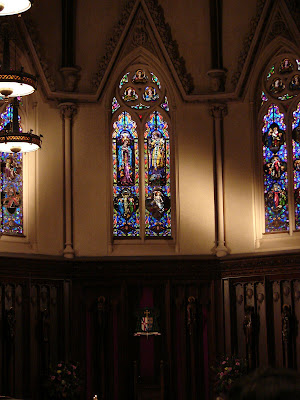
The sanctuary of the cathedral


The Chrism Mass may only be celebrated by a bishop since while any priest can bless the Oil of the Sick and Oil of Catechumens, only a bishop can consecrate Sacred Chrism.

Nearly all the priests from the diocese and a large number of deacons attended the Mass. The cathedral was nearly filled to capacity.


Bishop Coleman delivers his homily


Bishop Coleman's homily was based on Pope Benedict's comments that the Eucharist must always remain central in the lives of priests.

Following the homily, the priests renewed their priestly commitment:


Bishop: My brothers, today we celebrate the memory of that first Eucharist at which our Lord Jesus Christ shared with His apostles and with us His call to the priestly service of His Church. Now, in the presence of your bishop and God's holy people, are you ready to renew your own dedication to Christ as priests of His new covenant?

Priests: I am.

Bishop: At your ordination you accepted the responsibilites of the priesthood out of love for the Lord Jesus and His Church. Are you resolved to unite yourselves more closely to Christ and try to become more like Him by joyfully sacrificing your own pleasure and ambition to being His peace and love to your brothers and sisters?

Priests: I am.

Bishop: Are you resolved to be faithful ministers of the mysteries of God, to celebrate the Eucharist and other liturgical services with sincere devotion? Are you resolved to imitate Jesus Christ, the head and shepherd of the Church, by teaching the Christian faith without thinking of your own profit, solely for the well-being of the people you were sent to serve.

Priests: I am.

The bishop now addresses the people:

Bishop: My brothers and sisters, pray for your priests. Ask the Lord to bless them with the fullness of His Love, to help them be faithful ministers of Christ, the high priest, so that they will be able to lead you to Him, the fountain of your salvation.

People: Lord, Jesus Christ, hear us and answer our prayer.

Bishop: Pray also for me, that despite my own unworthiness, I may faithfully fulfill the office of apostle which Jesus Christ has entrusted to me. Pray that I may become more like our High Priest and Good Shepherd. the Teacher and Servant of all, and so become a genuile sign of Christ's loving presence among you.

People: Lord, Jesus Christ, hear us and answer our prayer.


This renewal of commitment is a beautiful ceremony which reminds us to the importance, and fragility of the priesthood. The priestly commitment is not a one time commitment, it must be renewed each day and in each moment. Likewise, we must commit to support our priests through prayer and temporal support.


The three vessels of oil before being blessed.
Purple = Sick
White = Chrism
Green = Catechumens
The balsam is in the glass cruet on the right.


The Oil of the Sick is blessed during the Eucharistic Prayer, just before the Doxology.


The bishop says: God of all consolation, you chose and sent your Son to heal the world. Graciously listen to our prayer of faith: send the power of your Holy Spirit, the Consoler, into this precious oil, this soothing ointment, this rich gift, this fruit of the earth. Bless + this oil and sanctify it for our use. Make this oil a remedy for all who are anointed with it; heal them in body, in soul, and in spirit, and deliver them from every affliction. We ask this through Jesus Christ, you Son, who lives and reigns with you and the Holy Spirit, one God, forever and ever. Amen.

Blessing the Oil of Catechumens

After Communion, the bishop blesses the Oil of Catechumens saying:


Lord, protector of all who believe in you bless + this oil and give wisdom and strength to all who are anointed with it in preparation for their baptism. Bring them to a deeper understanding of the gospel, help them to accept the challenge of Christian living, and lead them to the joy of new birth in the family of your Church. We ask this through Christ, our Lord. Amen.

Then the olive oil which will become Chrism is uncovered. The Bishop pours balsam into the oil.


Adding balsam to the olive oil


Then he says:


Let us pray that God, our almighty Father, will bless this oil so that all who are anointed with it may be inwardly transformed and come to share in eternal salvation.


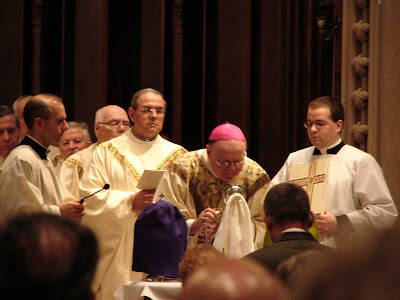
Bishop Coleman breathes into the vessel of Chrism


The Bishop breathes over the open vessel of Chrism.

He continues:


God, our maker, source of all growth in holiness accept the joyful thanks and praise we offer in the name of your Church. In the beginning, at your command, the earth produced fruit-bearing trees. From the fruit of the olive tree you have provided up with oil for holy chrism. The prophet David sang of the life and joy that the oil would bring us in the sacraments of your love. After the avenging flood, the dove, returning to Noah with an olive branch, announced your gift of peace. This was a sign of a greater giift to come. Now in the waters of baptism wash away the sins of men and by the anointing with oil make us radiant with your joy. At your command, Aaron was washed with water, and your servant Moses, his brother, anointed him priest. This, too, foreshadowed greater things to come. After your Son, Jesus Christ of Lord, asked John for baptism in the waters of Jordan, you sent the Spirit upon him in the form of a dove and by the witness of your own voice you declared him to be your only, well-beloved Son. In this you clearly fulfilled the prophecy of David, that Christ would be anointed with the oil of gladness beyond his fellow men.


All concelebrants extend their right hands toward the chrism in silence until the end of the prayer.


And so, Father, we ask you to bless + this oil you have created. Fill it with the power of your Holy Spirit through Christ your Son. It is from him that chrism takes its name and with chrism that you have anointed for yourself priests and kings, prophets and martyrs. Make this chrism a sign of life and salvation for those who are to be born again in the waters of baptism. Wash away the evil they have inherited from sinful Adam, and when they are anointed with this holy oil make them temples of your glory, radiant with the goodness of life that has its source in you. Through this sign of chrism grant them royal, priestly, and prophetic honor, and clothe them with incorruption. Let this be indeed the chrism of salvation for those who will be born again of water and the Holy Spirit. May they come to share eternal life in the glory of your kingdom. We ask this through Christ our Lord. Amen.

Wednesday, February 21, 2007

Pope Benedict's Letter to Archbishop Wielgus

Made public today was a Letter from Benedict XVI to Archbishop Stanislaw Wielgus, emeritus of Warsaw, Poland. The text bears the date of February 12.

The Holy Father thanks the archbishop "for the trust with which you opened your soul before me, showing the anguished suffering of you heart throughout your life as a priest and bishop, until the moment of your resignation from the office of archbishop of Warsaw.
"In recent times I have participated in you sufferings and wish to assure you of my spiritual closeness and fraternal understanding.

"As for the past, I am fully aware of the exceptional circumstances in which you had to undertake your service, when the communist regime in Poland used all possible means to suffocate the freedom of citizens, and particularly of the clergy.

"As rector of the University of Lublin and as bishop of Plock you gave proof of your great piety, and of your profound love for Jesus Christ and for the Church.

"When, one month ago, you presented your resignation in the awareness that the situation that had arisen made it impossible for you to begin your episcopal service with the indispensable degree of authority, I clearly saw in this act a profound sensitivity for the good of the Church of Warsaw and of Poland, as well as your own humility and detachment from office.

"I would like, first of all, to encourage you to maintain faith and serenity of heart. I express the desire that you may resume your activity at the service of Christ, in whatever way proves possible, so that your vast and profound knowledge and priestly piety may be used for the good of the beloved Church in Poland.

"The episcopal mission, today as in the past, is marked by suffering. May Our Lord never cease to support you with His grace. Help will also come from the friendship of brother bishops and of the people who have known and respected you."

VIS

Saturday, February 17, 2007

Archbishop Lipscomb Gets New Pallium

From the Press Register:


Mobile Catholic Archbishop Oscar H. Lipscomb said he received a new pallium Thursday night from the Vatican to replace the one stolen from his car on Christmas Eve.

The pallium was taken from Lipscomb's Mercedes about 6:30 p.m. Christmas Eve in front of a home on Spring Bank Road in Mobile's Spring Hill neighborhood. Several other religious items also were stolen.

Lipscomb said he had planned to petition church officials in the Vatican for a new pallium while he was there for work next month. A pallium, worn around the neck, chest and shoulders, is a white, woolen circular band, 2 inches wide, ornamented with six small black crosses and weighted pendants in the front and back, according to the Maryknoll Catholic Dictionary.

Lipscomb said he returned from Montgomery on Thursday night to find a packet sent to him by the pope's representative in Washington, D.C., who had apparently asked the Vatican for the new pallium.

"I didn't even have to ask for one," Lipscomb said Friday.

Two of the items stolen from his car, a pectoral cross and his crosier, or ceremonial shepherd's staff, have been recovered by two separate thrift store shoppers.

Both items were found at America's Thrift Stores at 312 Schillinger Road in west Mobile near Airport Boulevard. The pectoral cross was bought for $6, the crosier for $10.96.


My advice to all thrift shop managers: the average Catholic does not have a crozier in his house. Now, where is that pallium?

Tuesday, February 13, 2007

Bishops Reflect on the Amazing Holy Eucharist

Relevant Radio will host a new 6 part radio program entitled "Bishops Reflect on the Amazing Holy Eucharist". The participating bishops will be Cardinal Francis George of Chicago, Cardinal Justin Rigali of Philadelphia, Archbishop Raymond Burke of St. Louis, Archbishop Timothy Dolan of Milwaukee, Archbishop John Myers of Newark, Archbishop Donald Wuerl of Washington, D.C., Bishop Robert Morlino of Madison, and Bishop David A. Zubik of Green Bay.

It's a stellar list and should be a good program.

Check out the program schedule here.

If Relevant Radio doesn't air in your area, you can listen online.

Thursday, January 18, 2007

Bishop D'Arcy Ad Multos Annos

From Allston-Brighton TAB:

Not many people get to celebrate a jubilee in their lifetime, but Bishop John D’Arcy has earned that rare distinction. With the anniversary of his 50th year as a priest fast approaching, D’Arcy chose to celebrate the occasion by returning to his roots and giving a Mass in the beloved neighborhood where he was born and raised, and to which he still has close ties.

D’Arcy, who is currently the bishop of the Diocese of Fort Wayne-South Bend, Ind., is Brighton-born and bred. The son of Irish immigrants, as a child he lived on Upcrest Road and worked in his father’s grocery store. But rather than follow in his father’s footsteps and go into the food trade, D’Arcy chose to follow a higher calling and entered the priesthood.

“It was always something I thought about,” D’Arcy said, “Especially since I grew up in a family with strong Catholic ties, in a town with so much of a Catholic presence.”
Our Lady of the Presentation was his local parish, and the church figured strongly in the D’Arcy family’s life. “My parents were married there, and I celebrated my first Mass there,” he said. “It was our church. It was my spiritual roots.”

D’Arcy has had a rich and rewarding career in the service of God, starting in 1949 when he entered St. John’s Seminary in Brighton. After being ordained in 1957, he served at St. Mary’s in Beverly for nine years. He was then sent to Rome from 1965-68, where he earned a doctorate in spiritual theology.

His path then took him back to St. John’s, where he was on the faculty for several years. In 1975, he was ordained as auxiliary bishop for Boston, and in 1981, he was appointed regional bishop for Lowell. Since 1985, he has been bishop of Ft. Wayne-South Bend, a tough job, but one he loves. “It’s been a joy being in Indiana, but demanding,” he said.

Recently, D’Arcy got a letter from Monsignor William Fay of St. Columbkille’s, inviting him to say a Mass there. Fay has known D’Arcy since their days at St. John’s Seminary, when Fay was a student and D’Arcy a faculty member.

“I thought it would be a great idea for him give a Mass back in his old neighborhood,” said Fay. “I think the world of him. He’s a good priest and a great bishop.”

Last Sunday, more than 400 people attended the Mass, and several dozen came to a celebratory reception on his behalf. Many of the attendees were relatives, former classmates from St. John’s and old friends from the former Presentation parish who came say hello and wish him well.

D’Arcy mourned the loss of Our Lady of Presentation, which was closed in 2004. “I feel sad that OLP was closed,” he said. “I have had to close parishes in Indiana, and I know that it’s hard.” But he expressed excitement that the parish’s former members seem to have transplanted themselves to St. Columbkille’s and continue to carry on Brighton’s strong Catholic traditions.

Though D’Arcy has been a resident of the Midwest for the last 21 years, he will never call anywhere but Brighton home. He has family and friends here, and returns every Easter for a week and every summer for almost a month.

Tuesday, January 16, 2007

All The Pope's Men

Here is an interesting article from the Salt Lake Tribune. Rocco is quoted, as can be expected. lol!

I don't agree with everything in the article, but it does give something to think about.

Since becoming pope in April 2005, Benedict XVI has appointed about 30 U.S. bishops, and some see a pattern emerging that is different from John Paul II's, particularly in his later years.
Benedict is more involved in the process, observers say, poring over dossiers and case files, and he appears to value competence more than ideology.

Benedict's bishops tend to be "unflinchingly positive (men) who avoid conflict at all costs," said Rocco Palmo, a Philadelphia-based Vatican watcher who writes for the Tablet in London.

Such leaders show by example that the essence of the church is to uplift, not condemn. They are "open not only within the church but in public," Palmo said. "They are working for the good of all, Catholics and non."

The latest Benedict appointee who appears to bear this out is Bishop John Wester, the newly chosen leader of Utah's 200,000 Catholics, who is viewed as a pragmatist and nurturer and not as an ideologue.
Archbishop George Niederauer, of San Francisco, Wester's boss and the former head of the Salt Lake diocese, called him "one of the kindest-hearted persons I have ever met. He's solicitous of people's welfare. He has a good sense of humor and sees the inherent silliness in things."

Observers say Wester likely will not threaten to excommunicate Catholic politicians who support abortion rights, or attack gay activists or academics who challenge doctrinal interpretations. They do not think he will be rigid or authoritarian, or impervious to the needs of abuse victims.

"Some bishops come with their own or someone else's agenda," said Monsignor Francis Mannion, pastor at St. Vincent de Paul Church in Millcreek, Utah. "I don't think (Wester) is coming with any heavy agenda."

It is clear that Pope Benedict doesn't want "showboats as much as good, convincing men of integrity," said David Gibson, author of "The Rule of Benedict: Pope Benedict XVI and His Battle With the Modern Mind."

"It is part of a campaign for competency, especially after the sexual abuse crisis … (to find men) who can preach the Gospel and mind the store," he added.

Benedict has "actually disappointed people on the right who wanted a purge, and eased fears on the left," Gibson said. "He has not appointed crusaders, just good, strong orthodox bishops who can engage the culture without being flamboyant, without stirring divisions."
Niederauer, appointed by Benedict to be archbishop of San Francisco last year, is one such man.

He is gregarious, urbane, warm and witty. While he supports the church's positions, he is open-minded on such issues as gays in the seminary. Everyone, he argues, pledges celibacy whatever his attractions.

Niederauer "has been a hit," said the Rev. Thomas Reese, senior fellow at Georgetown's Woodstock Theological Center. "That was a great appointment."

Others see further evidence of Benedict's priorities in the choice of Archbishop Donald Wuerl, who took his place in June, for the Washington, D.C., diocese.

The Washington Post called the 65-year-old Wuerl a "poised, teacherly Pittsburgher … known as a behind-the-scenes bridge-builder, someone who preferred pressing quietly in private to making demands in public."

Wuerl is "thoughtful and well educated," Gibson said.

Sunday, January 14, 2007

Bishop Joseph Meng Ziwen Dies At 103

I think I have mentioned on this blog that one of my cousins is a priest in Hong Kong. He has also served in Macao and in China. Therefore, I have a great concern and awareness of the underground Church in China.

From ANSA:


He was a “humble but extraordinary pastor who was dedicated to his community and had out of the ordinary energy and vitality,” said Fr Giancarlo Politi, a missionary with the Pontifical Institute for Foreign Missions and a China expert, as he remembered Mgr Joseph Meng Ziwen, bishop of Nanning (Guangxi), who passed away last Sunday at the age of 103 as a result of a liver tumour. He was the oldest prelate in the whole of China.

Father Politi told AsiaNews that the bishop “was someone who up to three years ago still said mass every Sunday in three different parishes without sparing himself.” His coadjutor, Mgr John Baptist Tan Yanchuan, will celebrate the funeral tomorrow.

Born into a non-Catholic family on March 19, 1903, in Hengling, Bishop Meng was baptised as a youth. When he was 18 years old he spent eight years at a minor seminary. After studying six years of theology and philosophy at the major seminary in Penang, Malaysia, he was ordained into the priesthood in Nanning in 1935.

After the Communist revolution he was accused of collaborating with the Kuomintang and sent to a laogai (reform through labour) camp in the early fifties and released in 1957.

Upon his release that year, he resumed work at a church in Nanning, where, thanks to his medical training, he set up and ran a clinic, but was re-arrested the following year charged with helping the enemies of the Revolution. He was eventually released in 1970.

In the 1980s, Bishop Meng was able to reclaim some Church property and rebuild churches. He recruited young Catholics as nuns and seminarians to help in evangelisation work. “Bringing Christ to the world” remained his lifelong goal.

He was ordained bishop by the Holy See in 1984, but the Communist regime refused to accept his appointment. To avoid problems for his community he always signed diocesan papers as a simple priest. For his parishioners, he was affectionately known as lao shenfu, the old priest.

Father Politi remembers that the prelate “always led humble life. Although he could not call himself bishop he was always relatively free to move around Guangxi to visit small Christian communities and lived quietly. Here, there never were any of the open clashes with the Church as elsewhere in China”. The recent arrests on December 27 of nine priests in Baoding, in the central province if Hebei, are an example of this open conflict.

Bishop Meng’s death follows the passing of four official bishops, all in the last month. Whether official or not, prelates are getting older and the tense situation between the Patriotic Association (which seeks to control appointments) and the Vatican have made new nominations a thorny issue for the whole Church in China.

Father Politi is quite pessimistic about the future. “I can’t see any chance of solving the issue in the near future. The Communist Party only wants to maintain its power and thus must maintain the status quo”.

Yet, even though Sino-Vatican relations are difficult, “the life of the Church in the country is growing despite everything,” he said.

Sunday, January 07, 2007

Archbishop Wielgus Resigns

Just 2 days after his installation as Archbishop of Warsaw, Archbishop Stanislaus Wielgus has resigned.

From ABC News:

Warsaw's new archbishop resigned amid a scandal about his cooperation with the communist-era secret police, Poland's Roman Catholic Church said Sunday.
Archbishop Stanislaw Wielgus, who took the office on Friday, has submitted his resignation, Poland's Episcopate said in a statement.

The church said Pope Benedict XVI asked the outgoing archbishop, Cardinal Jozef Glemp, to administer the archdiocese until a replacement is found.

(...)

Wielgus acknowledged Friday that he did have contact with the secret service, but he said that documents indicating he collaborated were written by the secret police and reflected their account of events, not the truth.

Read the complete article here.

Thursday, November 30, 2006

Oops, They Did it Again!

Kyodo News is reporting that another illicit Chinese ordination has occured.

China's state-sanctioned Catholic organization said Thursday a priest in the eastern province of Jiangsu has been ordained as bishop coadjutor, marking China's third bishop ordination this year without Vatican approval.

Father Wang Renlei's 2.5-hour ordination ceremony was attended by about 1,000 parishioners, including more than 20 priests from the local Xuzhou diocese and other provinces, vice chairman of the government-backed Chinese Catholic Patriotic Association Liu Bainian told Kyodo News.

Vicar general Wang, 36, was voted to be the bishop coadjutor to assist Bishop Qian Yurong, 94, in an uncontested election in October.

"Qian, who remains as the diocese bishop, has no immediate plan to retire," Liu said.

China ordained Ma Yinglin of Yunnan Province in April and Liu Xinhong of Anhui Province in May without Vatican approval, prompting a statement from the Vatican that hinted at automatic excommunication of the two bishops.

Liu Bainian said that as China does not have diplomatic ties with the Vatican, there is no appropriate channel for China to communicate with it about bishop ordination.

Diplomatic ties between China and the Vatican were severed shortly after the Communist Party took power in 1949.


Talks have been held on and off on restoring ties but two major hurdles remain in the way, namely China's demands that the Vatican cut ties with Taiwan and that the Church stay out of China's internal affairs, which it interprets to include ordination of bishops.

The latest ordination has dealt a "fatal blow" to dialogue between the Holy See and China, a Vatican source was quoted as saying by AsiaNews, a Rome-based website.

The website, frequently reporting on Catholic Church-related matters in Asian countries, reported Wednesday that two Vatican-approved bishops in China's northern province of Hebei were forced to take part in Wang's ordination.

It cited sources as saying that an unspecified number of other bishops expected to take part in the ceremony were kept in isolation and subjected to physical and psychological pressures.

"It is impossible, church matters are managed by the diocese and there is no government interference," Liu said in dismissing the report. "None of the priests and bishops who attended the ceremony had been forced against their will."

Catholics in China are divided into two groups, one worshipping at churches controlled by the Catholic Patriotic Association -- an organization set up by the authorities to keep a grip on the religion -- while others loyal to the Vatican go to underground churches.